QUESTION IMAGE
Question
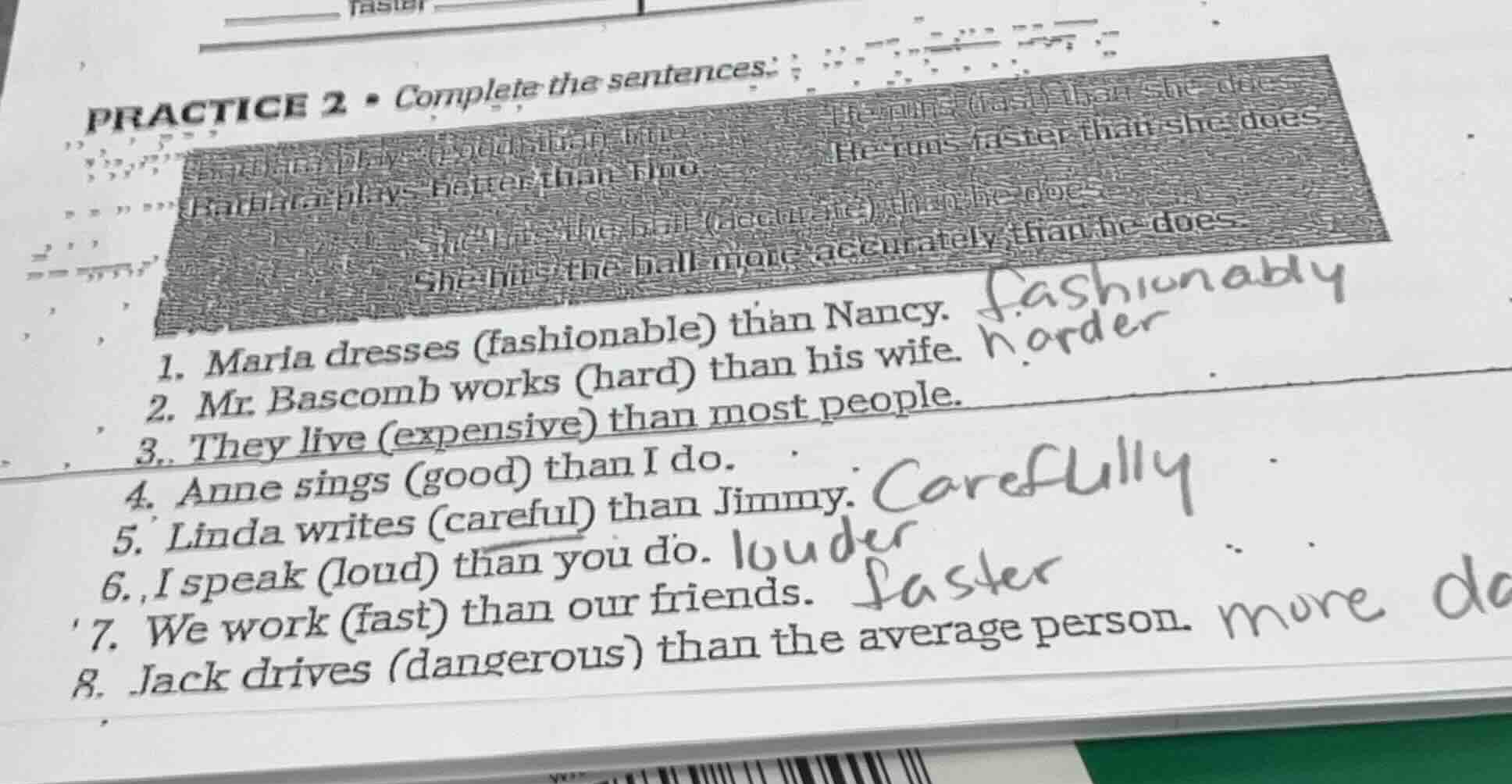
practice 2 • complete the sentences. 1. maria dresses (fashionable) than nancy. 2. mr. bascomb works (hard) than his wife. 3. they live (expensive) than most people. 4. anne sings (good) than i do. 5. linda writes (careful) than jimmy. 6. i speak (loud) than you do. 7. we work (fast) than our friends. 8. jack drives (dangerous) than the average person.
To solve these sentences, we need to use the comparative form of the adverbs (since the verbs are being modified) or adjectives (if the word is modifying a noun, but here they modify verbs). For most one - syllable adverbs, we add " - er", and for some two - syllable or more adverbs, we use "more + adverb". Also, we need to convert adjectives to adverbs when necessary (by adding " - ly" in most cases).
1. Maria dresses (fashionable) than Nancy.
Step 1: Identify the part of speech and form
The word "dresses" is a verb, so we need an adverb to modify it. The adjective "fashionable" becomes the adverb "fashionably". Since we are making a comparison (using "than"), we use the comparative form of the adverb. For two - syllable adverbs like "fashionably", we use "more + adverb".
So the correct form is "more fashionably".
2. Mr. Bascomb works (hard) than his wife.
Step 1: Identify the part of speech and form
The word "works" is a verb, and "hard" can be an adverb (it has the same form as the adjective in this case). For one - syllable adverbs, we form the comparative by adding " - er". So the comparative form of "hard" (as an adverb) is "harder".
3. They live (expensive) than most people.
Step 1: Identify the part of speech and form
The word "live" is a verb, so we need an adverb. The adjective "expensive" becomes the adverb "expensively" (by adding " - ly"). Since "expensively" is a two - syllable adverb, we use "more + adverb" for the comparative form. So the correct form is "more expensively".
4. Anne sings (good) than I do.
Step 1: Identify the part of speech and form
The word "sings" is a verb, so we need an adverb. The adjective "good" has the adverb form "well". For the comparative form of "well", we use "better" (it is an irregular comparative form).
5. Linda writes (careful) than Jimmy.
Step 1: Identify the part of speech and form
The word "writes" is a verb, so we need an adverb. The adjective "careful" becomes the adverb "carefully" (by adding " - ly"). Since "carefully" is a two - syllable adverb, we use "more + adverb" for the comparative form. So the correct form is "more carefully".
6. I speak (loud) than you do.
Step 1: Identify the part of speech and form
The word "speak" is a verb, so we need an adverb. The adjective "loud" can become the adverb "loudly" (by adding " - ly") or "loud" (it can function as an adverb in informal usage). For the comparative form, if we use "loud" as an adverb, the comparative is "louder"; if we use "loudly", the comparative is "more loudly". The more common form in this context is "louder" (using "loud" as an adverb).
7. We work (fast) than our friends.
Step 1: Identify the part of speech and form
The word "work" is a verb, and "fast" is an adverb (it has the same form as the adjective). For one - syllable adverbs, we form the comparative by adding " - er". So the comparative form of "fast" (as an adverb) is "faster".
8. Jack drives (dangerous) than the average person.
Step 1: Identify the part of speech and form
The word "drives" is a verb, so we need an adverb. The adjective "dangerous" becomes the adverb "dangerously" (by adding " - ly"). Since "dangerously" is a two - syllable adverb, we use "more + adverb" for the comparative form. So the correct form is "more dangerously".

Snap & solve any problem in the app
Get step-by-step solutions on Sovi AI
Photo-based solutions with guided steps
Explore more problems and detailed explanations
s:
- Maria dresses \(\boldsymbol{\text{more fashionably}}\) than Nancy.
- Mr. Bascomb works \(\boldsymbol{\text{harder}}\) than his wife.
- They live \(\boldsymbol{\text{more expensively}}\) than most people.
- Anne sings \(\boldsymbol{\text{better}}\) than I do.
- Linda writes \(\boldsymbol{\text{more carefully}}\) than Jimmy.
- I speak \(\boldsymbol{\text{louder}}\) than you do.
- We work \(\boldsymbol{\text{faster}}\) than our friends.
- Jack drives \(\boldsymbol{\text{more dangerously}}\) than the average person.