QUESTION IMAGE
Question
practice: determining formulas
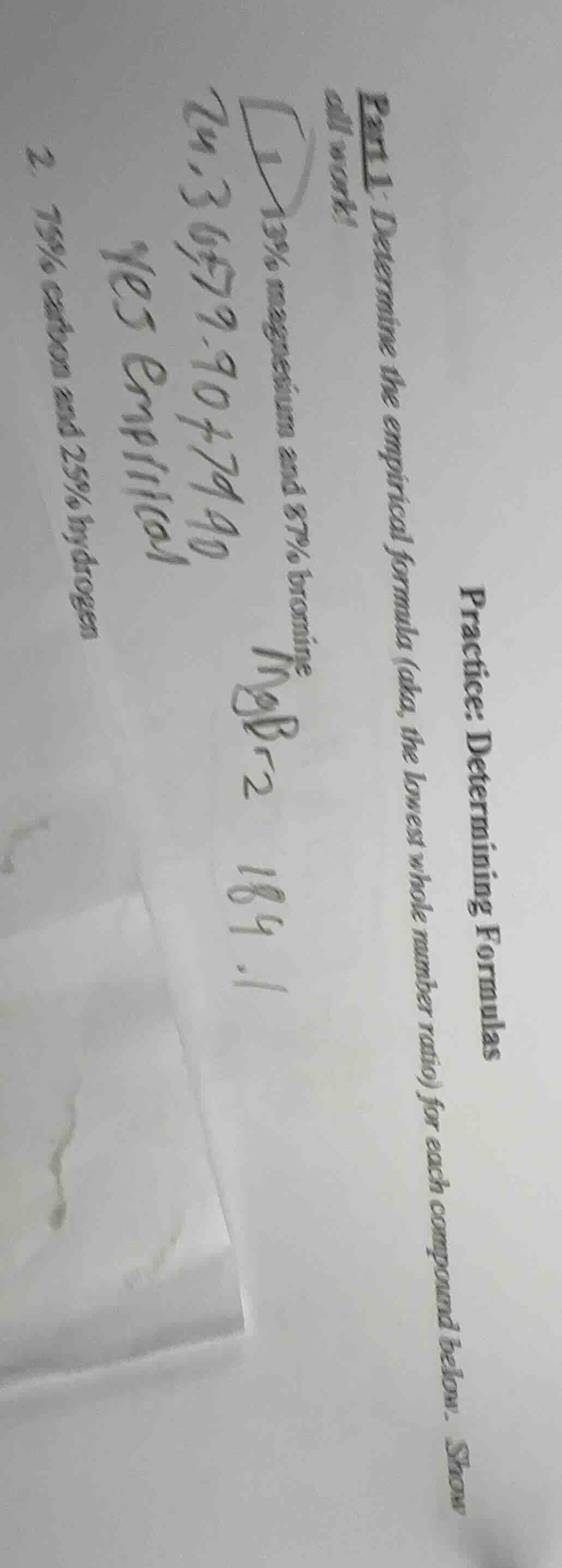
part 1: determine the empirical formula, aka, the lowest whole number ratio, for each compound below. show all work!
- 13% magnesium and 87% bromine
- 75% carbon and 25% hydrogen
Step1: (For Compound 1) Assume 100g sample
Mass of Mg = 13g, Mass of Br = 87g
Step2: Convert mass to moles
Molar mass of Mg = 24.305 g/mol, Molar mass of Br = 79.904 g/mol
Moles of Mg: $\frac{13}{24.305} \approx 0.535$
Moles of Br: $\frac{87}{79.904} \approx 1.089$
Step3: Find mole ratio
Divide by smallest mole value (0.535):
Ratio of Mg: $\frac{0.535}{0.535} = 1$
Ratio of Br: $\frac{1.089}{0.535} \approx 2$
Step4: (For Compound 2) Assume 100g sample
Mass of C = 75g, Mass of H = 25g
Step5: Convert mass to moles
Molar mass of C = 12.011 g/mol, Molar mass of H = 1.008 g/mol
Moles of C: $\frac{75}{12.011} \approx 6.244$
Moles of H: $\frac{25}{1.008} \approx 24.799$
Step6: Find mole ratio
Divide by smallest mole value (6.244):
Ratio of C: $\frac{6.244}{6.244} = 1$
Ratio of H: $\frac{24.799}{6.244} \approx 4$

Snap & solve any problem in the app
Get step-by-step solutions on Sovi AI
Photo-based solutions with guided steps
Explore more problems and detailed explanations
- Empirical formula for magnesium-bromine compound: $\text{MgBr}_2$
- Empirical formula for carbon-hydrogen compound: $\text{CH}_4$