QUESTION IMAGE
Question
practice mixed number addition and subtraction
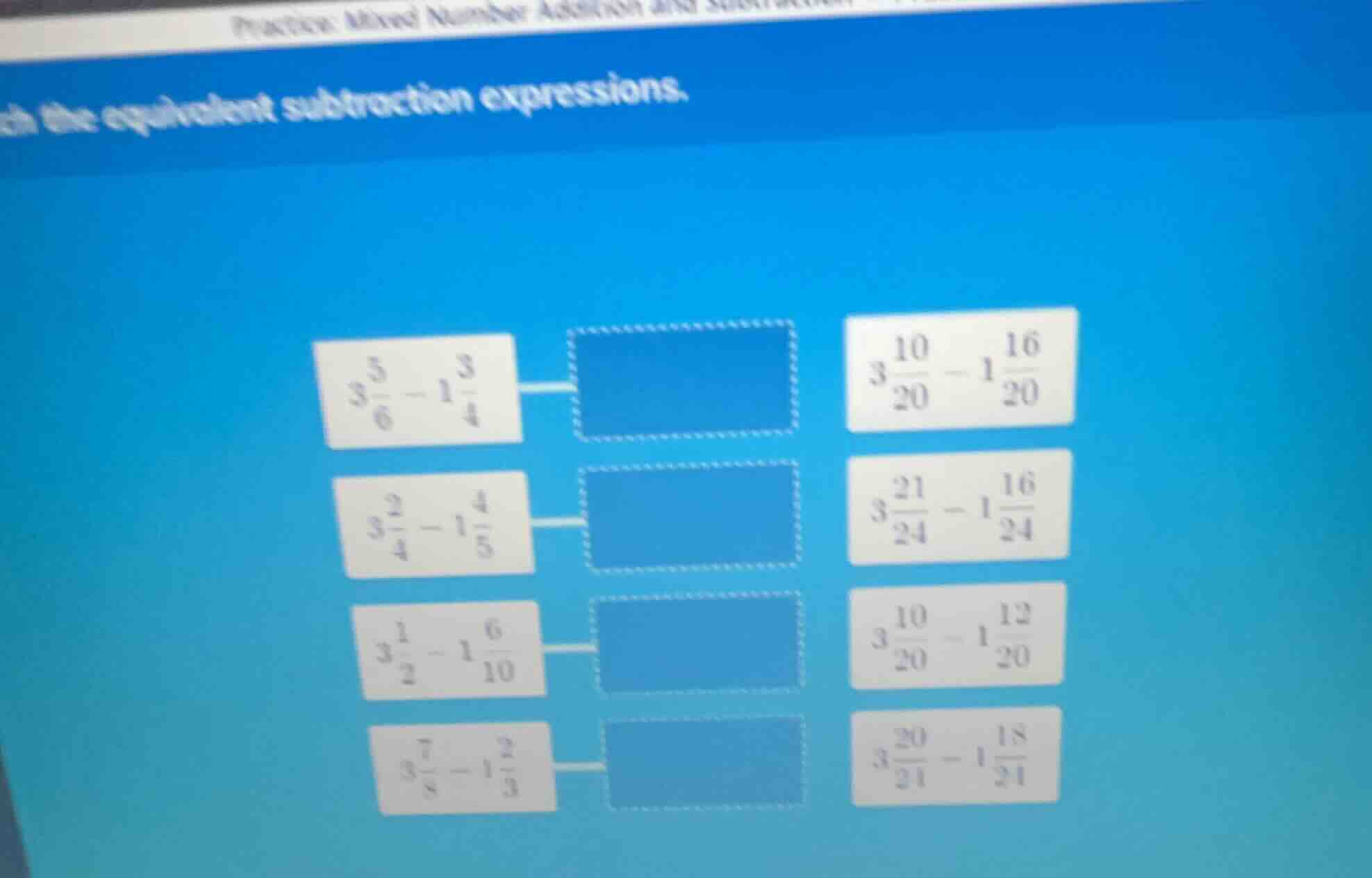
match the equivalent subtraction expressions.
$3\frac{5}{6}-1\frac{3}{4}$
$3\frac{2}{4}-1\frac{4}{5}$
$3\frac{1}{2}-1\frac{6}{10}$
$3\frac{7}{8}-1\frac{2}{3}$
$3\frac{10}{20}-1\frac{16}{20}$
$3\frac{21}{24}-1\frac{16}{24}$
$3\frac{10}{20}-1\frac{12}{20}$
$3\frac{20}{24}-1\frac{18}{24}$
To solve this, we need to find a common denominator for each pair of mixed numbers and rewrite them, then match with the equivalent expression.
For \( 3\frac{5}{6} - 1\frac{3}{4} \):
Step 1: Find a common denominator for 6 and 4.
The least common denominator (LCD) of 6 and 4 is 12.
Rewrite the fractions:
\( 3\frac{5}{6} = 3\frac{5\times2}{6\times2} = 3\frac{10}{12} \)
\( 1\frac{3}{4} = 1\frac{3\times3}{4\times3} = 1\frac{9}{12} \)
But wait, maybe the right side uses 24? Wait, let's check the right expressions. Wait, the right has denominators 20,24,20,24? Wait, no, let's re - evaluate. Wait, the right expressions:
Wait, the first right expression is \( 3\frac{10}{20}-1\frac{16}{20} \), second \( 3\frac{21}{24}-1\frac{16}{24} \), third \( 3\frac{10}{20}-1\frac{12}{20} \), fourth \( 3\frac{20}{24}-1\frac{18}{24} \) (Wait, maybe I misread the last one. Let's re - express the left expressions with common denominators matching the right.
- \( 3\frac{5}{6}-1\frac{3}{4} \):
- LCD of 6 and 4 is 12, but the right has 24? Wait, \( \frac{5}{6}=\frac{20}{24} \), \( \frac{3}{4}=\frac{18}{24} \). Wait, no, the right second expression is \( 3\frac{21}{24}-1\frac{16}{24} \). Wait, \( 3\frac{5}{6}=3\frac{20}{24} \)? No, \( \frac{5}{6}=\frac{20}{24} \), \( 3\frac{5}{6}=3\frac{20}{24} \), \( 1\frac{3}{4}=1\frac{18}{24} \). Wait, no, the fourth right expression is \( 3\frac{20}{24}-1\frac{18}{24} \). Wait, maybe I made a mistake. Let's do it step by step for each left expression:
First left: \( 3\frac{5}{6}-1\frac{3}{4} \)
- Convert to improper fractions or find common denominator. Let's find LCD of 6 and 4, which is 12. But the right has denominators 20,24,20,24. Wait, maybe the problem is about borrowing (regrouping) in mixed numbers. Wait, no, the task is to match equivalent subtraction expressions. So we need to rewrite the left mixed numbers with the same denominator as one of the right and see which one is equivalent.
Let's rewrite \( 3\frac{5}{6} \) and \( 1\frac{3}{4} \) with denominator 24:
\( 3\frac{5}{6}=3\frac{5\times4}{6\times4}=3\frac{20}{24} \)
\( 1\frac{3}{4}=1\frac{3\times6}{4\times6}=1\frac{18}{24} \)
Wait, but the right fourth expression is \( 3\frac{20}{24}-1\frac{18}{24} \)? No, the fourth right is \( 3\frac{20}{24}-1\frac{18}{24} \)? Wait, no, looking at the right expressions:
Wait the right expressions are:
- \( 3\frac{10}{20}-1\frac{16}{20} \)
- \( 3\frac{21}{24}-1\frac{16}{24} \)
- \( 3\frac{10}{20}-1\frac{12}{20} \)
- \( 3\frac{20}{24}-1\frac{18}{24} \) (Wait, maybe the last left is \( 3\frac{7}{8}-1\frac{2}{3} \))
Wait, let's take the second left: \( 3\frac{2}{4}-1\frac{4}{5} \) (Wait, no, it's \( 3\frac{2}{4}-1\frac{4}{5} \)? No, it's \( 3\frac{2}{4}-1\frac{4}{5} \)? Wait, the left is \( 3\frac{2}{4}-1\frac{4}{5} \)? No, the left is \( 3\frac{2}{4}-1\frac{4}{5} \)? Wait, no, the left is \( 3\frac{2}{4}-1\frac{4}{5} \)? Wait, no, the second left is \( 3\frac{2}{4}-1\frac{4}{5} \). Wait, LCD of 4 and 5 is 20.
\( 3\frac{2}{4}=3\frac{10}{20} \) (since \( \frac{2}{4}=\frac{10}{20} \))
\( 1\frac{4}{5}=1\frac{16}{20} \) (since \( \frac{4}{5}=\frac{16}{20} \))
So \( 3\frac{2}{4}-1\frac{4}{5}=3\frac{10}{20}-1\frac{16}{20} \), which is the first right expression.
Second left: \( 3\frac{2}{4}-1\frac{4}{5} \)
- \( \frac{2}{4}=\frac{10}{20} \), \( \frac{4}{5}=\frac{16}{20} \)
- So \( 3\frac{2}{4}-1\frac{4}{5}=3\frac{10}{20}-1\frac{16}{20} \) (matches first right)
Third left: \( 3\frac{1}{2}-1\frac{6}{10} \)
- \( \frac{1}{2}=\frac{10}{20} \), \( \frac{6}{10}=\frac{12}{20} \)
- So \( 3\frac{1}{2}-1\frac…

Snap & solve any problem in the app
Get step-by-step solutions on Sovi AI
Photo-based solutions with guided steps
Explore more problems and detailed explanations
To solve this, we need to find a common denominator for each pair of mixed numbers and rewrite them, then match with the equivalent expression.
For \( 3\frac{5}{6} - 1\frac{3}{4} \):
Step 1: Find a common denominator for 6 and 4.
The least common denominator (LCD) of 6 and 4 is 12.
Rewrite the fractions:
\( 3\frac{5}{6} = 3\frac{5\times2}{6\times2} = 3\frac{10}{12} \)
\( 1\frac{3}{4} = 1\frac{3\times3}{4\times3} = 1\frac{9}{12} \)
But wait, maybe the right side uses 24? Wait, let's check the right expressions. Wait, the right has denominators 20,24,20,24? Wait, no, let's re - evaluate. Wait, the right expressions:
Wait, the first right expression is \( 3\frac{10}{20}-1\frac{16}{20} \), second \( 3\frac{21}{24}-1\frac{16}{24} \), third \( 3\frac{10}{20}-1\frac{12}{20} \), fourth \( 3\frac{20}{24}-1\frac{18}{24} \) (Wait, maybe I misread the last one. Let's re - express the left expressions with common denominators matching the right.
- \( 3\frac{5}{6}-1\frac{3}{4} \):
- LCD of 6 and 4 is 12, but the right has 24? Wait, \( \frac{5}{6}=\frac{20}{24} \), \( \frac{3}{4}=\frac{18}{24} \). Wait, no, the right second expression is \( 3\frac{21}{24}-1\frac{16}{24} \). Wait, \( 3\frac{5}{6}=3\frac{20}{24} \)? No, \( \frac{5}{6}=\frac{20}{24} \), \( 3\frac{5}{6}=3\frac{20}{24} \), \( 1\frac{3}{4}=1\frac{18}{24} \). Wait, no, the fourth right expression is \( 3\frac{20}{24}-1\frac{18}{24} \). Wait, maybe I made a mistake. Let's do it step by step for each left expression:
First left: \( 3\frac{5}{6}-1\frac{3}{4} \)
- Convert to improper fractions or find common denominator. Let's find LCD of 6 and 4, which is 12. But the right has denominators 20,24,20,24. Wait, maybe the problem is about borrowing (regrouping) in mixed numbers. Wait, no, the task is to match equivalent subtraction expressions. So we need to rewrite the left mixed numbers with the same denominator as one of the right and see which one is equivalent.
Let's rewrite \( 3\frac{5}{6} \) and \( 1\frac{3}{4} \) with denominator 24:
\( 3\frac{5}{6}=3\frac{5\times4}{6\times4}=3\frac{20}{24} \)
\( 1\frac{3}{4}=1\frac{3\times6}{4\times6}=1\frac{18}{24} \)
Wait, but the right fourth expression is \( 3\frac{20}{24}-1\frac{18}{24} \)? No, the fourth right is \( 3\frac{20}{24}-1\frac{18}{24} \)? Wait, no, looking at the right expressions:
Wait the right expressions are:
- \( 3\frac{10}{20}-1\frac{16}{20} \)
- \( 3\frac{21}{24}-1\frac{16}{24} \)
- \( 3\frac{10}{20}-1\frac{12}{20} \)
- \( 3\frac{20}{24}-1\frac{18}{24} \) (Wait, maybe the last left is \( 3\frac{7}{8}-1\frac{2}{3} \))
Wait, let's take the second left: \( 3\frac{2}{4}-1\frac{4}{5} \) (Wait, no, it's \( 3\frac{2}{4}-1\frac{4}{5} \)? No, it's \( 3\frac{2}{4}-1\frac{4}{5} \)? Wait, the left is \( 3\frac{2}{4}-1\frac{4}{5} \)? No, the left is \( 3\frac{2}{4}-1\frac{4}{5} \)? Wait, no, the left is \( 3\frac{2}{4}-1\frac{4}{5} \)? Wait, no, the second left is \( 3\frac{2}{4}-1\frac{4}{5} \). Wait, LCD of 4 and 5 is 20.
\( 3\frac{2}{4}=3\frac{10}{20} \) (since \( \frac{2}{4}=\frac{10}{20} \))
\( 1\frac{4}{5}=1\frac{16}{20} \) (since \( \frac{4}{5}=\frac{16}{20} \))
So \( 3\frac{2}{4}-1\frac{4}{5}=3\frac{10}{20}-1\frac{16}{20} \), which is the first right expression.
Second left: \( 3\frac{2}{4}-1\frac{4}{5} \)
- \( \frac{2}{4}=\frac{10}{20} \), \( \frac{4}{5}=\frac{16}{20} \)
- So \( 3\frac{2}{4}-1\frac{4}{5}=3\frac{10}{20}-1\frac{16}{20} \) (matches first right)
Third left: \( 3\frac{1}{2}-1\frac{6}{10} \)
- \( \frac{1}{2}=\frac{10}{20} \), \( \frac{6}{10}=\frac{12}{20} \)
- So \( 3\frac{1}{2}-1\frac{6}{10}=3\frac{10}{20}-1\frac{12}{20} \) (matches third right)
Fourth left: \( 3\frac{7}{8}-1\frac{2}{3} \)
- LCD of 8 and 3 is 24.
- \( \frac{7}{8}=\frac{21}{24} \), \( \frac{2}{3}=\frac{16}{24} \)
- So \( 3\frac{7}{8}-1\frac{2}{3}=3\frac{21}{24}-1\frac{16}{24} \) (matches second right)
And the first left \( 3\frac{5}{6}-1\frac{3}{4} \):
- \( \frac{5}{6}=\frac{20}{24} \), \( \frac{3}{4}=\frac{18}{24} \)
- So \( 3\frac{5}{6}-1\frac{3}{4}=3\frac{20}{24}-1\frac{18}{24} \) (matches fourth right)
Now, let's list the matches:
- \( 3\frac{5}{6}-1\frac{3}{4} \) matches \( 3\frac{20}{24}-1\frac{18}{24} \) (fourth right)
- \( 3\frac{2}{4}-1\frac{4}{5} \) matches \( 3\frac{10}{20}-1\frac{16}{20} \) (first right)
- \( 3\frac{1}{2}-1\frac{6}{10} \) matches \( 3\frac{10}{20}-1\frac{12}{20} \) (third right)
- \( 3\frac{7}{8}-1\frac{2}{3} \) matches \( 3\frac{21}{24}-1\frac{16}{24} \) (second right)
So the matching is:
- \( 3\frac{5}{6}-1\frac{3}{4} \) → \( 3\frac{20}{24}-1\frac{18}{24} \)
- \( 3\frac{2}{4}-1\frac{4}{5} \) → \( 3\frac{10}{20}-1\frac{16}{20} \)
- \( 3\frac{1}{2}-1\frac{6}{10} \) → \( 3\frac{10}{20}-1\frac{12}{20} \)
- \( 3\frac{7}{8}-1\frac{2}{3} \) → \( 3\frac{21}{24}-1\frac{16}{24} \)