QUESTION IMAGE
Question
practice with parallelogram theorems.
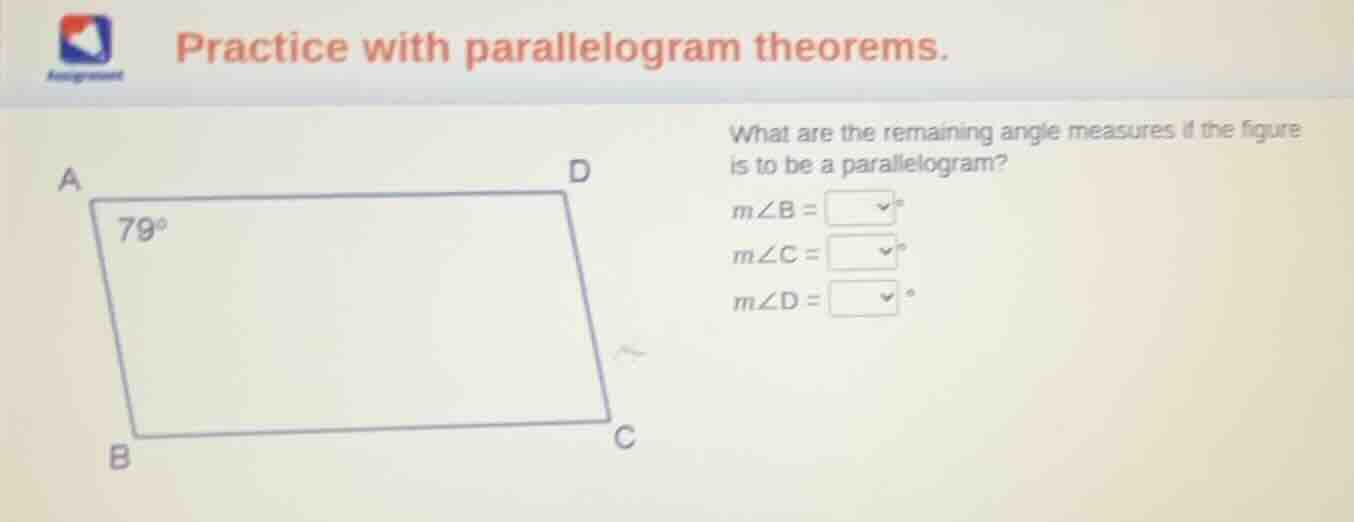
what are the remaining angle measures if the figure is to be a parallelogram?
m∠b =
°
m∠c =
°
m∠d =
°
(the parallelogram has vertices a, b, c, d with ∠a = 79°)
Step1: Recall parallelogram angle properties
In a parallelogram, consecutive angles are supplementary (sum to \(180^\circ\)) and opposite angles are equal. So, \(\angle A\) and \(\angle C\) are opposite, \(\angle B\) and \(\angle D\) are opposite, \(\angle A\) and \(\angle B\) are consecutive, \(\angle B\) and \(\angle C\) are consecutive, etc. Given \(m\angle A = 79^\circ\).
Step2: Find \(m\angle B\)
Since \(\angle A\) and \(\angle B\) are consecutive angles in a parallelogram, they are supplementary. So, \(m\angle B = 180^\circ - m\angle A\).
\(m\angle B = 180^\circ - 79^\circ = 101^\circ\)
Step3: Find \(m\angle C\)
In a parallelogram, opposite angles are equal. \(\angle A\) and \(\angle C\) are opposite, so \(m\angle C = m\angle A\).
\(m\angle C = 79^\circ\)
Step4: Find \(m\angle D\)
In a parallelogram, opposite angles are equal. \(\angle B\) and \(\angle D\) are opposite, so \(m\angle D = m\angle B\).
\(m\angle D = 101^\circ\)

Snap & solve any problem in the app
Get step-by-step solutions on Sovi AI
Photo-based solutions with guided steps
Explore more problems and detailed explanations
\(m\angle B = 101^\circ\), \(m\angle C = 79^\circ\), \(m\angle D = 101^\circ\)