QUESTION IMAGE
Question
practice
polygons and angles
find the sum of the interior angle measures of each polygon.
- pentagon
- decagon
- 16 - gon
- 18 - gon
- 30 - gon
- 34 - gon
find the measure of one interior angle in each regular polygon.
round to the nearest tenth if necessary.
- pentagon
- octagon
- 24 - gon
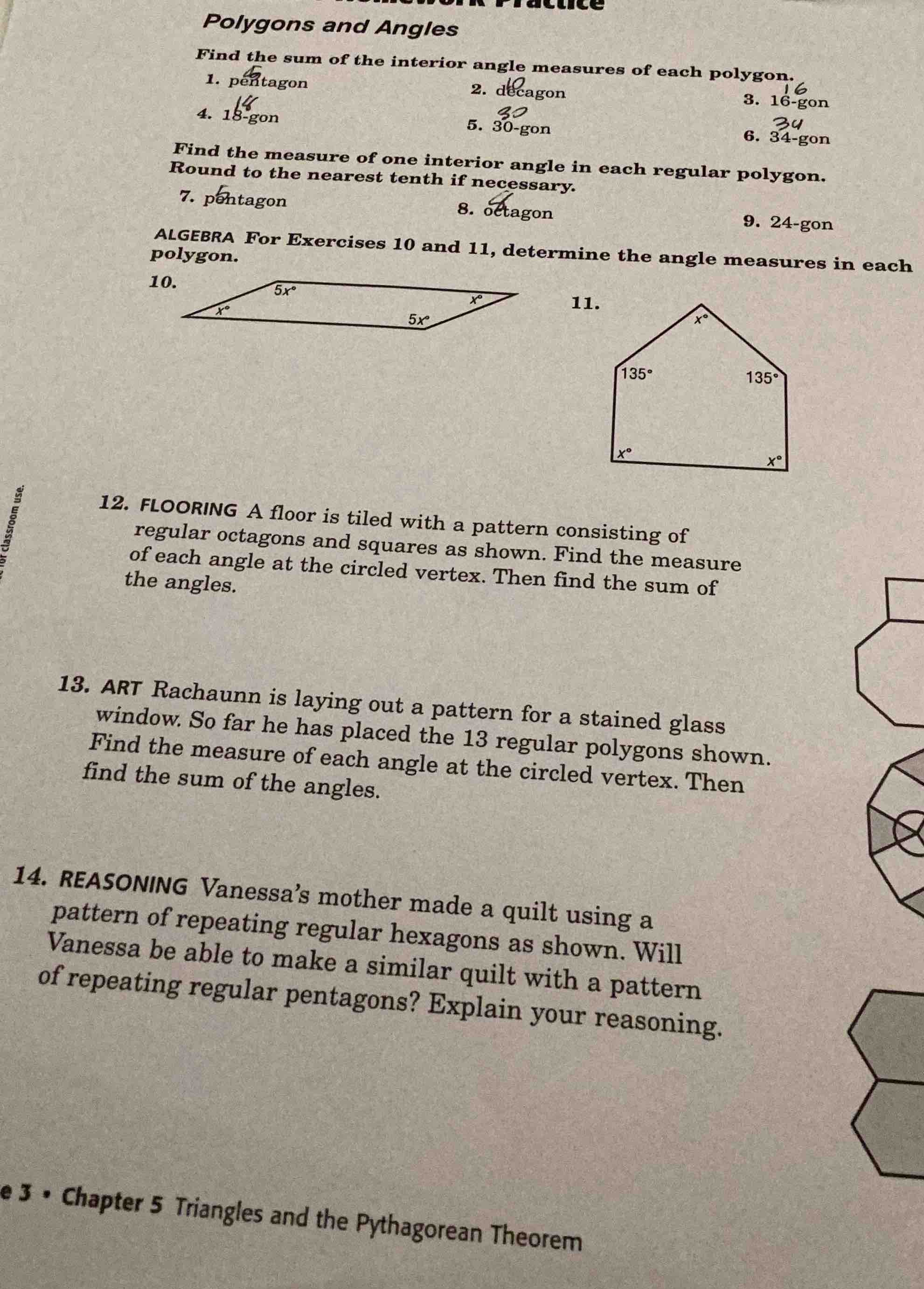
algebra for exercises 10 and 11, determine the angle measures in each polygon.
- diagram of a parallelogram with angles (x^circ), (5x^circ), (x^circ), (5x^circ)
- diagram of a pentagon with angles (135^circ), (135^circ), (x^circ), (x^circ), (x^circ)
- flooring a floor is tiled with a pattern consisting of regular octagons and squares as shown. find the measure of each angle at the circled vertex. then find the sum of the angles.
- art rachaunn is laying out a pattern for a stained glass window. so far he has placed the 13 regular polygons shown. find the measure of each angle at the circled vertex. then find the sum of the angles.
- reasoning vanessa’s mother made a quilt using a pattern of repeating regular hexagons as shown. will vanessa be able to make a similar quilt with a pattern of repeating regular pentagons? explain your reasoning.
3 • chapter 5 triangles and the pythagorean theorem
Step1: Sum of interior angles formula
The formula for the sum of interior angles of an $n$-sided polygon is $(n-2) \times 180^\circ$.
Step2: Solve 1-6 (sum of interior angles)
1. Pentagon ($n=5$)
2. Decagon ($n=10$)
3. 16-gon ($n=16$)
4. 18-gon ($n=18$)
5. 30-gon ($n=30$)
6. 34-gon ($n=34$)
Step3: Solve 7-9 (one interior angle, regular polygon)
Use $\frac{(n-2) \times 180^\circ}{n}$ for one interior angle.
7. Regular pentagon ($n=5$)
8. Regular octagon ($n=8$)
9. Regular 24-gon ($n=24$)
Step4: Solve 10 (parallelogram angle sum)
Parallelogram has $n=4$, sum of angles is $360^\circ$. Set up equation:
Angles: $30^\circ, 150^\circ, 30^\circ, 150^\circ$
Step5: Solve 11 (pentagon angle sum)
Pentagon sum is $540^\circ$. Set up equation:
Angles: $90^\circ, 90^\circ, 135^\circ, 135^\circ, 90^\circ$
Step6: Solve 12 (floor tiling angles)
Regular octagon interior angle is $135^\circ$, square interior angle is $90^\circ$.
At the circled vertex: octagon angle $=135^\circ$, square angle $=90^\circ$.
Sum: $135^\circ + 90^\circ + 135^\circ = 360^\circ$
Step7: Solve 13 (stained glass angles)
13-gon interior angle:
Sum at circled vertex (3 polygons): $152.3^\circ \times 3 \approx 456.9^\circ$
Step8: Solve 14 (tiling with pentagons)
Regular pentagon interior angle is $108^\circ$. For tiling, the sum of angles at a vertex must be $360^\circ$.
$360^\circ \div 108^\circ = \frac{10}{3} \approx 3.33$, which is not an integer. So pentagons cannot tile without gaps.

Snap & solve any problem in the app
Get step-by-step solutions on Sovi AI
Photo-based solutions with guided steps
Explore more problems and detailed explanations
- $540^\circ$
- $1440^\circ$
- $2520^\circ$
- $2880^\circ$
- $5040^\circ$
- $5760^\circ$
- $108^\circ$
- $135^\circ$
- $165^\circ$
- $30^\circ, 150^\circ, 30^\circ, 150^\circ$
- $90^\circ, 90^\circ, 135^\circ, 135^\circ, 90^\circ$
- Octagon angle: $135^\circ$, square angle: $90^\circ$; Sum: $360^\circ$
- One 13-gon angle: $\approx 152.3^\circ$; Sum: $\approx 456.9^\circ$
- No, regular pentagons cannot tile a plane. Their interior angle is $108^\circ$, and $360^\circ$ is not evenly divisible by $108^\circ$, so gaps would form at the vertices.