QUESTION IMAGE
Question
practice problems
9 problems
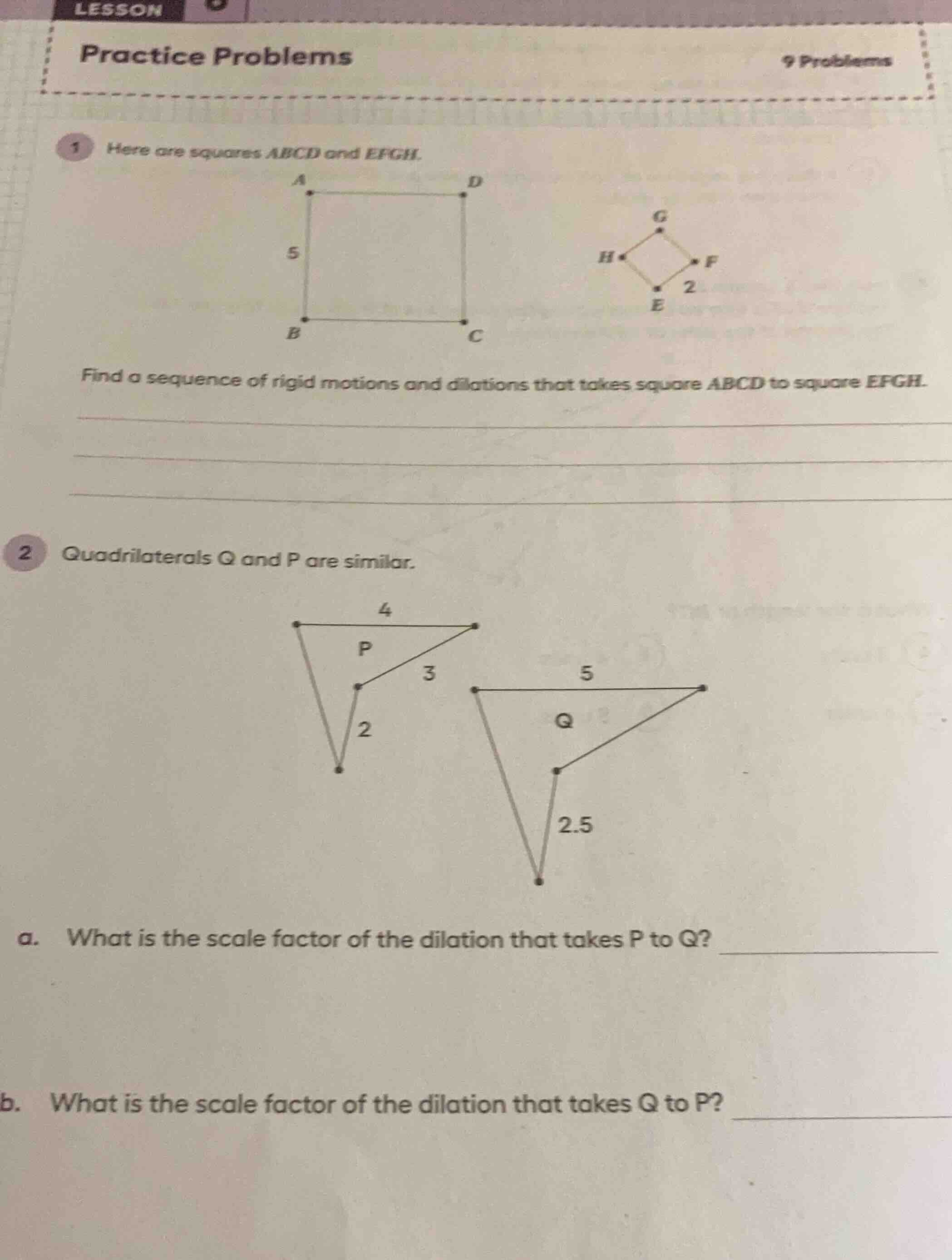
1 here are squares abcd and efgh.
find a sequence of rigid motions and dilations that takes square abcd to square efgh.
2 quadrilaterals q and p are similar.
a. what is the scale factor of the dilation that takes p to q?
b. what is the scale factor of the dilation that takes q to p?
Problem 1
Step1: Identify scale factor
Scale factor = $\frac{\text{Side length of EFGH}}{\text{Side length of ABCD}} = \frac{2}{5}$
Step2: Define rigid motion + dilation
- Rotate square ABCD 45° around its center (rigid motion, preserves size/shape).
- Dilate the rotated square using the scale factor $\frac{2}{5}$ with the same center (reduces size to match EFGH).
- Translate the dilated square to the position of EFGH (rigid motion, preserves size/shape).
Problem 2a
Step1: Calculate P to Q scale factor
Scale factor = $\frac{\text{Corresponding side of Q}}{\text{Corresponding side of P}} = \frac{5}{4} = 1.25$
(Can also use $\frac{2.5}{2} = 1.25$ or $\frac{3.75}{3} = 1.25$ for verification)
Problem 2b
Step1: Calculate Q to P scale factor
Scale factor = $\frac{\text{Corresponding side of P}}{\text{Corresponding side of Q}} = \frac{4}{5} = 0.8$
(Can also use $\frac{2}{2.5} = 0.8$ or $\frac{3}{3.75} = 0.8$ for verification)

Snap & solve any problem in the app
Get step-by-step solutions on Sovi AI
Photo-based solutions with guided steps
Explore more problems and detailed explanations
- A valid sequence:
- Rotate square ABCD 45° around its center.
- Dilate the rotated square by a scale factor of $\frac{2}{5}$ using the same center.
- Translate the resulting square to the position of square EFGH.
2a. $\frac{5}{4}$ (or 1.25)
2b. $\frac{4}{5}$ (or 0.8)