QUESTION IMAGE
Question
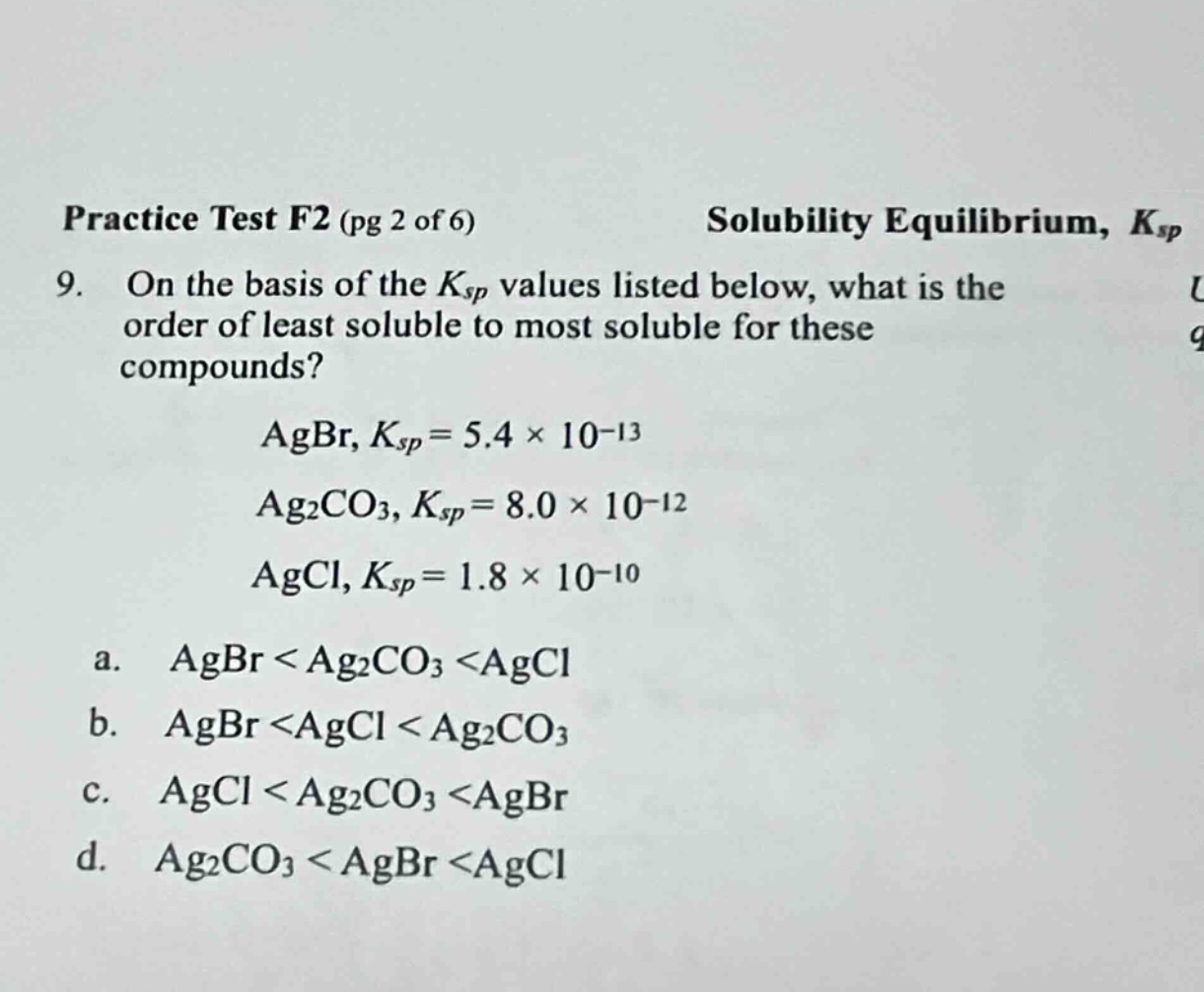
practice test f2 (pg 2 of 6) solubility equilibrium, $k_{sp}$ 9. on the basis of the $k_{sp}$ values listed below, what is the order of least soluble to most soluble for these compounds? $\ce{agbr}, k_{sp}=5.4\times10^{-13}$ $\ce{ag2co3}, k_{sp}=8.0\times10^{-12}$ $\ce{agcl}, k_{sp}=1.8\times10^{-10}$ a. $\ce{agbr} < \ce{ag2co3} < \ce{agcl}$ b. $\ce{agbr} < \ce{agcl} < \ce{ag2co3}$ c. $\ce{agcl} < \ce{ag2co3} < \ce{agbr}$ d. $\ce{ag2co3} < \ce{agbr} < \ce{agcl}$
Step1: Recall \( K_{sp} \) and solubility
For sparingly soluble salts, a smaller \( K_{sp} \) generally means lower solubility (but we must consider the stoichiometry for salts with different ion ratios). However, for these three, we can first compare the \( K_{sp} \) magnitudes directly (after checking ion ratios, but here AgBr and AgCl have 1:1 ratio, \( Ag_2CO_3 \) has 2:1 ratio. Wait, actually, let's calculate molar solubility (\( s \)) for each to be precise.
For \( AgBr \) (1:1 salt, \( AgBr(s)
ightleftharpoons Ag^+(aq) + Br^-(aq) \)):
\( K_{sp} = [Ag^+][Br^-] = s \cdot s = s^2 \)
\( s = \sqrt{K_{sp}} = \sqrt{5.4 \times 10^{-13}} \approx \sqrt{54 \times 10^{-14}} \approx 7.35 \times 10^{-7} \, M \)
For \( Ag_2CO_3 \) (2:1 salt, \( Ag_2CO_3(s)
ightleftharpoons 2Ag^+(aq) + CO_3^{2-}(aq) \)):
\( K_{sp} = [Ag^+]^2[CO_3^{2-}] = (2s)^2 \cdot s = 4s^3 \)
\( s = \sqrt[3]{\frac{K_{sp}}{4}} = \sqrt[3]{\frac{8.0 \times 10^{-12}}{4}} = \sqrt[3]{2.0 \times 10^{-12}} \approx 1.26 \times 10^{-4} \, M \)
For \( AgCl \) (1:1 salt, \( AgCl(s)
ightleftharpoons Ag^+(aq) + Cl^-(aq) \)):
\( K_{sp} = [Ag^+][Cl^-] = s \cdot s = s^2 \)
\( s = \sqrt{K_{sp}} = \sqrt{1.8 \times 10^{-10}} \approx 1.34 \times 10^{-5} \, M \)
Step2: Compare molar solubilities
Now, compare the \( s \) values:
- \( AgBr \): \( \approx 7.35 \times 10^{-7} \, M \)
- \( Ag_2CO_3 \): \( \approx 1.26 \times 10^{-4} \, M \)
- \( AgCl \): \( \approx 1.34 \times 10^{-5} \, M \)
Order of least soluble (smallest \( s \)) to most soluble (largest \( s \)):
\( AgBr \) (smallest \( s \)) < \( AgCl \) (next) < \( Ag_2CO_3 \)? Wait, no, wait my calculation for \( Ag_2CO_3 \) was wrong? Wait, no: \( 8.0 \times 10^{-12} / 4 = 2.0 \times 10^{-12} \), cube root of \( 2.0 \times 10^{-12} \) is \( \approx 1.26 \times 10^{-4} \), which is larger than \( AgCl \)'s \( 1.34 \times 10^{-5} \). Wait, but initial \( K_{sp} \) values: \( AgBr \) is \( 5.4 \times 10^{-13} \), \( Ag_2CO_3 \) is \( 8.0 \times 10^{-12} \), \( AgCl \) is \( 1.8 \times 10^{-10} \). Wait, maybe I messed up the stoichiometry approach. Alternatively, for 1:1 salts (AgBr, AgCl), smaller \( K_{sp} \) means smaller solubility. So \( AgBr \) (\( 5.4 \times 10^{-13} \)) has smaller \( K_{sp} \) than \( AgCl \) (\( 1.8 \times 10^{-10} \)), so \( AgBr \) is less soluble than \( AgCl \). Now for \( Ag_2CO_3 \), even though its \( K_{sp} \) is \( 8.0 \times 10^{-12} \) (larger than \( AgBr \)'s, smaller than \( AgCl \)'s), its molar solubility is higher because of the 2:1 ratio. Wait, let's recalculate \( Ag_2CO_3 \) solubility:
\( K_{sp} = 4s^3 = 8.0 \times 10^{-12} \)
\( s^3 = 2.0 \times 10^{-12} \)
\( s = \sqrt[3]{2.0 \times 10^{-12}} \approx 1.26 \times 10^{-4} \, M \)
For \( AgCl \): \( s = \sqrt{1.8 \times 10^{-10}} \approx 1.34 \times 10^{-5} \, M \)
Ah, so \( Ag_2CO_3 \) has higher solubility than \( AgCl \)? Wait, that can't be. Wait, no, \( 1.26 \times 10^{-4} \) is 0.000126, and \( 1.34 \times 10^{-5} \) is 0.0000134. So yes, \( Ag_2CO_3 \) is more soluble than \( AgCl \). Wait, but the \( K_{sp} \) of \( Ag_2CO_3 \) is \( 8.0 \times 10^{-12} \), which is smaller than \( AgCl \)'s \( 1.8 \times 10^{-10} \), but because of the 2:1 ion ratio, its solubility is higher. So the order of least soluble to most soluble:
Least soluble: \( AgBr \) (smallest \( K_{sp} \) among 1:1, and even with 2:1, its solubility is lower than \( Ag_2CO_3 \)) → then \( Ag_2CO_3 \)? Wait no, wait my calculation for \( Ag_2CO_3 \) is wrong? Wait, no, let's check again. Wait, \( Ag_2CO_3 \): \( K_{sp} = [Ag^+]^2[CO_3^{2-}] \). Let \( s \) be…

Snap & solve any problem in the app
Get step-by-step solutions on Sovi AI
Photo-based solutions with guided steps
Explore more problems and detailed explanations
b. \( \text{AgBr} < \text{AgCl} < \text{Ag}_2\text{CO}_3 \)