QUESTION IMAGE
Question
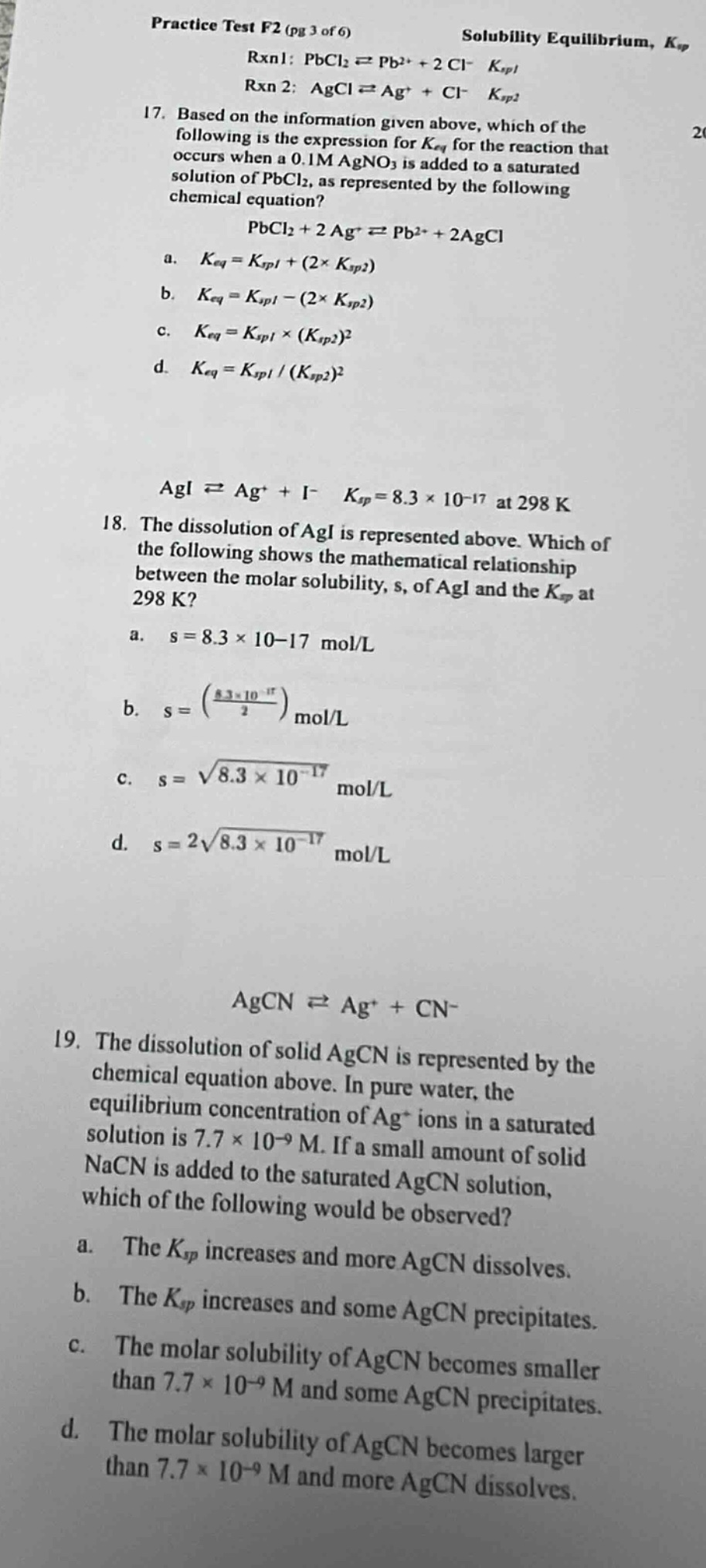
practice test f2 (pg 3 of 6) solubility equilibrium, $k_{sp}$
rxn1: $pbcl_2 \
ightleftarrows pb^{2+} + 2 cl^- \\ k_{sp1}$
rxn 2: $agcl \
ightleftarrows ag^+ + cl^- \\ k_{sp2}$
- based on the information given above, which of the following is the expression for $k_{eq}$ for the reaction that occurs when a 0.1m $agno_3$ is added to a saturated solution of $pbcl_2$, as represented by the following chemical equation?
$pbcl_2 + 2 ag^+ \
ightleftarrows pb^{2+} + 2agcl$
a. $k_{eq} = k_{sp1} + (2 \times k_{sp2})$
b. $k_{eq} = k_{sp1} - (2 \times k_{sp2})$
c. $k_{eq} = k_{sp1} \times (k_{sp2})^2$
d. $k_{eq} = k_{sp1} / (k_{sp2})^2$
$agi \
ightleftarrows ag^+ + i^- \\ k_{sp} = 8.3 \times 10^{-17}$ at 298 k
- the dissolution of $agi$ is represented above. which of the following shows the mathematical relationship between the molar solubility, $s$, of $agi$ and the $k_{sp}$ at 298 k?
a. $s = 8.3 \times 10^{-17}$ mol/l
b. $s = \left( \frac{8.3 \times 10^{-17}}{2} \
ight)$ mol/l
c. $s = \sqrt{8.3 \times 10^{-17}}$ mol/l
d. $s = 2\sqrt{8.3 \times 10^{-17}}$ mol/l
$agcn \
ightleftarrows ag^+ + cn^-$
- the dissolution of solid $agcn$ is represented by the chemical equation above. in pure water, the equilibrium concentration of $ag^+$ ions in a saturated solution is $7.7 \times 10^{-9}$ m. if a small amount of solid $nacn$ is added to the saturated $agcn$ solution, which of the following would be observed?
a. the $k_{sp}$ increases and more $agcn$ dissolves.
b. the $k_{sp}$ increases and some $agcn$ precipitates.
c. the molar solubility of $agcn$ becomes smaller than $7.7 \times 10^{-9}$ m and some $agcn$ precipitates.
d. the molar solubility of $agcn$ becomes larger than $7.7 \times 10^{-9}$ m and more $agcn$ dissolves.
Question 17
Step1: Recall \( K_{sp} \) expressions
For \( \text{Rxn 1: } \text{PbCl}_2
ightleftharpoons \text{Pb}^{2+} + 2\text{Cl}^- \), \( K_{sp1} = [\text{Pb}^{2+}][\text{Cl}^-]^2 \).
For \( \text{Rxn 2: } \text{AgCl}
ightleftharpoons \text{Ag}^+ + \text{Cl}^- \), \( K_{sp2} = [\text{Ag}^+][\text{Cl}^-] \), so \( \frac{1}{K_{sp2}} = \frac{1}{[\text{Ag}^+][\text{Cl}^-]} \), and squaring (for 2 moles of \( \text{Cl}^- \) in the net reaction) gives \( \frac{1}{(K_{sp2})^2} = \frac{1}{[\text{Ag}^+]^2[\text{Cl}^-]^2} \).
Step2: Derive \( K_{eq} \) for net reaction
Net reaction: \( \text{PbCl}_2 + 2\text{Ag}^+
ightleftharpoons \text{Pb}^{2+} + 2\text{AgCl} \).
\( K_{eq} = \frac{[\text{Pb}^{2+}]}{[\text{Ag}^+]^2} \).
From \( K_{sp1} \), \( [\text{Pb}^{2+}] = \frac{K_{sp1}}{[\text{Cl}^-]^2} \). Substitute into \( K_{eq} \):
\( K_{eq} = \frac{K_{sp1}/[\text{Cl}^-]^2}{[\text{Ag}^+]^2} = \frac{K_{sp1}}{[\text{Ag}^+]^2[\text{Cl}^-]^2} \).
But \( [\text{Ag}^+][\text{Cl}^-] = K_{sp2} \), so \( [\text{Ag}^+]^2[\text{Cl}^-]^2 = (K_{sp2})^2 \). Thus, \( K_{eq} = \frac{K_{sp1}}{(K_{sp2})^2} \).
Step1: Write \( K_{sp} \) for \( \text{AgI} \)
For \( \text{AgI}
ightleftharpoons \text{Ag}^+ + \text{I}^- \), \( K_{sp} = [\text{Ag}^+][\text{I}^-] \).
Step2: Relate to molar solubility \( s \)
Let molar solubility be \( s \). Then \( [\text{Ag}^+] = s \) and \( [\text{I}^-] = s \) (1:1 stoichiometry).
Thus, \( K_{sp} = s \times s = s^2 \).
Step3: Solve for \( s \)
\( s^2 = K_{sp} \implies s = \sqrt{K_{sp}} \). Substituting \( K_{sp} = 8.3 \times 10^{-17} \), \( s = \sqrt{8.3 \times 10^{-17}} \, \text{mol/L} \).
- \( K_{sp} \) is temperature - dependent, not concentration - dependent. Adding \( \text{NaCN} \) increases \( [\text{CN}^-] \) (common ion effect).
- According to Le Chatelier’s principle, the equilibrium \( \text{AgCN}
ightleftharpoons \text{Ag}^+ + \text{CN}^- \) shifts left (precipitation occurs) to reduce \( [\text{CN}^-] \).
- Molar solubility (\( s \)) decreases because \( s = \sqrt{K_{sp}/[\text{CN}^-]} \) (from \( K_{sp} = s(s + [\text{CN}^-]_{\text{added}}) \approx s[\text{CN}^-]_{\text{added}} \) for small \( s \)), so \( s \) becomes smaller than \( 7.7 \times 10^{-9} \, \text{M} \).

Snap & solve any problem in the app
Get step-by-step solutions on Sovi AI
Photo-based solutions with guided steps
Explore more problems and detailed explanations
d. \( K_{eq} = K_{sp1} / (K_{sp2})^2 \)