QUESTION IMAGE
Question
9 practice 9 (from unit 1, lesson 20)
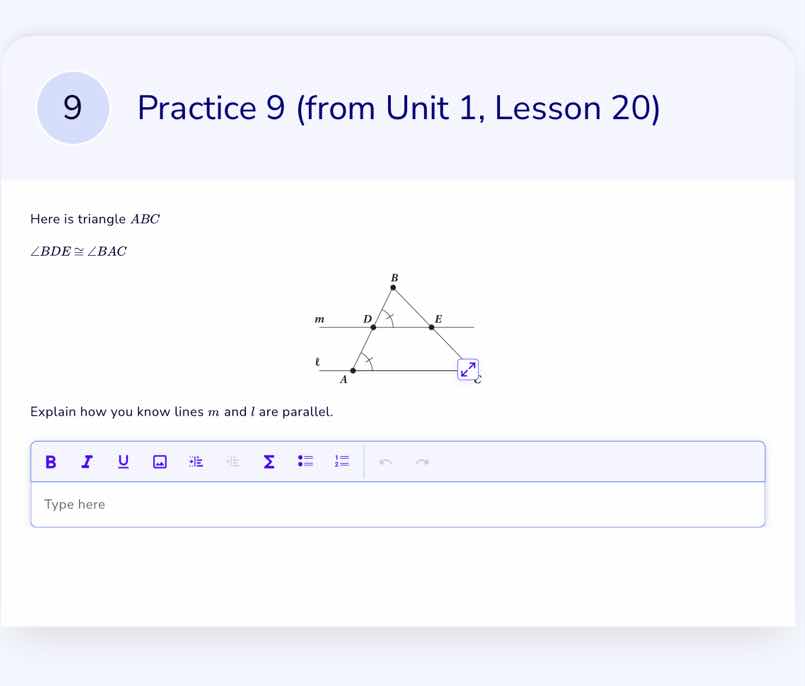
here is triangle abc
$\angle bde \cong \angle bac$
explain how you know lines m and l are parallel.
To determine if lines \( m \) and \( l \) are parallel, we use the Corresponding Angles Theorem, which states that if two corresponding angles formed by a transversal cutting through two lines are congruent, then the two lines are parallel.
- Identify the angles: \( \angle BDE \) and \( \angle BAC \) are given as congruent (\( \angle BDE \cong \angle BAC \)).
- Analyze the transversal: Line \( BA \) acts as a transversal intersecting lines \( m \) (at \( D \)) and \( l \) (at \( A \)).
- Apply the theorem: Since \( \angle BDE \) (on line \( m \)) and \( \angle BAC \) (on line \( l \)) are corresponding angles and congruent, by the Corresponding Angles Theorem, lines \( m \) and \( l \) must be parallel.

Snap & solve any problem in the app
Get step-by-step solutions on Sovi AI
Photo-based solutions with guided steps
Explore more problems and detailed explanations
Lines \( m \) and \( l \) are parallel because \( \angle BDE \cong \angle BAC \) (given), and these are corresponding angles formed by transversal \( BA \). By the Corresponding Angles Theorem, if corresponding angles are congruent, the lines cut by the transversal are parallel. Thus, \( m \parallel l \).