QUESTION IMAGE
Question
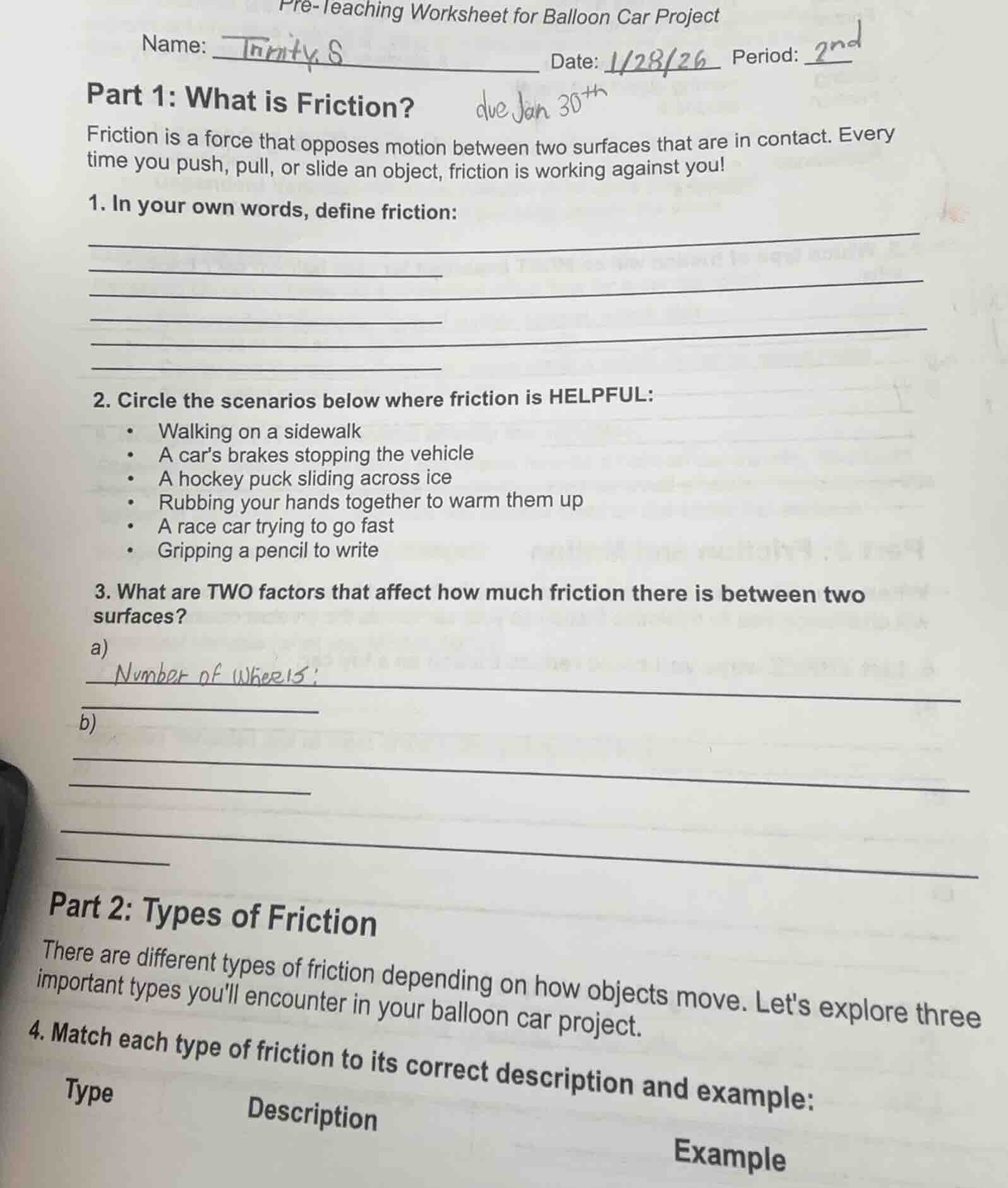
pre - teaching worksheet for balloon car project
name: trinity s date: 1/28/26 period: 2nd
part 1: what is friction?
due jan 30th
friction is a force that opposes motion between two surfaces that are in contact. every time you push, pull, or slide an object, friction is working against you!
- in your own words, define friction:
- circle the scenarios below where friction is helpful:
- walking on a sidewalk
- a car’s brakes stopping the vehicle
- a hockey puck sliding across ice
- rubbing your hands together to warm them up
- a race car trying to go fast
- gripping a pencil to write
- what are two factors that affect how much friction there is between two surfaces?
a)
number of wheels:
b)
part 2: types of friction
there are different types of friction depending on how objects move. lets explore three important types youll encounter in your balloon car project.
- match each type of friction to its correct description and example:
type description example
Question 1: Define friction in your own words
Friction is a force that acts when two surfaces are in contact and resists the motion between them. For example, when you slide a book on a table, friction makes it harder to move the book smoothly.
- Walking on a sidewalk: Friction between shoes and sidewalk helps us not slip, so it's helpful.
- A car’s brakes stopping the vehicle: Brakes use friction to slow down the car, which is helpful for safety.
- Rubbing your hands together to warm them up: Friction between hands produces heat, so it's helpful.
- Gripping a pencil to write: Friction between fingers and pencil helps us hold it, so it's helpful.
- A hockey puck sliding across ice: We want the puck to slide easily, so friction here is not helpful.
- A race car trying to go fast: Less friction is better for speed, so friction here is not helpful.
So the scenarios to circle are "Walking on a sidewalk", "A car’s brakes stopping the vehicle", "Rubbing your hands together to warm them up", "Gripping a pencil to write".
The main factors affecting friction between two surfaces are the roughness of the surfaces (how smooth or rough they are) and the amount of force pressing the surfaces together (normal force). The initial answer of "Number of Wheels" is incorrect as the number of wheels doesn't directly affect friction between surfaces (though it can affect pressure distribution, but the key factor is the force per area).
So the two factors are:
a) The roughness of the surfaces (how rough or smooth the surfaces in contact are)
b) The amount of force pressing the surfaces together (normal force)

Snap & solve any problem in the app
Get step-by-step solutions on Sovi AI
Photo-based solutions with guided steps
Explore more problems and detailed explanations
Friction is a force that resists the motion between two surfaces that are touching each other.