QUESTION IMAGE
Question
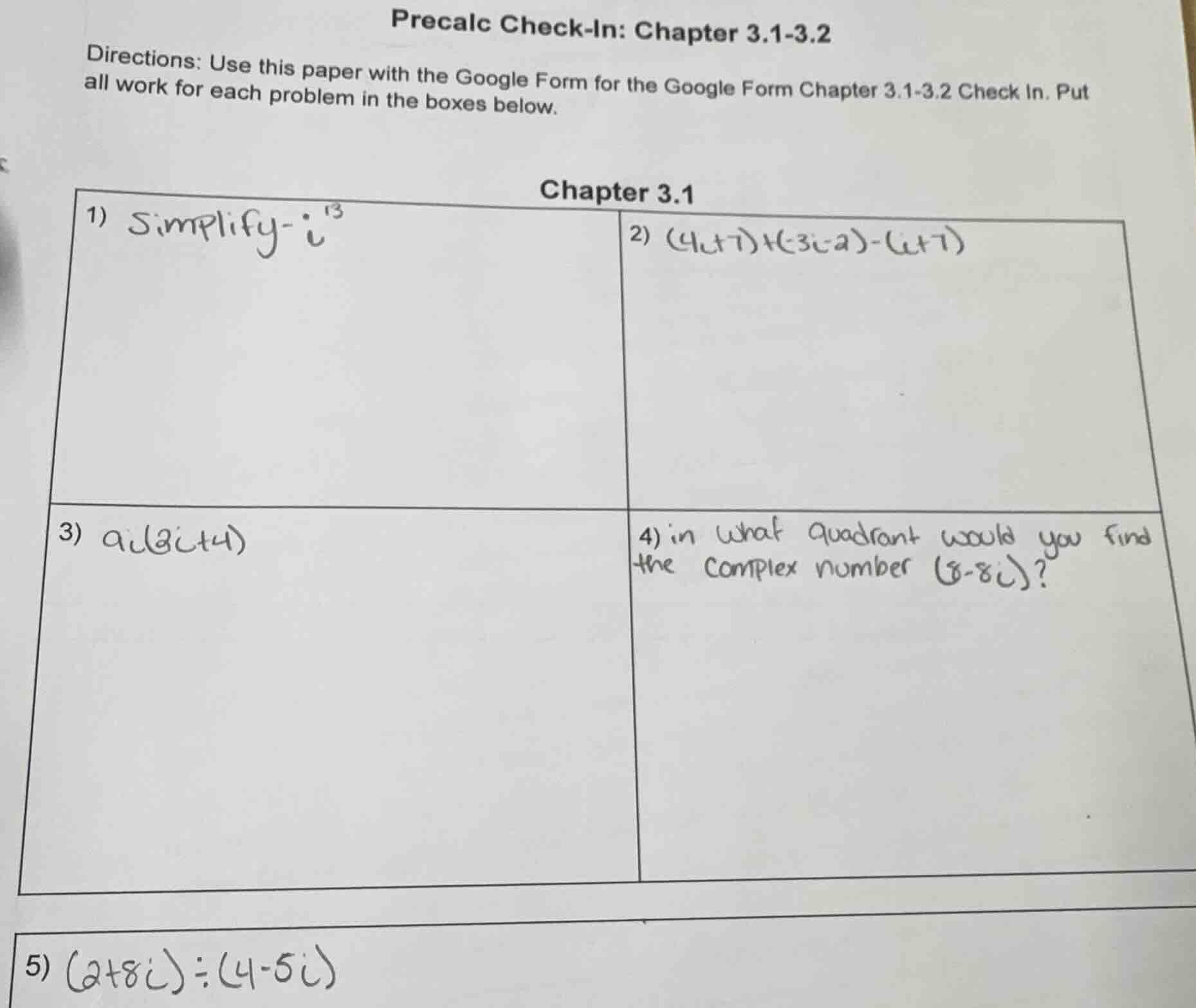
precalc check-in: chapter 3.1-3.2
directions: use this paper with the google form for the google form chapter 3.1-3.2 check in. put all work for each problem in the boxes below.
chapter 3.1
- simplify ( i^{13} )
- ( (4i + 7) + (-3i - 2) - (i + 7) )
- ( 9i(2i + 4) )
- in what quadrant would you find the complex number ( (8 - 8i) )?
- ( (2 + 8i) div (4 - 5i) )
Problem 1: Simplify \( i^{13} \)
Step 1: Recall the cycle of \( i \)
The imaginary unit \( i \) has a cycle: \( i^1 = i \), \( i^2 = -1 \), \( i^3 = -i \), \( i^4 = 1 \), and then it repeats every 4 powers. So we can express the exponent as a multiple of 4 plus a remainder.
We divide 13 by 4: \( 13 = 4 \times 3 + 1 \). So \( i^{13} = i^{4 \times 3 + 1} \).
Step 2: Use the property of exponents
Using the property \( a^{m+n} = a^m \times a^n \), we can rewrite \( i^{4 \times 3 + 1} \) as \( (i^4)^3 \times i^1 \).
We know that \( i^4 = 1 \), so \( (i^4)^3 = 1^3 = 1 \). Then \( (i^4)^3 \times i^1 = 1 \times i = i \).
Step 1: Remove parentheses
Distribute the negative sign in the last term: \( (4i + 7) + (-3i - 2) - i - 7 \).
Step 2: Combine like terms (real parts and imaginary parts)
- Real parts: \( 7 - 2 - 7 \)
- Imaginary parts: \( 4i - 3i - i \)
Calculating real parts: \( 7 - 2 - 7 = -2 \)
Calculating imaginary parts: \( 4i - 3i - i = 0i \)
Step 3: Combine results
Adding the real and imaginary parts together: \( -2 + 0i = -2 \)
Step 1: Distribute the \( 9i \)
Using the distributive property \( a(b + c) = ab + ac \), we get \( 9i \times 2i + 9i \times 4 \).
Step 2: Multiply the terms
- For \( 9i \times 2i \): \( 9 \times 2 \times i \times i = 18i^2 \)
- For \( 9i \times 4 \): \( 36i \)
Step 3: Substitute \( i^2 = -1 \)
Since \( i^2 = -1 \), \( 18i^2 = 18(-1) = -18 \).
Step 4: Combine terms
Now we have \( -18 + 36i \).

Snap & solve any problem in the app
Get step-by-step solutions on Sovi AI
Photo-based solutions with guided steps
Explore more problems and detailed explanations
\( i \)