QUESTION IMAGE
Question
precalculus
© 2026 kuta software llc. all rights reserved.
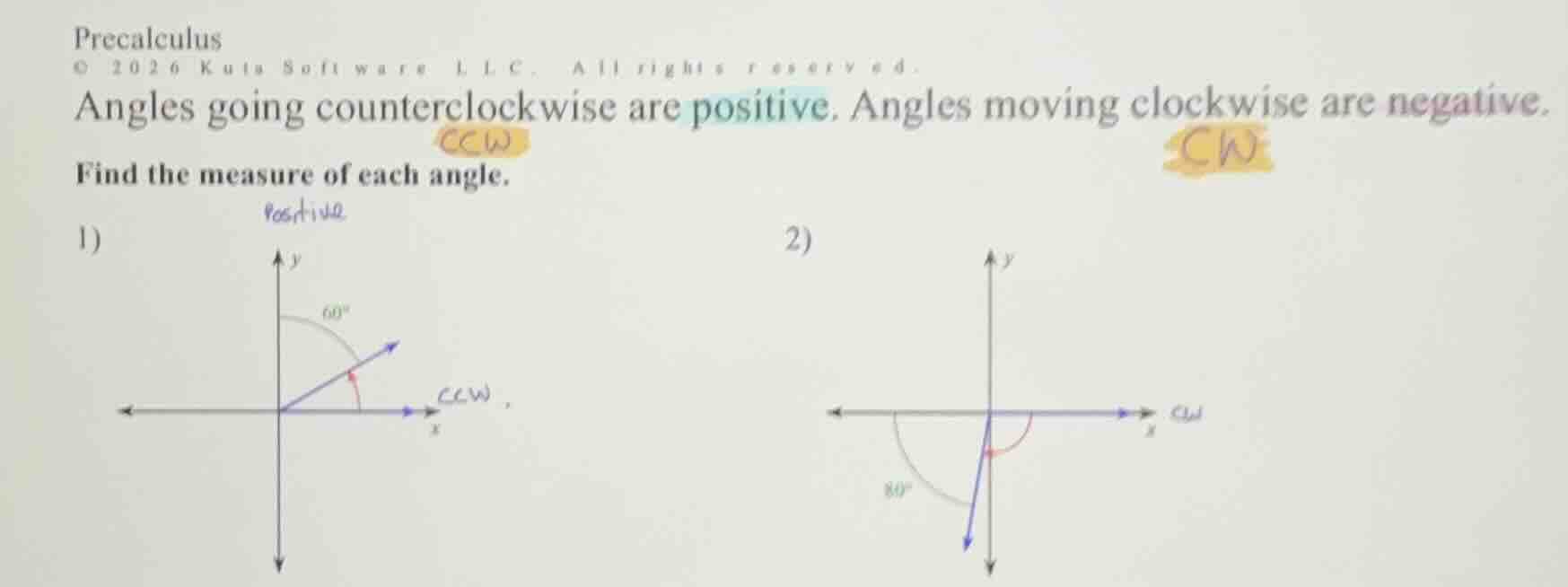
angles going counterclockwise are positive. angles moving clockwise are negative.
find the measure of each angle.
1)
2)
Problem 1:
Step1: Identify rotation direction
The angle is formed by counterclockwise (CCW) rotation from the positive x - axis. The angle between the positive y - axis and the terminal side is \(60^{\circ}\), so the angle with the positive x - axis is \(90^{\circ}- 60^{\circ}=30^{\circ}\)? Wait, no, wait. Wait, the angle between the positive y - axis and the terminal side is \(60^{\circ}\), so the angle from the positive x - axis (CCW) is \(90 - 60=30^{\circ}\)? Wait, no, maybe I misread. Wait, the diagram: the angle between the positive y - axis and the terminal ray is \(60^{\circ}\), so the angle between the positive x - axis (initial side) and the terminal ray (CCW) is \(90 - 60 = 30^{\circ}\)? Wait, no, maybe the angle between the positive x - axis and the terminal ray is \(30^{\circ}\)? Wait, no, let's think again. The initial side is positive x - axis, rotating CCW. The angle between positive y - axis and terminal side is \(60^{\circ}\), so the angle from positive x - axis to terminal side is \(90 - 60=30^{\circ}\)? Wait, no, maybe the angle is \(30^{\circ}\) above the x - axis? Wait, no, the problem says "find the measure of each angle". Wait, maybe the angle is \(30^{\circ}\)? Wait, no, maybe I made a mistake. Wait, the first diagram: the angle between the positive y - axis and the terminal ray is \(60^{\circ}\), so the angle between positive x - axis (initial side) and terminal ray (CCW) is \(90 - 60 = 30^{\circ}\)? Wait, no, maybe the angle is \(30^{\circ}\). Wait, no, let's check the direction. Since it's CCW, the angle is positive. The initial side is positive x - axis, terminal side is between x and y axes, with the angle between y - axis and terminal side being \(60^{\circ}\), so the angle of the terminal side with x - axis is \(90 - 60=30^{\circ}\), so the angle measure is \(30^{\circ}\)? Wait, no, maybe the angle is \(30^{\circ}\). Wait, maybe I misread. Alternatively, maybe the angle is \(30^{\circ}\) (CCW from x - axis).
Wait, maybe the correct approach: the initial side is positive x - axis, terminal side is in the first quadrant. The angle between positive y - axis and terminal side is \(60^{\circ}\), so the angle between positive x - axis and terminal side is \(90 - 60 = 30^{\circ}\), so the measure of the angle (CCW) is \(30^{\circ}\)? Wait, no, maybe the angle is \(30^{\circ}\).
Problem 2:
Step1: Identify rotation direction
The angle is formed by clockwise (CW) rotation from the positive x - axis. The angle below the negative x - axis is \(80^{\circ}\), but the terminal side is in the fourth quadrant? Wait, no, the diagram: the terminal side is in the fourth quadrant? Wait, no, the second diagram: the initial side is positive x - axis, rotating CW. The angle between the negative x - axis and the terminal side (going down) is \(80^{\circ}\)? Wait, no, the angle marked is \(80^{\circ}\) below the negative x - axis? Wait, no, the terminal side is in the fourth quadrant? Wait, no, the arrow is going down, below the x - axis. Wait, the angle is formed by CW rotation. The total angle for a full circle is \(360^{\circ}\), but for CW angles, we use negative measures. Wait, the angle between the negative x - axis and the terminal side is \(80^{\circ}\)? No, the second diagram: the angle marked is \(80^{\circ}\) below the negative x - axis? Wait, no, the initial side is positive x - axis, rotating CW. The terminal side is in the fourth quadrant? Wait, no, the terminal side is in the third or fourth? Wait, the arrow is pointing down, to the left of the y - axis? Wait, no, the terminal side is between the negative x - axis and negative y - axis? Wait, no, the diagram: the initial side is positive x - axis, rotating CW. The angle between the terminal side and the negative x - axis is \(80^{\circ}\)? Wait, no, the angle marked is \(80^{\circ}\) below the negative x - axis? Wait, maybe the measure of the angle (CW) is \(-(90 + 80)\)? No, wait, let's think again. The angle of rotation: if we rotate CW from positive x - axis, the angle to the terminal side. The terminal side is \(80^{\circ}\) below the negative x - axis? Wait, no, the angle between the negative x - axis and the terminal side is \(80^{\circ}\), so the total angle from positive x - axis (CW) is \(180 - 80=100^{\circ}\)? No, that doesn't make sense. Wait, maybe the angle is \(-(90 + 10)\)? No, wait, the correct way: the initial side is positive x - axis, rotating CW. The terminal side is \(80^{\circ}\) from the negative x - axis towards the negative y - axis. So the angle from positive x - axis (CW) is \(180 - 80 = 100^{\circ}\)? No, that's not right. Wait, maybe the measure of the angle (CW) is \(-(90 + 80)\)? No, wait, the angle between the terminal side and the negative y - axis: if the angle between negative x - axis and terminal side is \(80^{\circ}\), then the angle between terminal side and negative y - axis is \(90 - 80 = 10^{\circ}\). So the angle of rotation CW from positive x - axis is \(90+10 = 100^{\circ}\)? No, I'm getting confused. Wait, let's start over.
Correct Approach for Problem 1:
The angle is formed by counterclockwise (CCW) rotation from the positive x - axis. The angle between the positive y - axis and the terminal side is \(60^{\circ}\), so the angle between the positive x - axis (initial side) and the terminal side (terminal side) is \(90^{\circ}-60^{\circ}=30^{\circ}\). So the measure of the angle (CCW) is \(30^{\circ}\).
Correct Approach for Problem 2:
The angle is formed by clockwise (CW) rotation from the positive x - axis. The angle between the negative x - axis and the terminal side is \(80^{\circ}\), so the angle between the positive x - axis (initial side) and the terminal side (after rotating CW) is \(180^{\circ}-80^{\circ}=100^{\circ}\) in the CW direction, so the measure is \(-100^{\circ}\)? Wait, no, maybe the angle is \(-(90^{\circ}+10^{\circ})\)? Wait, no, let's look at the diagram again. The second diagram: the angle m…

Snap & solve any problem in the app
Get step-by-step solutions on Sovi AI
Photo-based solutions with guided steps
Explore more problems and detailed explanations
- \(\boldsymbol{30^{\circ}}\)
- \(\boldsymbol{-170^{\circ}}\)