QUESTION IMAGE
Question
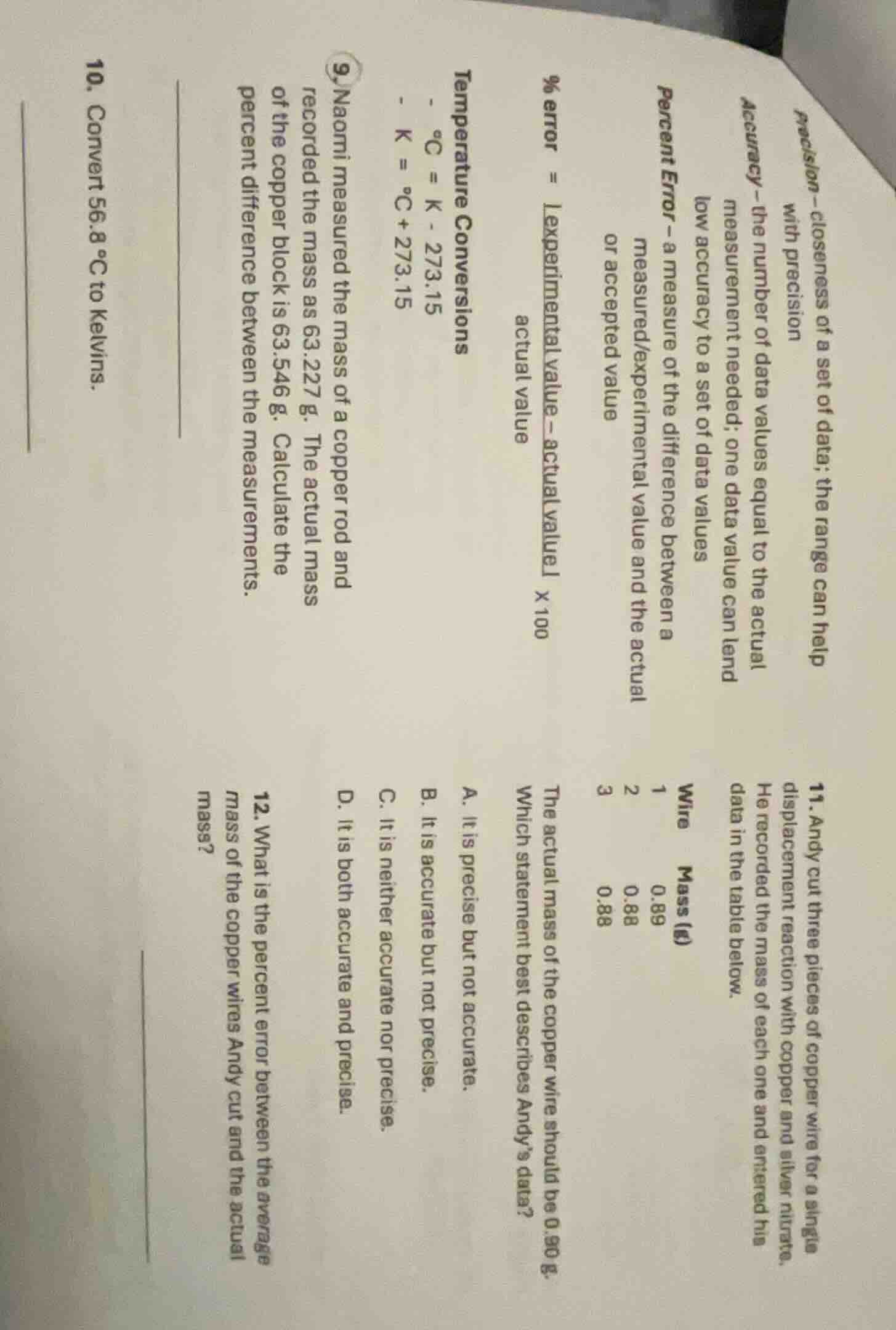
precision – closeness of a set of data; the range can help with precision
accuracy – the number of data values equal to the actual measurement needed; one data value can lend low accuracy to a set of data values
percent error – a measure of the difference between a measured/experimental value and the actual or accepted value
% error = |experimental value – actual value| / actual value × 100
temperature conversions
- °c = k - 273.15
- k = °c + 273.15
- naomi measured the mass of a copper rod and recorded the mass as 63.227 g. the actual mass of the copper block is 63.546 g. calculate the percent difference between the measurements.
- convert 56.8 °c to kelvins.
- andy cut three pieces of copper wire for a single displacement reaction with copper and silver nitrate. he recorded the mass of each one and entered his data in the table below.
wire | mass (g)
1 | 0.89
2 | 0.88
3 | 0.89
the actual mass of the copper wire should be 0.90 g. which statement best describes andy’s data?
a. it is precise but not accurate.
b. it is accurate but not precise.
c. it is neither accurate nor precise.
d. it is both accurate and precise.
- what is the percent error between the average mass of the copper wires andy cut and the actual mass?
Step1: Solve Q9: Define percent difference formula
Percent difference = $\frac{|m_1 - m_2|}{\frac{m_1 + m_2}{2}} \times 100$
Step2: Q9: Plug in mass values
$m_1=63.227\ \text{g}, m_2=63.546\ \text{g}$
First calculate numerator: $|63.227 - 63.546| = 0.319$
Denominator: $\frac{63.227 + 63.546}{2} = \frac{126.773}{2} = 63.3865$
Percent difference = $\frac{0.319}{63.3865} \times 100$
Step3: Q9: Compute final value
$\frac{0.319}{63.3865} \times 100 \approx 0.503\%$
Step4: Solve Q10: Use Kelvin conversion formula
$K = ^\circ\text{C} + 273.15$
Step5: Q10: Substitute temperature value
$K = 56.8 + 273.15$
Step6: Q10: Calculate result
$K = 329.95$
Step7: Solve Q11: Analyze precision/accuracy
First, check precision: values 0.89, 0.88, 0.88 are close (high precision). Actual mass = 0.90 g, average = $\frac{0.89+0.88+0.88}{3} = 0.883\ \text{g}$, which is not close to 0.90 g (low accuracy).
Step8: Solve Q12: Find percent error
First, calculate average mass: $\frac{0.89+0.88+0.88}{3} = 0.883\ \text{g}$
Percent error = $\frac{|\text{experimental value} - \text{actual value}|}{\text{actual value}} \times 100 = \frac{|0.883 - 0.90|}{0.90} \times 100$
Step9: Q12: Compute final value
$\frac{0.017}{0.90} \times 100 \approx 1.89\%$

Snap & solve any problem in the app
Get step-by-step solutions on Sovi AI
Photo-based solutions with guided steps
Explore more problems and detailed explanations
- $\approx 0.50\%$
- $329.95\ \text{K}$
- A. It is precise but not accurate.
- $\approx 1.89\%$