QUESTION IMAGE
Question
preparation
before beginning the time study, complete the five questions below, which cover important topics you have previously learned about in class: (1) atomic structure, (2) electron configuration, and (3) valence, core, and outer electrons. if you are confused about any of these topics, refer to the supplementary tutorial videos and the openstax textbook listed below.
atomic structure
resource
- flowers, p, et al. (2023). chapter 2.3 in chemistry 2e. openstax. <https://openstax.org/books/chemistry-2e/pages/2-3-atomic-structure-and-symbolism>
videos
- nuclide symbol: atomic number, mass number, ions, and isotopes. running time: 5:03 min. produced by professor dave explains. <https://youtu.be/5pynomnktiq>
- how to calculate the number of protons, neutrons, and electrons. running time: 13:11 min. produced by the organic chemistry tutor. <https://youtu.be/6sdd7uifthg>
question
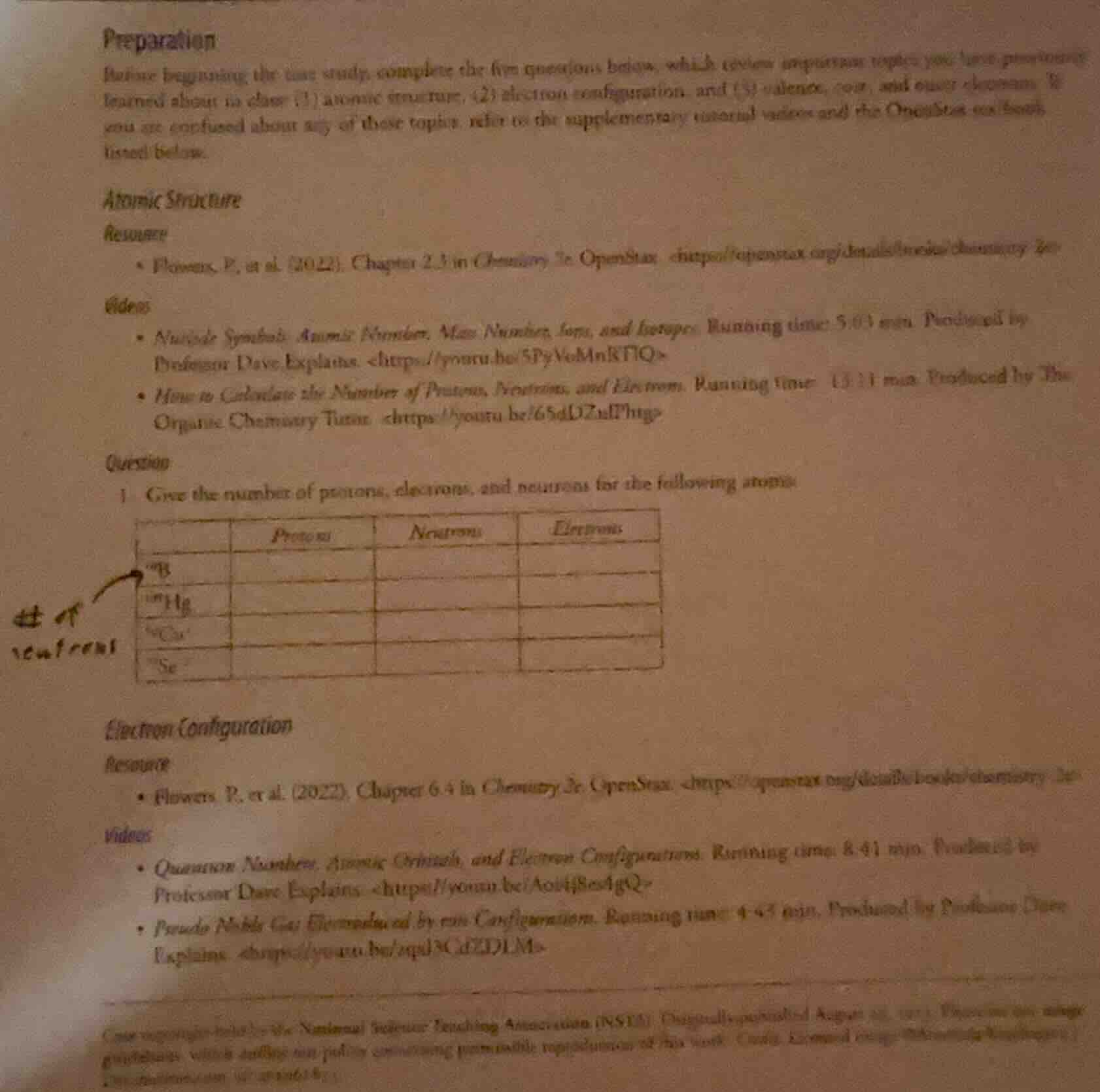
1 give the number of protons, electrons, and neutrons for the following atoms:
| protons | neutrons | electrons | |
|---|---|---|---|
| $^{204}\text{hg}$ | |||
| $^{40}\text{ca}^{2+}$ | |||
| $^{79}\text{se}^{2-}$ |
electron configuration
resource
- flowers, p, et al. (2023). chapter 6.4 in chemistry 2e. openstax. <https://openstax.org/books/chemistry-2e/pages/6-4-electron-configurations>
videos
- quantum numbers, atomic orbitals, and electron configurations. running time: 8:41 min. produced by professor dave explains. <https://youtu.be/ao8ih8bqvhq>
- pseudo noble gas electron configuration. running time: 4:43 min. produced by professor dave explains. <https://youtu.be/qpl3c6eedlm>
To solve for the number of protons, neutrons, and electrons in an atom, we use the following concepts:
- Protons: Equal to the atomic number (\(Z\)) of the element.
- Electrons: For a neutral atom, electrons = protons. If the atom is an ion, adjust for charge (e.g., \( \text{Ca}^{2+} \) has 2 fewer electrons than protons).
- Neutrons: Calculated as \( \text{Mass number} (A) - \text{Atomic number} (Z) \), where \( A \) is the superscript in the isotope notation.
1. For \( \boldsymbol{^{10}\text{B}} \) (Boron-10)
- Atomic number of B (Z): 5 (from periodic table).
- Protons: \( Z = 5 \).
- Electrons: Neutral atom, so electrons = protons = 5.
- Mass number (A): 10 (superscript).
- Neutrons: \( A - Z = 10 - 5 = 5 \).
2. For \( \boldsymbol{^{204}\text{Hg}} \) (Mercury-204)
- Atomic number of Hg (Z): 80 (periodic table).
- Protons: \( Z = 80 \).
- Electrons: Neutral atom, so electrons = 80.
- Mass number (A): 204.
- Neutrons: \( 204 - 80 = 124 \).
3. For \( \boldsymbol{\text{Ca}^{2+}} \) (Calcium ion, assume mass number 40 for \( ^{40}\text{Ca}^{2+} \) if not specified)
- Atomic number of Ca (Z): 20.
- Protons: \( Z = 20 \).
- Electrons: \( \text{Ca}^{2+} \) has a +2 charge, so electrons = protons - 2 = \( 20 - 2 = 18 \).
- Mass number (A): 40 (common isotope of Ca).
- Neutrons: \( 40 - 20 = 20 \).
4. For \( \boldsymbol{\text{Se}^{2-}} \) (Selenium ion, assume mass number 79 for \( ^{79}\text{Se}^{2-} \) if not specified)
- Atomic number of Se (Z): 34.
- Protons: \( Z = 34 \).
- Electrons: \( \text{Se}^{2-} \) has a -2 charge, so electrons = protons + 2 = \( 34 + 2 = 36 \).
- Mass number (A): 79 (common isotope of Se).
- Neutrons: \( 79 - 34 = 45 \).
Filling the Table:
| Isotope/Ion | Protons | Neutrons | Electrons |
|---|---|---|---|
| \( ^{204}\text{Hg} \) | 80 | 124 | 80 |
| \( \text{Ca}^{2+} \) | 20 | 20 | 18 |
| \( \text{Se}^{2-} \) | 34 | 45 | 36 |
(Note: If the mass number for \( \text{Ca}^{2+} \) or \( \text{Se}^{2-} \) differs, recalculate neutrons using the given \( A \).)

Snap & solve any problem in the app
Get step-by-step solutions on Sovi AI
Photo-based solutions with guided steps
Explore more problems and detailed explanations
To solve for the number of protons, neutrons, and electrons in an atom, we use the following concepts:
- Protons: Equal to the atomic number (\(Z\)) of the element.
- Electrons: For a neutral atom, electrons = protons. If the atom is an ion, adjust for charge (e.g., \( \text{Ca}^{2+} \) has 2 fewer electrons than protons).
- Neutrons: Calculated as \( \text{Mass number} (A) - \text{Atomic number} (Z) \), where \( A \) is the superscript in the isotope notation.
1. For \( \boldsymbol{^{10}\text{B}} \) (Boron-10)
- Atomic number of B (Z): 5 (from periodic table).
- Protons: \( Z = 5 \).
- Electrons: Neutral atom, so electrons = protons = 5.
- Mass number (A): 10 (superscript).
- Neutrons: \( A - Z = 10 - 5 = 5 \).
2. For \( \boldsymbol{^{204}\text{Hg}} \) (Mercury-204)
- Atomic number of Hg (Z): 80 (periodic table).
- Protons: \( Z = 80 \).
- Electrons: Neutral atom, so electrons = 80.
- Mass number (A): 204.
- Neutrons: \( 204 - 80 = 124 \).
3. For \( \boldsymbol{\text{Ca}^{2+}} \) (Calcium ion, assume mass number 40 for \( ^{40}\text{Ca}^{2+} \) if not specified)
- Atomic number of Ca (Z): 20.
- Protons: \( Z = 20 \).
- Electrons: \( \text{Ca}^{2+} \) has a +2 charge, so electrons = protons - 2 = \( 20 - 2 = 18 \).
- Mass number (A): 40 (common isotope of Ca).
- Neutrons: \( 40 - 20 = 20 \).
4. For \( \boldsymbol{\text{Se}^{2-}} \) (Selenium ion, assume mass number 79 for \( ^{79}\text{Se}^{2-} \) if not specified)
- Atomic number of Se (Z): 34.
- Protons: \( Z = 34 \).
- Electrons: \( \text{Se}^{2-} \) has a -2 charge, so electrons = protons + 2 = \( 34 + 2 = 36 \).
- Mass number (A): 79 (common isotope of Se).
- Neutrons: \( 79 - 34 = 45 \).
Filling the Table:
| Isotope/Ion | Protons | Neutrons | Electrons |
|---|---|---|---|
| \( ^{204}\text{Hg} \) | 80 | 124 | 80 |
| \( \text{Ca}^{2+} \) | 20 | 20 | 18 |
| \( \text{Se}^{2-} \) | 34 | 45 | 36 |
(Note: If the mass number for \( \text{Ca}^{2+} \) or \( \text{Se}^{2-} \) differs, recalculate neutrons using the given \( A \).)