QUESTION IMAGE
Question
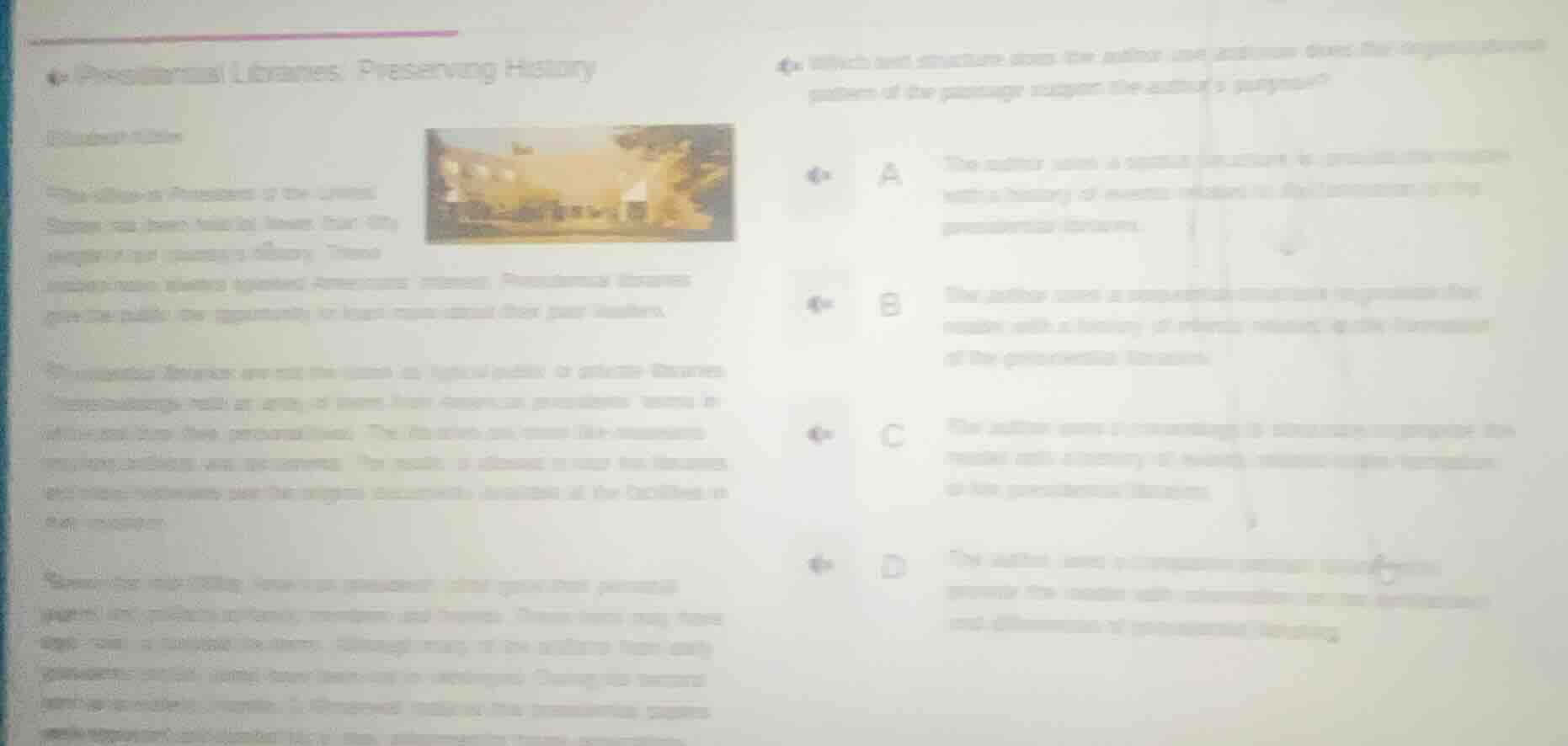
presidential libraries: preserving history student guide the college of presidents of the united states has been called home for 13 of the largest of our countrys library. these institutions educate and inform americans views on presidential libraries give the public the opportunity to learn more about their leaders. presidential libraries are not the same as typical public or private libraries. these buildings hold an array of items from americas presidents living in office and long after, personalized. the libraries can range from museums to public buildings and government. for example, it allowed to tour the libraries and view the documents and the original documents available at the facilities in that location. since the mid-1950s, americas presidents chief spots that personal papers and materials formerly kept private and forgotten. these items may have gone - seen in a historical library. although many of the artifacts from early presidents periods partly have been lost or destroyed. during the twentieth century, the government made an effort to preserve these presidential papers. which text structure does the author use and how does the organizational pattern of the passage support the author’s purpose? a the author uses a spatial structure to provide the reader with a history of events related to the formation of the presidential libraries. b the author uses a chronological structure to provide the reader with a history of events related to the formation of the presidential libraries. c the author uses a cause/effect to structure to provide the reader with a history of events related to the formation of the presidential libraries. d the author uses a compare/contrast structure to provide the reader with a history of events related to the formation of the presidential libraries.
The passage first introduces what Presidential Libraries are, how they differ from regular libraries, then covers their history/development. This is a sequential structure that presents events in order to inform readers about the libraries' formation and background. Option A incorrectly calls it spatial (which focuses on location). Option C's "chronology" is related but the structure is broader sequential presentation of information about the libraries' origins, not just strict date-ordered events. Option D is wrong because the passage does not use comparison as its main structure.

Snap & solve any problem in the app
Get step-by-step solutions on Sovi AI
Photo-based solutions with guided steps
Explore more problems and detailed explanations
B. The author uses a sequential structure to provide the reader with a history of events related to the formation of the presidential libraries.