QUESTION IMAGE
Question
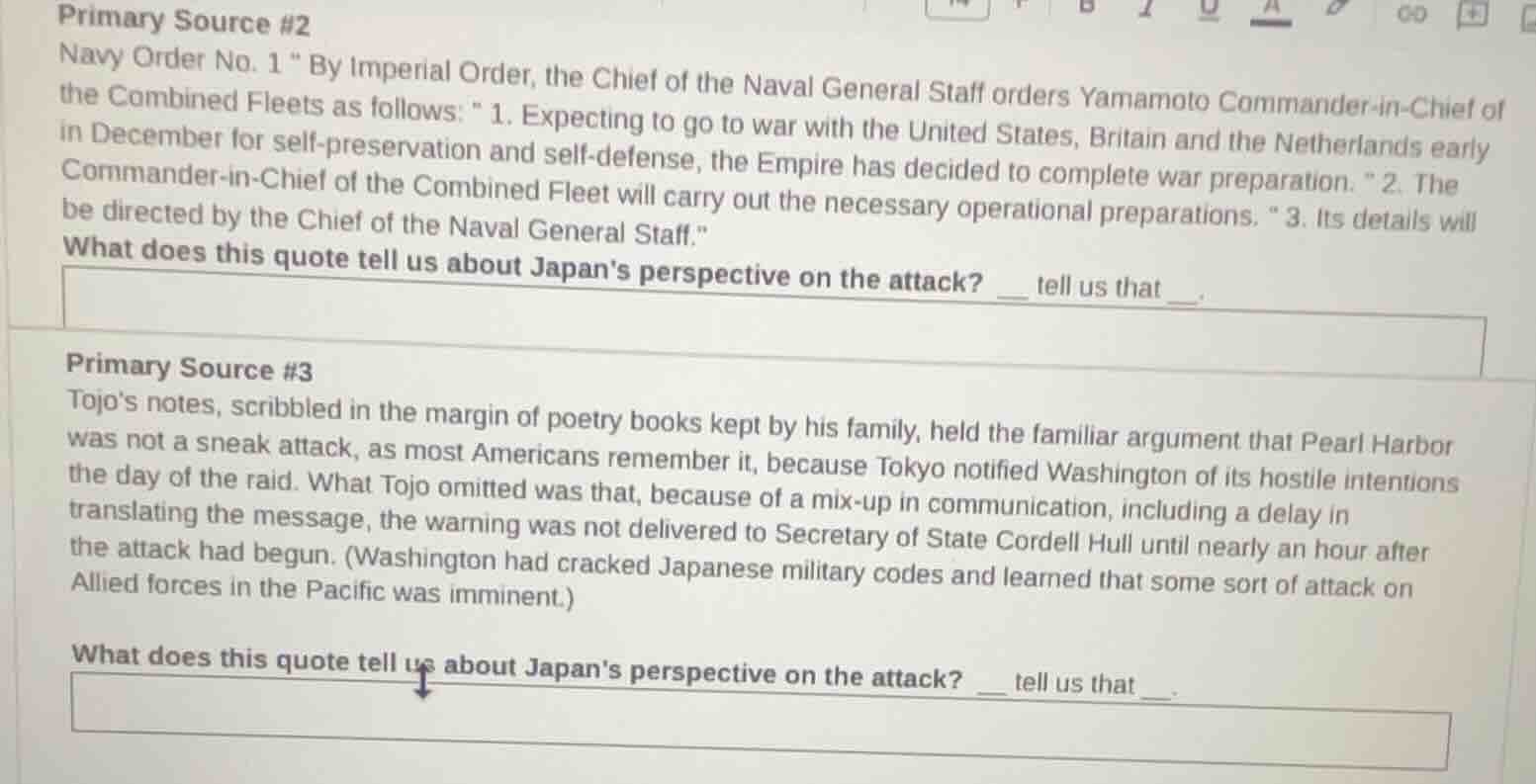
primary source #2
navy order no. 1 “ by imperial order, the chief of the naval general staff orders yamamoto commander - in - chief of
the combined fleets as follows: ” 1. expecting to go to war with the united states, britain and the netherlands early
in december for self - preservation and self - defense, the empire has decided to complete war preparation. ” 2. the
commander - in - chief of the combined fleet will carry out the necessary operational preparations. “ 3. its details will
be directed by the chief of the naval general staff.”
what does this quote tell us about japan’s perspective on the attack? tell us that .
primary source #3
tojo’s notes, scribbled in the margin of poetry books kept by his family, held the familiar argument that pearl harbor
was not a sneak attack, as most americans remember it, because tokyo notified washington of its hostile intentions
the day of the raid. what tojo omitted was that, because of a mix - up in communication, including a delay in
translating the message, the warning was not delivered to secretary of state cordell hull until nearly an hour after
the attack had begun. (washington had cracked japanese military codes and learned that some sort of attack on
allied forces in the pacific was imminent.)
what does this quote tell us about japan’s perspective on the attack? tell us that .
For Primary Source #2: The order frames the upcoming war with the U.S., Britain, and the Netherlands as a matter of self-preservation and self-defense for Japan, positioning the attack as a defensive, pre-emptive measure for the empire's survival.
For Primary Source #3: Tojo's perspective frames the Pearl Harbor attack as not a sneak attack, claiming Japan intended to notify Washington of hostile intentions, and blames communication delays for the warning arriving after the attack started, ignoring that the delayed notification made it effectively unannounced.

Snap & solve any problem in the app
Get step-by-step solutions on Sovi AI
Photo-based solutions with guided steps
Explore more problems and detailed explanations
- Primary Source #2 tells us that Japan framed its upcoming attack (and war with the U.S., Britain, Netherlands) as an act of self-preservation and self-defense, positioning the conflict as necessary for the empire's survival.
- Primary Source #3 tells us that Japan (via Tojo) argued the Pearl Harbor attack was not a sneak attack, claiming it tried to notify Washington of hostile intentions, and blamed communication delays for the warning arriving after the attack began.