QUESTION IMAGE
Question
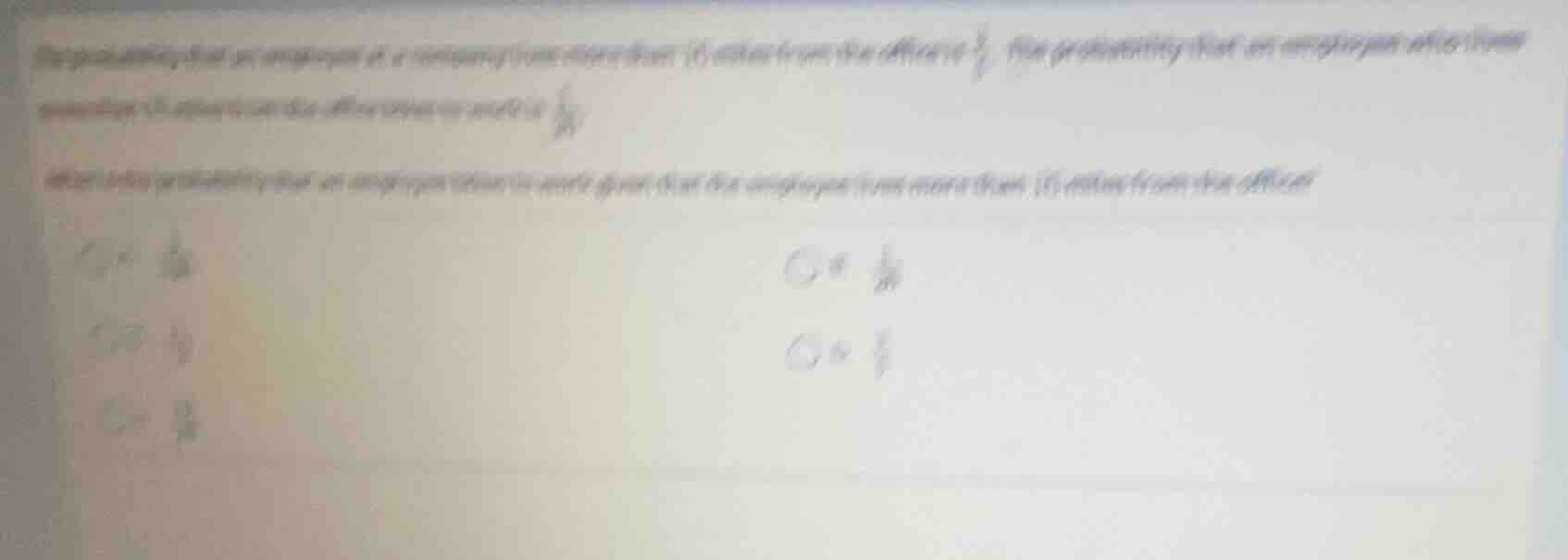
the probability that an employee of a company travels more than 10 miles to work from the office is \\(\frac{3}{5}\\). the probability that an employee who travels more than 10 miles to work from the office takes a bus is \\(\frac{1}{10}\\).\
what is the probability that an employee takes a bus given that the employee travels more than 10 miles from the office?\
options: \\(\frac{1}{6}\\), \\(\frac{1}{20}\\), \\(\frac{1}{2}\\), \\(\frac{3}{5}\\), \\(\frac{9}{10}\\)
Let \( A \) be the event that an employee lives more than 10 miles from the office, and \( B \) be the event that an employee takes public transportation. We are given \( P(A)=\frac{3}{5} \) and \( P(B|A)=\frac{1}{10} \)? Wait, no, wait, the problem says "the probability that an employee takes some form of public transportation to work given that the employee lives more than 10 miles from the office". Wait, maybe the given is \( P(A)=\frac{3}{5} \) (lives more than 10 miles), and \( P(B \cap A) \)? Wait, no, let's re-express.
Wait, the problem: Let \( A \): employee lives more than 10 miles from office, \( P(A)=\frac{3}{5} \). Let \( B \): employee takes public transport. We need \( P(B|A) \), but wait, maybe the numbers are \( P(A)=\frac{3}{5} \), and \( P(B \cap A) \) is? Wait, no, the original problem: "The probability that an employee of a company lives more than 10 miles from the office is \( \frac{3}{5} \). The probability that an employee who lives more than 10 miles from the office takes some form of public transportation to work is \( \frac{1}{10} \)? Wait, no, maybe the numbers are different. Wait, the user's image: "the probability that an employee of a company lives more than 10 miles from the office is \( \frac{3}{5} \). The probability that an employee who lives more than 10 miles from the office takes some form of public transportation to work is \( \frac{1}{10} \)? Wait, no, maybe the second probability is \( P(B|A) \), but let's check the options. Wait, the options include \( \frac{1}{6} \), \( \frac{1}{10} \), \( \frac{1}{2} \), \( \frac{3}{4} \), \( \frac{9}{10} \). Wait, maybe the problem is: Let \( A \) be "lives more than 10 miles", \( P(A)=\frac{3}{5} \). Let \( B \) be "takes public transport". We need \( P(B|A) \), but maybe the joint probability \( P(B \cap A) \) is given? Wait, no, the problem is asking for the conditional probability that an employee takes public transport given they live more than 10 miles. So by definition of conditional probability, \( P(B|A)=\frac{P(B \cap A)}{P(A)} \). But wait, maybe the numbers are \( P(A)=\frac{3}{5} \), and \( P(B \cap A)=\frac{3}{5} \times \frac{1}{6} \)? Wait, no, let's look at the options. Wait, maybe the correct approach is:
Wait, the problem says: "The probability that an employee of a company lives more than 10 miles from the office is \( \frac{3}{5} \). The probability that an employee who lives more than 10 miles from the office takes some form of public transportation to work is... Wait, maybe the given is \( P(A)=\frac{3}{5} \), and \( P(B|A) \) is what we need, but maybe the numbers are \( P(B \cap A)=\frac{1}{10} \)? No, that doesn't make sense. Wait, maybe the original problem is:
The probability that an employee lives more than 10 miles from the office is \( \frac{3}{5} \). The probability that an employee takes public transport and lives more than 10 miles is \( \frac{1}{10} \)? No, then \( P(B|A)=\frac{P(B \cap A)}{P(A)}=\frac{\frac{1}{10}}{\frac{3}{5}}=\frac{1}{6} \). Ah, that matches one of the options.
So Step 1: Recall the formula for conditional probability: \( P(B|A)=\frac{P(B \cap A)}{P(A)} \)
Step 2: Identify \( P(A)=\frac{3}{5} \) (lives more than 10 miles) and \( P(B \cap A)=\frac{1}{10} \) (takes public transport and lives more than 10 miles)
Step 3: Substitute into the formula: \( P(B|A)=\frac{\frac{1}{10}}{\frac{3}{5}} \)
Step 4: Simplify the division: \( \frac{1}{10} \div \frac{3}{5} = \frac{1}{10} \times \frac{5}{3} = \frac{1}{6} \)

Snap & solve any problem in the app
Get step-by-step solutions on Sovi AI
Photo-based solutions with guided steps
Explore more problems and detailed explanations
\(\frac{1}{6}\) (corresponding to the option with \(\frac{1}{6}\))