QUESTION IMAGE
Question
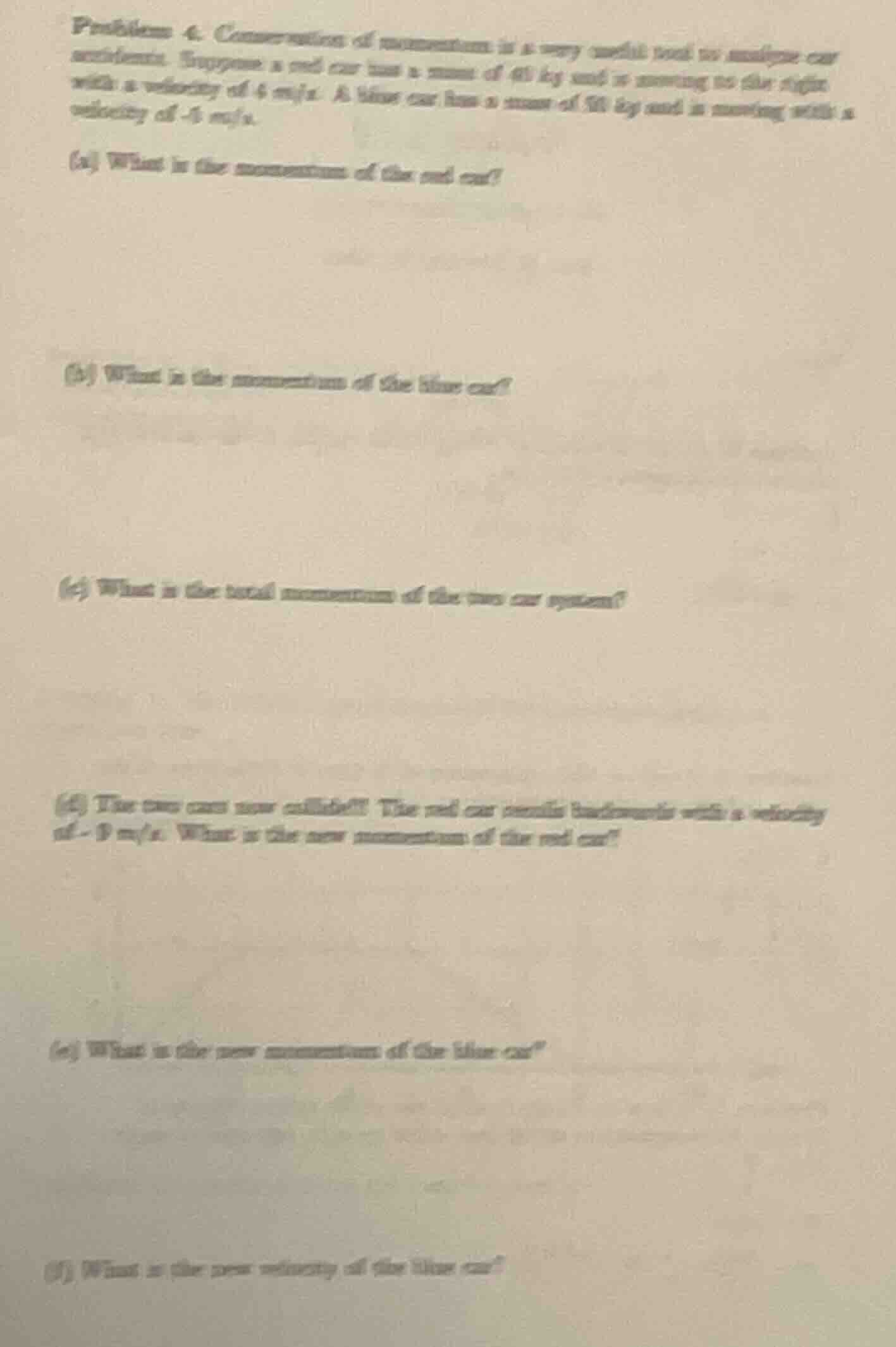
problem 4. conservation of momentum is a very useful tool to analyze car accidents. suppose a red car has a mass of 40 kg and is moving to the right with a velocity of 4 m/s. a blue car has a mass of 50 kg and is moving with a velocity of -4 m/s.
(a) what is the momentum of the red car?
(b) what is the momentum of the blue car?
(c) what is the total momentum of the two car system?
(d) the two cars now collide! the red car recoils backwards with a velocity of -9 m/s. what is the new momentum of the red car?
(e) what is the new momentum of the blue car?
(f) what is the new velocity of the blue car?
Step1: Define momentum formula
Momentum is calculated as $p = m \times v$, where $m$ = mass, $v$ = velocity.
Step2: Calculate red car's initial momentum
Substitute $m=40\ \text{kg}$, $v=4\ \text{m/s}$
$p_{\text{red, initial}} = 40 \times 4 = 160\ \text{kg·m/s}$
Step3: Calculate blue car's initial momentum
Substitute $m=50\ \text{kg}$, $v=-4\ \text{m/s}$
$p_{\text{blue, initial}} = 50 \times (-4) = -200\ \text{kg·m/s}$
Step4: Calculate total initial system momentum
Sum the two initial momenta
$p_{\text{total, initial}} = 160 + (-200) = -40\ \text{kg·m/s}$
Step5: Calculate red car's final momentum
Substitute $m=40\ \text{kg}$, $v=-9\ \text{m/s}$
$p_{\text{red, final}} = 40 \times (-9) = -360\ \text{kg·m/s}$
Step6: Calculate blue car's final momentum
Use conservation of momentum: $p_{\text{total, initial}} = p_{\text{total, final}}$
$p_{\text{blue, final}} = p_{\text{total, initial}} - p_{\text{red, final}} = -40 - (-360) = 320\ \text{kg·m/s}$
Step7: Calculate blue car's final velocity
Rearrange $p = m \times v$ to $v = \frac{p}{m}$
$v_{\text{blue, final}} = \frac{320}{50} = 6.4\ \text{m/s}$

Snap & solve any problem in the app
Get step-by-step solutions on Sovi AI
Photo-based solutions with guided steps
Explore more problems and detailed explanations
(a) $160\ \text{kg·m/s}$
(b) $-200\ \text{kg·m/s}$
(c) $-40\ \text{kg·m/s}$
(d) $-360\ \text{kg·m/s}$
(e) $320\ \text{kg·m/s}$
(f) $6.4\ \text{m/s}$