QUESTION IMAGE
Question
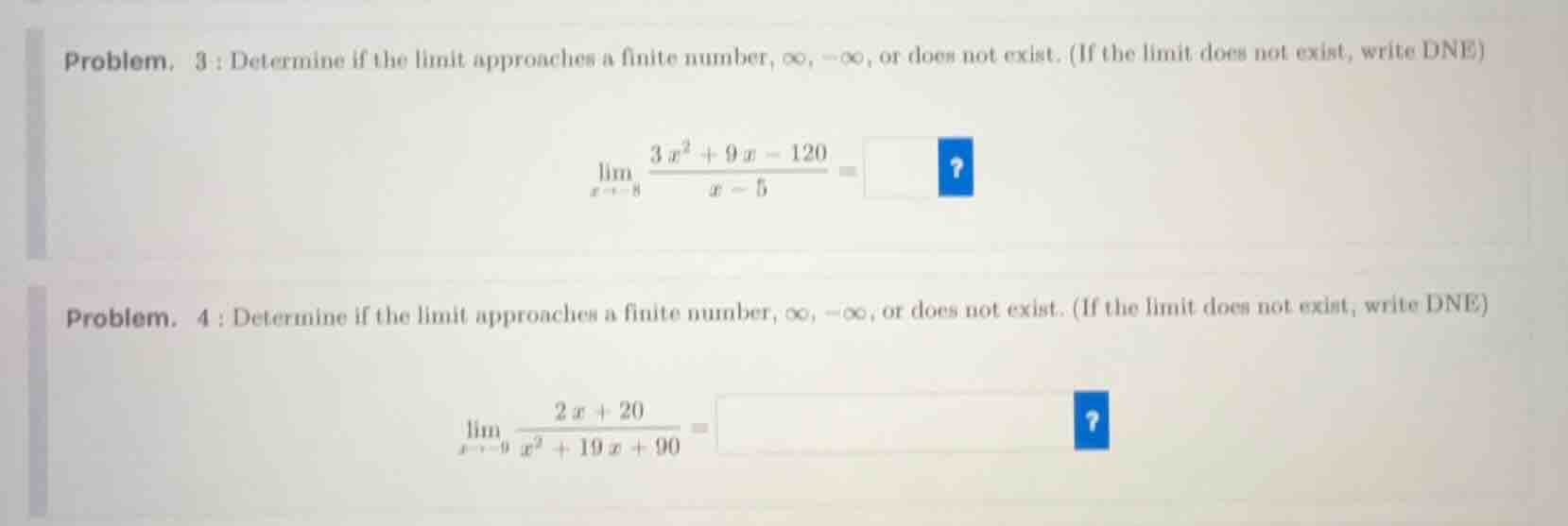
problem. 3 : determine if the limit approaches a finite number, \\(\infty\\), \\(-\infty\\), or does not exist. (if the limit does not exist, write dne)\\(\lim_{x \to -8} \frac{3x^2 + 9x - 120}{x - 5} = \\)\
problem. 4 : determine if the limit approaches a finite number, \\(\infty\\), \\(-\infty\\), or does not exist. (if the limit does not exist, write dne)\\(\lim_{x \to -9} \frac{2x + 20}{x^2 + 19x + 90} = \\)
Problem 3
Step1: Factor the numerator
First, factor the quadratic expression in the numerator \(3x^2 + 9x - 120\). We can factor out a 3 first: \(3(x^2 + 3x - 40)\). Then factor the quadratic inside the parentheses: \(x^2 + 3x - 40=(x + 8)(x - 5)\). So the numerator becomes \(3(x + 8)(x - 5)\).
The limit is now \(\lim_{x\to - 8}\frac{3(x + 8)(x - 5)}{x - 5}\)
Step2: Cancel common factors
We can cancel out the common factor of \(x - 5\) (assuming \(x
eq5\), which is true as \(x\to - 8\)): \(\lim_{x\to - 8}3(x + 8)\)
Step3: Substitute \(x=-8\)
Now substitute \(x = - 8\) into the expression \(3(x + 8)\): \(3(-8 + 8)=3\times0 = 0\)
Step1: Factor the denominator
First, factor the quadratic expression in the denominator \(x^2+19x + 90\). We need two numbers that multiply to 90 and add up to 19. The numbers are 9 and 10. So \(x^2 + 19x+90=(x + 9)(x + 10)\)
The limit is \(\lim_{x\to - 9}\frac{2x + 20}{(x + 9)(x + 10)}\)
Step2: Analyze the behavior as \(x\to - 9\)
As \(x\to - 9\), the numerator \(2x+20=2(-9)+20=-18 + 20 = 2\) (a non - zero finite number). The denominator: \((x + 9)\to0\) and \((x + 10)\to - 9+10 = 1\)
We can rewrite the limit as \(\lim_{x\to - 9}\frac{2}{(x + 9)(x + 10)}=\lim_{x\to - 9}\frac{2}{x + 10}\cdot\frac{1}{x + 9}\)
Step3: Analyze the one - sided limits
- Left - hand limit (\(x\to - 9^{-}\)):
As \(x\to - 9^{-}\), \(x+9\to0^{-}\) (approaches 0 from the left, negative side) and \(x + 10\to1\). So \(\frac{2}{x + 10}\to2\) and \(\frac{1}{x + 9}\to-\infty\). Then the product \(\frac{2}{x + 10}\cdot\frac{1}{x + 9}\to2\times(-\infty)=-\infty\)
- Right - hand limit (\(x\to - 9^{+}\)):
As \(x\to - 9^{+}\), \(x + 9\to0^{+}\) (approaches 0 from the right, positive side) and \(x + 10\to1\). So \(\frac{2}{x + 10}\to2\) and \(\frac{1}{x + 9}\to+\infty\). Then the product \(\frac{2}{x + 10}\cdot\frac{1}{x + 9}\to2\times(+\infty)=+\infty\)
Since the left - hand limit is \(-\infty\) and the right - hand limit is \(+\infty\), the two - sided limit does not exist.

Snap & solve any problem in the app
Get step-by-step solutions on Sovi AI
Photo-based solutions with guided steps
Explore more problems and detailed explanations
\(0\)