QUESTION IMAGE
Question
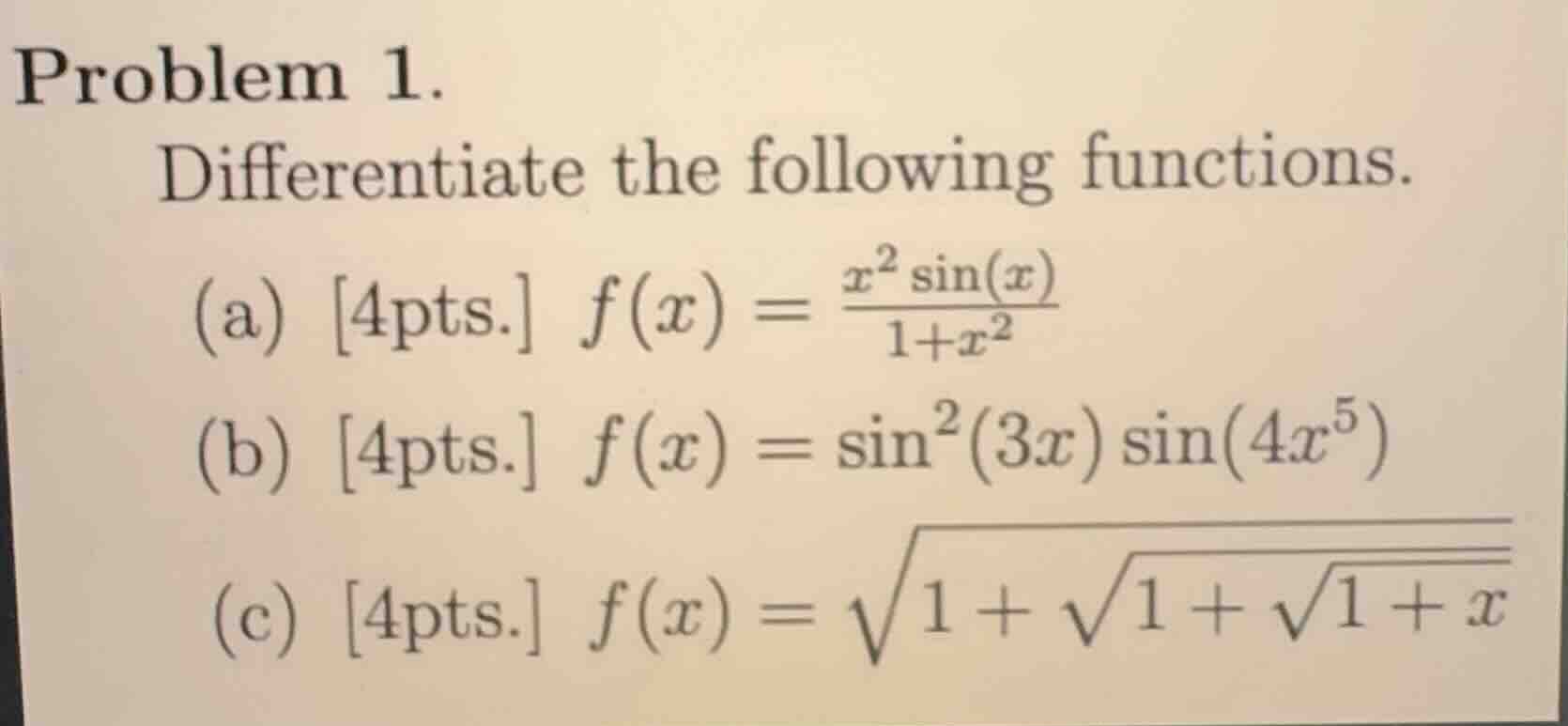
problem 1.
differentiate the following functions.
(a) 4pts. $f(x) = \frac{x^2 \sin(x)}{1 + x^2}$
(b) 4pts. $f(x) = \sin^2(3x) \sin(4x^5)$
(c) 4pts. $f(x) = \sqrt{1 + \sqrt{1 + \sqrt{1 + x}}}$
Part (a)
Step1: Identify quotient rule
We use the quotient rule: if \( f(x)=\frac{u(x)}{v(x)} \), then \( f^\prime(x)=\frac{u^\prime(x)v(x)-u(x)v^\prime(x)}{v(x)^2} \). Here, \( u(x) = x^2\sin(x) \) and \( v(x)=1 + x^2 \).
Step2: Differentiate \( u(x) \) (product rule)
Product rule: \( (ab)^\prime=a^\prime b+ab^\prime \). For \( u(x)=x^2\sin(x) \), \( a = x^2 \), \( b=\sin(x) \). So \( u^\prime(x)=2x\sin(x)+x^2\cos(x) \).
Step3: Differentiate \( v(x) \)
\( v(x)=1 + x^2 \), so \( v^\prime(x)=2x \).
Step4: Apply quotient rule
\[
\]
Step1: Identify product and chain rules
We have \( f(x)=u(x)v(x) \) where \( u(x)=\sin^2(3x) \) and \( v(x)=\sin(4x^5) \). First, use product rule: \( f^\prime(x)=u^\prime(x)v(x)+u(x)v^\prime(x) \). Then use chain rule for \( u^\prime \) and \( v^\prime \).
Step2: Differentiate \( u(x) \) (chain rule)
Let \( u=\sin(3x) \), so \( u(x)=u^2 \). Then \( u^\prime(x)=2u\cdot u^\prime=2\sin(3x)\cdot 3\cos(3x)=6\sin(3x)\cos(3x) \).
Step3: Differentiate \( v(x) \) (chain rule)
Let \( v=\sin(w) \), \( w = 4x^5 \). Then \( v^\prime(x)=\cos(w)\cdot w^\prime=\cos(4x^5)\cdot 20x^4=20x^4\cos(4x^5) \).
Step4: Apply product rule
\[
\]
Step1: Let \( y = f(x)=\sqrt{1+\sqrt{1+\sqrt{1 + x}}} \). Use chain rule multiple times. Let \( u = 1+\sqrt{1+\sqrt{1 + x}} \), so \( y=\sqrt{u}=u^{\frac{1}{2}} \). Then \( y^\prime=\frac{1}{2}u^{-\frac{1}{2}}\cdot u^\prime \).
Step2: Differentiate \( u \). Let \( v = 1+\sqrt{1 + x} \), so \( u = 1+\sqrt{v}=1 + v^{\frac{1}{2}} \). Then \( u^\prime=\frac{1}{2}v^{-\frac{1}{2}}\cdot v^\prime \).
Step3: Differentiate \( v \). Let \( w = 1 + x \), so \( v = 1+\sqrt{w}=1 + w^{\frac{1}{2}} \). Then \( v^\prime=\frac{1}{2}w^{-\frac{1}{2}}\cdot w^\prime \).
Step4: Differentiate \( w \)
\( w = 1 + x \), so \( w^\prime=1 \).
Step5: Back - substitute
First, \( v^\prime=\frac{1}{2}(1 + x)^{-\frac{1}{2}}\cdot1=\frac{1}{2\sqrt{1 + x}} \).
Then, \( u^\prime=\frac{1}{2}(1+\sqrt{1 + x})^{-\frac{1}{2}}\cdot\frac{1}{2\sqrt{1 + x}}=\frac{1}{4\sqrt{1+\sqrt{1 + x}}\sqrt{1 + x}} \).
Then, \( y^\prime=\frac{1}{2}(1+\sqrt{1+\sqrt{1 + x}})^{-\frac{1}{2}}\cdot\frac{1}{4\sqrt{1+\sqrt{1 + x}}\sqrt{1 + x}} \)
Simplify:
\[
f^\prime(x)=\frac{1}{8\sqrt{1+\sqrt{1+\sqrt{1 + x}}}\sqrt{1+\sqrt{1 + x}}\sqrt{1 + x}}
\]

Snap & solve any problem in the app
Get step-by-step solutions on Sovi AI
Photo-based solutions with guided steps
Explore more problems and detailed explanations
\( \frac{2x\sin(x)+x^2\cos(x)+x^4\cos(x)}{(1 + x^2)^2} \) (or factored form as above)