QUESTION IMAGE
Question
problem 3
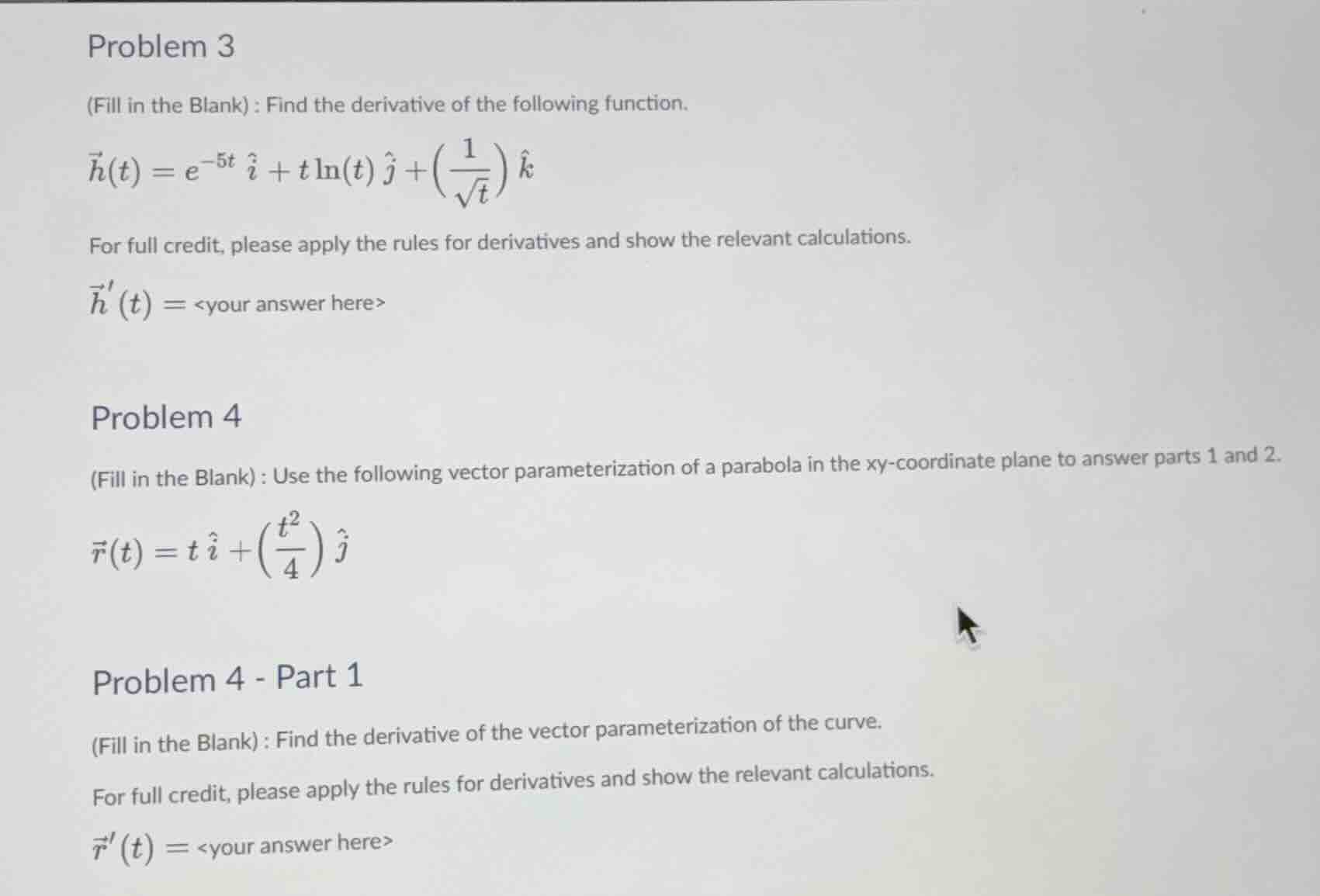
(fill in the blank) : find the derivative of the following function.
\\(\vec{h}(t) = e^{-5t} \hat{i} + t\ln(t) \hat{j} + \left( \frac{1}{\sqrt{t}} \
ight) \hat{k}\\)
for full credit, please apply the rules for derivatives and show the relevant calculations.
\\(\vec{h}(t) = \text{<your answer here>}\\)
problem 4
(fill in the blank) : use the following vector parameterization of a parabola in the xy - coordinate plane to answer parts 1 and 2.
\\(\vec{r}(t) = t \hat{i} + \left( \frac{t^2}{4} \
ight) \hat{j}\\)
problem 4 - part 1
(fill in the blank) : find the derivative of the vector parameterization of the curve.
for full credit, please apply the rules for derivatives and show the relevant calculations.
\\(\vec{r}(t) = \text{<your answer here>}\\)
Problem 3
Step1: Derive \( e^{-5t} \hat{i} \)
Using chain rule, derivative of \( e^{u} \) is \( e^{u}u' \). Let \( u = -5t \), so \( u' = -5 \). Thus, derivative is \( -5e^{-5t} \hat{i} \).
Step2: Derive \( t\ln(t) \hat{j} \)
Use product rule: \( (uv)' = u'v + uv' \), where \( u = t \), \( v = \ln(t) \). \( u' = 1 \), \( v' = \frac{1}{t} \). So \( (t\ln(t))' = 1 \cdot \ln(t) + t \cdot \frac{1}{t} = \ln(t) + 1 \). Thus, derivative is \( (\ln(t) + 1) \hat{j} \).
Step3: Derive \( \frac{1}{\sqrt{t}} \hat{k} \)
Rewrite \( \frac{1}{\sqrt{t}} = t^{-\frac{1}{2}} \). Use power rule: \( (t^n)' = nt^{n - 1} \). So \( (t^{-\frac{1}{2}})' = -\frac{1}{2}t^{-\frac{3}{2}} = -\frac{1}{2t^{\frac{3}{2}}} = -\frac{1}{2t\sqrt{t}} \). Thus, derivative is \( -\frac{1}{2t\sqrt{t}} \hat{k} \).
Step1: Derive \( t \hat{i} \)
Use power rule: \( (t^1)' = 1 \cdot t^{0} = 1 \). So derivative is \( 1 \hat{i} \).
Step2: Derive \( \frac{t^2}{4} \hat{j} \)
Use power rule: \( (\frac{t^2}{4})' = \frac{2t}{4} = \frac{t}{2} \). So derivative is \( \frac{t}{2} \hat{j} \).

Snap & solve any problem in the app
Get step-by-step solutions on Sovi AI
Photo-based solutions with guided steps
Explore more problems and detailed explanations
\( \vec{h}'(t) = -5e^{-5t} \hat{i} + (\ln(t) + 1) \hat{j} - \frac{1}{2t\sqrt{t}} \hat{k} \) (or equivalent forms like \( -5e^{-5t} \hat{i} + (\ln(t) + 1) \hat{j} - \frac{1}{2t^{\frac{3}{2}}} \hat{k} \))