QUESTION IMAGE
Question
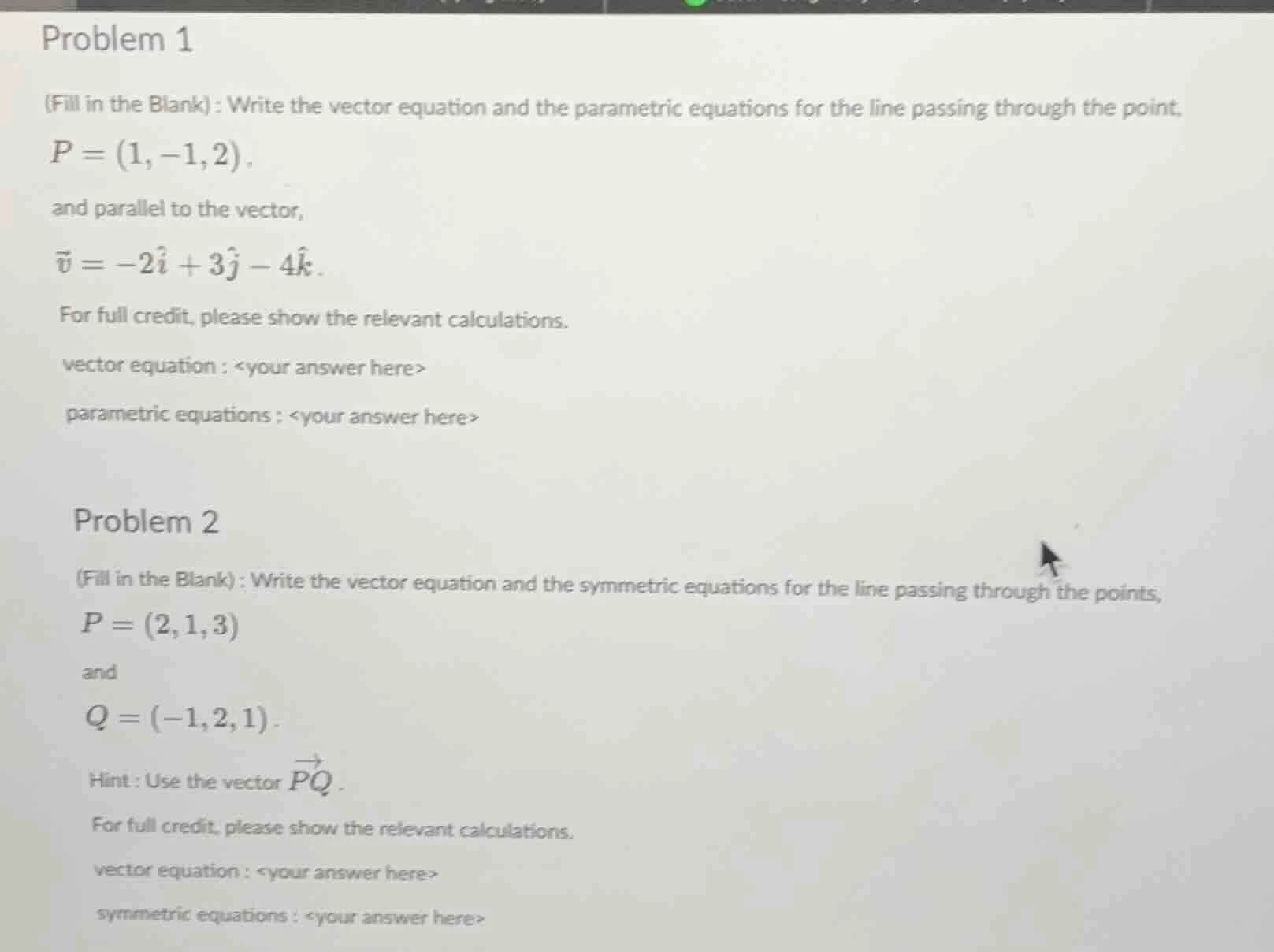
problem 1
(fill in the blank) : write the vector equation and the parametric equations for the line passing through the point,
$p = (1, -1, 2)$,
and parallel to the vector,
$\vec{v} = -2\hat{i} + 3\hat{j} - 4\hat{k}$.
for full credit, please show the relevant calculations.
vector equation : <your answer here>
parametric equations : <your answer here>
problem 2
(fill in the blank) : write the vector equation and the symmetric equations for the line passing through the points,
$p = (2, 1, 3)$
and
$q = (-1, 2, 1)$.
hint : use the vector $\overrightarrow{pq}$.
for full credit, please show the relevant calculations.
vector equation : <your answer here>
symmetric equations : <your answer here>
Problem 1
Step1: Recall vector line formula
A line through point $\vec{r_0} = \langle x_0,y_0,z_0
angle$ parallel to $\vec{v} = \langle a,b,c
angle$ has vector equation $\vec{r}(t) = \vec{r_0} + t\vec{v}$.
Step2: Substitute given values
Given $\vec{r_0} = \langle 1,-1,2
angle$, $\vec{v} = \langle -2,3,-4
angle$:
$\vec{r}(t) = \langle 1,-1,2
angle + t\langle -2,3,-4
angle$
Or in $\hat{i},\hat{j},\hat{k}$ form:
$\vec{r}(t) = (1 - 2t)\hat{i} + (-1 + 3t)\hat{j} + (2 - 4t)\hat{k}$
Step3: Derive parametric equations
Split the vector equation into components:
$x = 1 - 2t$, $y = -1 + 3t$, $z = 2 - 4t$
Problem 2
Step1: Compute direction vector $\overrightarrow{PQ}$
$\overrightarrow{PQ} = \langle x_Q - x_P, y_Q - y_P, z_Q - z_P
angle$
$\overrightarrow{PQ} = \langle -1-2, 2-1, 1-3
angle = \langle -3,1,-2
angle$
Step2: Write vector equation
Using point $P = \langle 2,1,3
angle$ and $\overrightarrow{PQ}$:
$\vec{r}(t) = \langle 2,1,3
angle + t\langle -3,1,-2
angle$
Or in $\hat{i},\hat{j},\hat{k}$ form:
$\vec{r}(t) = (2 - 3t)\hat{i} + (1 + t)\hat{j} + (3 - 2t)\hat{k}$
Step3: Derive symmetric equations
From parametric equations $x=2-3t$, $y=1+t$, $z=3-2t$, solve for $t$:
$t = \frac{x-2}{-3}$, $t = y-1$, $t = \frac{z-3}{-2}$
Set equal: $\frac{x-2}{-3} = y-1 = \frac{z-3}{-2}$

Snap & solve any problem in the app
Get step-by-step solutions on Sovi AI
Photo-based solutions with guided steps
Explore more problems and detailed explanations
Problem 1
Vector equation: $\boldsymbol{\vec{r}(t) = \langle 1,-1,2
angle + t\langle -2,3,-4
angle}$ (or $\boldsymbol{\vec{r}(t) = (1 - 2t)\hat{i} + (-1 + 3t)\hat{j} + (2 - 4t)\hat{k}}$)
Parametric equations: $\boldsymbol{x = 1 - 2t,\ y = -1 + 3t,\ z = 2 - 4t}$
Problem 2
Vector equation: $\boldsymbol{\vec{r}(t) = \langle 2,1,3
angle + t\langle -3,1,-2
angle}$ (or $\boldsymbol{\vec{r}(t) = (2 - 3t)\hat{i} + (1 + t)\hat{j} + (3 - 2t)\hat{k}}$)
Symmetric equations: $\boldsymbol{\frac{x-2}{-3} = y-1 = \frac{z-3}{-2}}$ (equivalent to $\boldsymbol{\frac{2-x}{3} = y-1 = \frac{3-z}{2}}$)