QUESTION IMAGE
Question
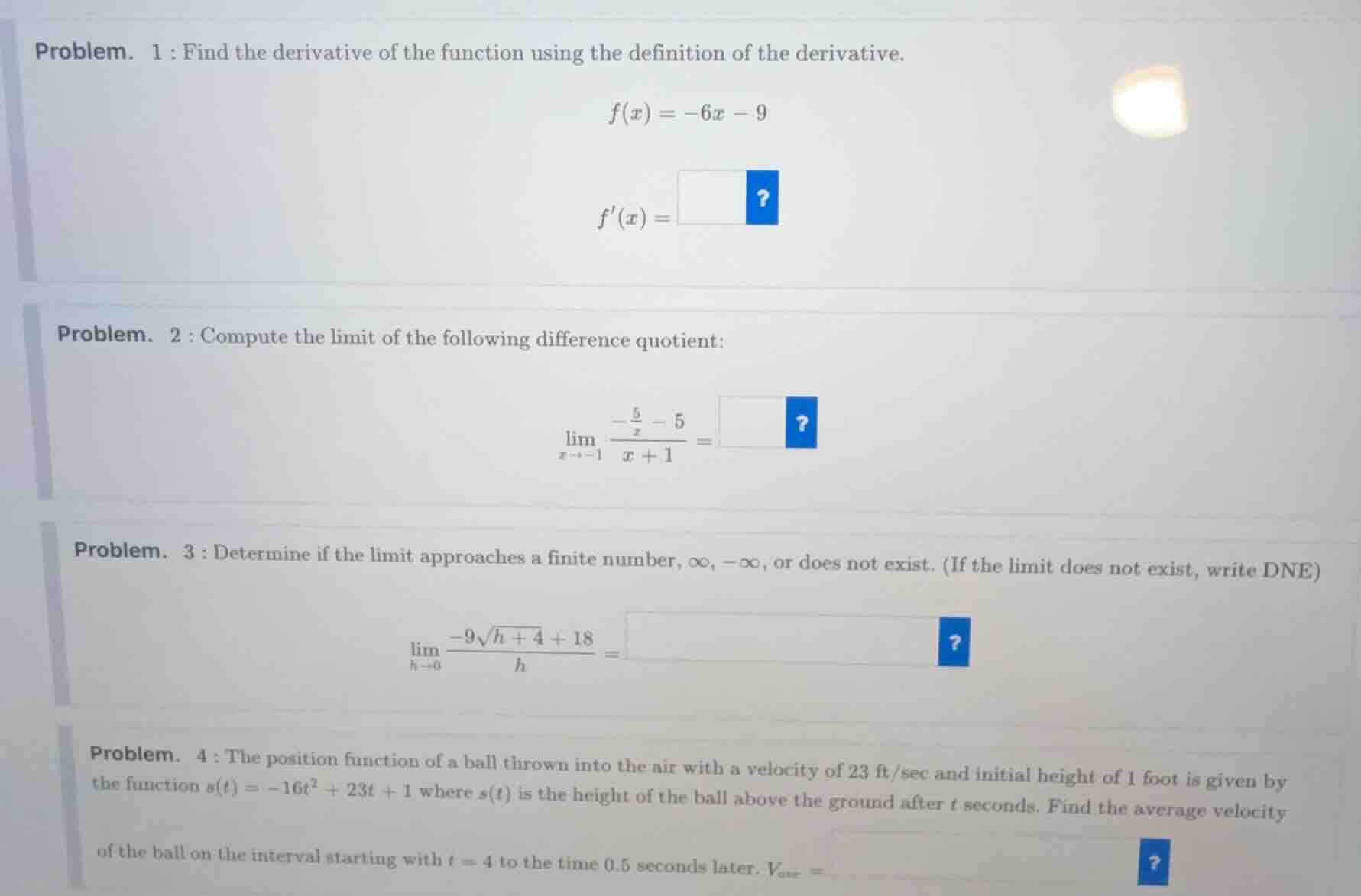
problem. 1 : find the derivative of the function using the definition of the derivative.
$f(x) = -6x - 9$
$f(x) = $
problem. 2 : compute the limit of the following difference quotient:
$limlimits_{x \to -1} \frac{\frac{-5}{x} - 5}{x + 1} = $
problem. 3 : determine if the limit approaches a finite number, $\infty$, $-\infty$, or does not exist. (if the limit does not exist, write dne)
$limlimits_{h \to 0} \frac{-9\sqrt{h + 4} + 18}{h} = $
problem. 4 : the position function of a ball thrown into the air with a velocity of 23 ft/sec and initial height of 1 foot is given by the function $s(t) = -16t^2 + 23t + 1$ where $s(t)$ is the height of the ball above the ground after $t$ seconds. find the average velocity of the ball on the interval starting with $t = 4$ to the time 0.5 seconds later. $v_{ave} = $
Problem 1
Step1: Recall the definition of derivative
The definition of the derivative is \( f'(x) = \lim_{h \to 0} \frac{f(x + h) - f(x)}{h} \). First, find \( f(x + h) \) for \( f(x) = -6x - 9 \).
\( f(x + h) = -6(x + h) - 9 = -6x - 6h - 9 \)
Step2: Substitute into the derivative formula
Substitute \( f(x + h) \) and \( f(x) \) into the formula:
\( \frac{f(x + h) - f(x)}{h} = \frac{(-6x - 6h - 9) - (-6x - 9)}{h} \)
Step3: Simplify the numerator
Simplify the numerator:
\( (-6x - 6h - 9) - (-6x - 9) = -6x - 6h - 9 + 6x + 9 = -6h \)
Step4: Simplify the fraction and take the limit
Now the fraction becomes \( \frac{-6h}{h} = -6 \) (for \( h
eq 0 \)). Then take the limit as \( h \to 0 \):
\( \lim_{h \to 0} -6 = -6 \)
Step1: Simplify the numerator
First, simplify the numerator \( \frac{-5}{x} - 5 \). Find a common denominator:
\( \frac{-5}{x} - 5 = \frac{-5 - 5x}{x} = \frac{-5(1 + x)}{x} \)
Step2: Substitute into the limit expression
The limit is \( \lim_{x \to -1} \frac{\frac{-5(1 + x)}{x}}{x + 1} \). Notice that \( x + 1 = -( -x - 1) \), but we can rewrite the fraction:
\( \frac{\frac{-5(1 + x)}{x}}{x + 1} = \frac{-5(1 + x)}{x(x + 1)} \) (for \( x
eq -1 \))
Step3: Cancel the common factor
Cancel out \( (x + 1) \) (since \( x \to -1 \) but \( x
eq -1 \) in the limit process):
\( \frac{-5(1 + x)}{x(x + 1)} = \frac{-5}{x} \)
Step4: Evaluate the limit
Now evaluate \( \lim_{x \to -1} \frac{-5}{x} \):
Substitute \( x = -1 \): \( \frac{-5}{-1} = 5 \)
Step1: Rationalize the numerator
The limit is \( \lim_{h \to 0} \frac{-9\sqrt{h + 4} + 18}{h} \). Multiply the numerator and denominator by the conjugate of the numerator, which is \( -9\sqrt{h + 4} - 18 \) (wait, actually the conjugate of \( -9\sqrt{h + 4} + 18 \) is \( -9\sqrt{h + 4} - 18 \)? No, the conjugate of \( a + b \) is \( a - b \), so here \( a = -9\sqrt{h + 4} \), \( b = 18 \), so conjugate is \( -9\sqrt{h + 4} - 18 \)? Wait, no: \( (-9\sqrt{h + 4} + 18) \) can be written as \( 18 - 9\sqrt{h + 4} \), so conjugate is \( 18 + 9\sqrt{h + 4} \). Let's do that:
Multiply numerator and denominator by \( 18 + 9\sqrt{h + 4} \):
\( \frac{(-9\sqrt{h + 4} + 18)(18 + 9\sqrt{h + 4})}{h(18 + 9\sqrt{h + 4})} \)
Step2: Expand the numerator
Expand the numerator using \( (a - b)(a + b) = a^2 - b^2 \), where \( a = 18 \), \( b = 9\sqrt{h + 4} \):
\( 18^2 - (9\sqrt{h + 4})^2 = 324 - 81(h + 4) \)
Simplify: \( 324 - 81h - 324 = -81h \)
Step3: Simplify the fraction
Now the fraction becomes:
\( \frac{-81h}{h(18 + 9\sqrt{h + 4})} \) (for \( h
eq 0 \))
Step4: Cancel the common factor and evaluate the limit
Cancel out \( h \):
\( \frac{-81}{18 + 9\sqrt{h + 4}} \)
Now take the limit as \( h \to 0 \):
Substitute \( h = 0 \): \( \frac{-81}{18 + 9\sqrt{0 + 4}} = \frac{-81}{18 + 9 \times 2} = \frac{-81}{18 + 18} = \frac{-81}{36} = -\frac{9}{4} \)

Snap & solve any problem in the app
Get step-by-step solutions on Sovi AI
Photo-based solutions with guided steps
Explore more problems and detailed explanations
\( -6 \)