QUESTION IMAGE
Question
problem 4
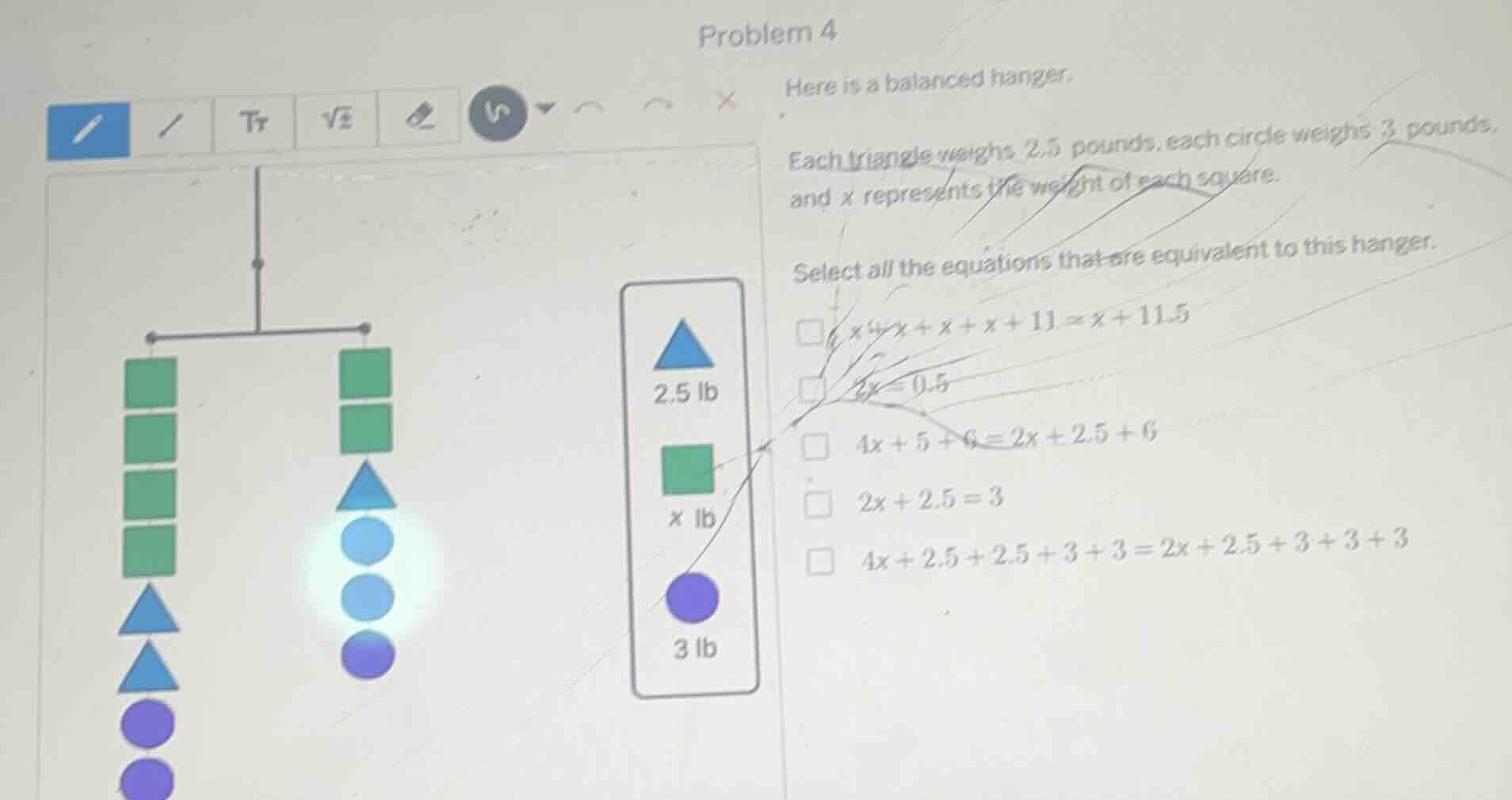
here is a balanced hanger.
each triangle weighs 2.5 pounds, each circle weighs 3 pounds, and x represents the weight of each square.
select all the equations that are equivalent to this hanger.
□ ( x + x + x + x + 11 = x + 11.5 )
□ ( 2x = 0.5 )
□ ( 4x + 5 + 6 = 2x + 2.5 + 6 )
□ ( 2x + 2.5 = 3 )
□ ( 4x + 2.5 + 2.5 + 3 + 3 = 2x + 2.5 + 3 + 3 + 3 )
To solve this, we first determine the weights on each side of the balanced hanger.
Step 1: Analyze the hanger's left and right sides
- Left side: 4 squares (\(4x\)), 2 triangles (\(2 \times 2.5 = 5\) pounds), and 2 circles (\(2 \times 3 = 6\) pounds). Total weight: \(4x + 5 + 6\).
- Right side: 2 squares (\(2x\)), 1 triangle (\(2.5\) pounds), and 3 circles (\(3 \times 3 = 9\) pounds? Wait, no—wait, looking at the diagram, the right side has 2 squares, 1 triangle, and 3 circles? Wait, no, let’s re-express:
Wait, the left side (from the diagram) has 4 squares, 2 triangles, 2 circles. The right side has 2 squares, 1 triangle, 3 circles. Wait, no, let's check the original problem again. Wait, the problem says "each triangle weighs 2.5 pounds, each circle weighs 3 pounds, and \(x\) is the weight of each square."
Wait, let's re-express the hanger:
- Left side: 4 squares (\(4x\)), 2 triangles (\(2 \times 2.5 = 5\)), 2 circles (\(2 \times 3 = 6\)). So total: \(4x + 5 + 6\).
- Right side: 2 squares (\(2x\)), 1 triangle (\(2.5\)), 3 circles (\(3 \times 3 = 9\))? Wait, no, maybe I misread. Wait, the last option is \(4x + 2.5 + 2.5 + 3 + 3 = 2x + 2.5 + 3 + 3 + 3\). Let's check that:
Left side: 4 squares, 2 triangles (\(2 \times 2.5\)), 2 circles (\(2 \times 3\)) → \(4x + 2.5 + 2.5 + 3 + 3\).
Right side: 2 squares, 1 triangle (\(2.5\)), 3 circles (\(3 \times 3\)) → \(2x + 2.5 + 3 + 3 + 3\).
Yes, that matches the last option: \(4x + 2.5 + 2.5 + 3 + 3 = 2x + 2.5 + 3 + 3 + 3\). Let's simplify both sides:
Step 2: Simplify the last equation
Left: \(4x + 5 + 6 = 4x + 11\)
Right: \(2x + 2.5 + 9 = 2x + 11.5\) Wait, no—wait, \(2.5 + 3 + 3 + 3 = 2.5 + 9 = 11.5\), and left is \(4x + 2.5 + 2.5 + 3 + 3 = 4x + 5 + 6 = 4x + 11\). Wait, maybe I made a mistake. Wait, let's check the third option: \(4x + 5 + 6 = 2x + 2.5 + 6\). Wait, no, the third option is \(4x + 5 + 6 = 2x + 2.5 + 6\). Let's simplify:
Subtract 6 from both sides: \(4x + 5 = 2x + 2.5\). Then subtract \(2x\) and \(2.5\) from both sides: \(2x + 2.5 = 0\)? No, that can’t be. Wait, maybe the last option is correct. Let's check the last equation: \(4x + 2.5 + 2.5 + 3 + 3 = 2x + 2.5 + 3 + 3 + 3\).
Simplify left: \(4x + (2.5 + 2.5) + (3 + 3) = 4x + 5 + 6 = 4x + 11\).
Simplify right: \(2x + 2.5 + (3 + 3 + 3) = 2x + 2.5 + 9 = 2x + 11.5\). Wait, that doesn’t balance. Wait, maybe I misread the diagram. Let's try another approach.
Wait, the balanced hanger means left weight = right weight. Let's re-express the hanger:
Left: 4 squares, 2 triangles, 2 circles.
Right: 2 squares, 1 triangle, 3 circles.
So:
\(4x + 2(2.5) + 2(3) = 2x + 1(2.5) + 3(3)\)
Simplify:
\(4x + 5 + 6 = 2x + 2.5 + 9\)
\(4x + 11 = 2x + 11.5\)
Subtract \(2x\) and 11 from both sides:
\(2x = 0.5\)
Ah! So \(2x = 0.5\) is equivalent. Let's check the options:
- Option 1: \(x + x + x + x + 11 = x + 11.5\) → \(4x + 11 = x + 11.5\) → \(3x = 0.5\) (not equivalent).
- Option 2: \(2x = 0.5\) (matches our simplification).
- Option 3: \(4x + 5 + 6 = 2x + 2.5 + 6\) → \(4x + 11 = 2x + 8.5\) → \(2x = -2.5\) (invalid).
- Option 4: \(2x + 2.5 = 3\) → \(2x = 0.5\)? Wait, \(2x + 2.5 = 3\) → \(2x = 0.5\) (yes! Wait, \(2x + 2.5 = 3\) → subtract 2.5: \(2x = 0.5\), which matches option 2. Wait, so option 4: \(2x + 2.5 = 3\) → \(2x = 0.5\), which is the same as option 2. Wait, let's re-express the hanger correctly.
Wait, maybe the left side has 4 squares, 2 triangles, 2 circles; right side has 2 squares, 1 triangle, 3 circles. So:
Left: \(4x + 2(2.5) + 2(3) = 4x + 5 + 6 = 4x + 11\)
Right: \(2x + 1(2.5) + 3(3) = 2x + 2.5 + 9 = 2x…

Snap & solve any problem in the app
Get step-by-step solutions on Sovi AI
Photo-based solutions with guided steps
Explore more problems and detailed explanations
To solve this, we first determine the weights on each side of the balanced hanger.
Step 1: Analyze the hanger's left and right sides
- Left side: 4 squares (\(4x\)), 2 triangles (\(2 \times 2.5 = 5\) pounds), and 2 circles (\(2 \times 3 = 6\) pounds). Total weight: \(4x + 5 + 6\).
- Right side: 2 squares (\(2x\)), 1 triangle (\(2.5\) pounds), and 3 circles (\(3 \times 3 = 9\) pounds? Wait, no—wait, looking at the diagram, the right side has 2 squares, 1 triangle, and 3 circles? Wait, no, let’s re-express:
Wait, the left side (from the diagram) has 4 squares, 2 triangles, 2 circles. The right side has 2 squares, 1 triangle, 3 circles. Wait, no, let's check the original problem again. Wait, the problem says "each triangle weighs 2.5 pounds, each circle weighs 3 pounds, and \(x\) is the weight of each square."
Wait, let's re-express the hanger:
- Left side: 4 squares (\(4x\)), 2 triangles (\(2 \times 2.5 = 5\)), 2 circles (\(2 \times 3 = 6\)). So total: \(4x + 5 + 6\).
- Right side: 2 squares (\(2x\)), 1 triangle (\(2.5\)), 3 circles (\(3 \times 3 = 9\))? Wait, no, maybe I misread. Wait, the last option is \(4x + 2.5 + 2.5 + 3 + 3 = 2x + 2.5 + 3 + 3 + 3\). Let's check that:
Left side: 4 squares, 2 triangles (\(2 \times 2.5\)), 2 circles (\(2 \times 3\)) → \(4x + 2.5 + 2.5 + 3 + 3\).
Right side: 2 squares, 1 triangle (\(2.5\)), 3 circles (\(3 \times 3\)) → \(2x + 2.5 + 3 + 3 + 3\).
Yes, that matches the last option: \(4x + 2.5 + 2.5 + 3 + 3 = 2x + 2.5 + 3 + 3 + 3\). Let's simplify both sides:
Step 2: Simplify the last equation
Left: \(4x + 5 + 6 = 4x + 11\)
Right: \(2x + 2.5 + 9 = 2x + 11.5\) Wait, no—wait, \(2.5 + 3 + 3 + 3 = 2.5 + 9 = 11.5\), and left is \(4x + 2.5 + 2.5 + 3 + 3 = 4x + 5 + 6 = 4x + 11\). Wait, maybe I made a mistake. Wait, let's check the third option: \(4x + 5 + 6 = 2x + 2.5 + 6\). Wait, no, the third option is \(4x + 5 + 6 = 2x + 2.5 + 6\). Let's simplify:
Subtract 6 from both sides: \(4x + 5 = 2x + 2.5\). Then subtract \(2x\) and \(2.5\) from both sides: \(2x + 2.5 = 0\)? No, that can’t be. Wait, maybe the last option is correct. Let's check the last equation: \(4x + 2.5 + 2.5 + 3 + 3 = 2x + 2.5 + 3 + 3 + 3\).
Simplify left: \(4x + (2.5 + 2.5) + (3 + 3) = 4x + 5 + 6 = 4x + 11\).
Simplify right: \(2x + 2.5 + (3 + 3 + 3) = 2x + 2.5 + 9 = 2x + 11.5\). Wait, that doesn’t balance. Wait, maybe I misread the diagram. Let's try another approach.
Wait, the balanced hanger means left weight = right weight. Let's re-express the hanger:
Left: 4 squares, 2 triangles, 2 circles.
Right: 2 squares, 1 triangle, 3 circles.
So:
\(4x + 2(2.5) + 2(3) = 2x + 1(2.5) + 3(3)\)
Simplify:
\(4x + 5 + 6 = 2x + 2.5 + 9\)
\(4x + 11 = 2x + 11.5\)
Subtract \(2x\) and 11 from both sides:
\(2x = 0.5\)
Ah! So \(2x = 0.5\) is equivalent. Let's check the options:
- Option 1: \(x + x + x + x + 11 = x + 11.5\) → \(4x + 11 = x + 11.5\) → \(3x = 0.5\) (not equivalent).
- Option 2: \(2x = 0.5\) (matches our simplification).
- Option 3: \(4x + 5 + 6 = 2x + 2.5 + 6\) → \(4x + 11 = 2x + 8.5\) → \(2x = -2.5\) (invalid).
- Option 4: \(2x + 2.5 = 3\) → \(2x = 0.5\)? Wait, \(2x + 2.5 = 3\) → \(2x = 0.5\) (yes! Wait, \(2x + 2.5 = 3\) → subtract 2.5: \(2x = 0.5\), which matches option 2. Wait, so option 4: \(2x + 2.5 = 3\) → \(2x = 0.5\), which is the same as option 2. Wait, let's re-express the hanger correctly.
Wait, maybe the left side has 4 squares, 2 triangles, 2 circles; right side has 2 squares, 1 triangle, 3 circles. So:
Left: \(4x + 2(2.5) + 2(3) = 4x + 5 + 6 = 4x + 11\)
Right: \(2x + 1(2.5) + 3(3) = 2x + 2.5 + 9 = 2x + 11.5\)
Subtract \(2x\) and 11 from both sides: \(2x = 0.5\) (option 2).
Now check option 4: \(2x + 2.5 = 3\) → \(2x = 0.5\) (same as option 2). Wait, is that possible? Wait, maybe the hanger is simpler. Let's look at the vertical balance: maybe the difference between left and right is simplified.
Wait, let's check the last option: \(4x + 2.5 + 2.5 + 3 + 3 = 2x + 2.5 + 3 + 3 + 3\). Simplify:
Left: \(4x + 5 + 6 = 4x + 11\)
Right: \(2x + 2.5 + 9 = 2x + 11.5\)
Subtract \(2x\) and 11: \(2x = 0.5\) (same as option 2 and 4). Wait, but option 4 is \(2x + 2.5 = 3\), which is \(2x = 0.5\). So that works.
Wait, let's check option 3: \(4x + 5 + 6 = 2x + 2.5 + 6\). Simplify: \(4x + 11 = 2x + 8.5\) → \(2x = -2.5\) (invalid, since weight can’t be negative).
Option 1: \(x + x + x + x + 11 = x + 11.5\) → \(4x + 11 = x + 11.5\) → \(3x = 0.5\) (not equivalent to \(2x = 0.5\)).
So the correct equations are those that simplify to \(2x = 0.5\) (option 2), \(2x + 2.5 = 3\) (option 4), and the last option \(4x + 2.5 + 2.5 + 3 + 3 = 2x + 2.5 + 3 + 3 + 3\) (which also simplifies to \(2x = 0.5\)). Wait, let's verify the last option:
Left: \(4x + 2.5 + 2.5 + 3 + 3 = 4x + 5 + 6 = 4x + 11\)
Right: \(2x + 2.5 + 3 + 3 + 3 = 2x + 2.5 + 9 = 2x + 11.5\)
Subtract \(2x\) and 11: \(2x = 0.5\) (matches option 2 and 4).
Wait, but let's check the diagram again. Maybe the left side has 4 squares, 2 triangles, 2 circles; right side has 2 squares, 1 triangle, 3 circles. So:
Left: \(4x + 2(2.5) + 2(3) = 4x + 5 + 6 = 4x + 11\)
Right: \(2x + 1(2.5) + 3(3) = 2x + 2.5 + 9 = 2x + 11.5\)
Subtract \(2x\) and 11: \(2x = 0.5\) (option 2).
Option 4: \(2x + 2.5 = 3\) → \(2x = 0.5\) (same as option 2).
Option 5 (last option): \(4x + 2.5 + 2.5 + 3 + 3 = 2x + 2.5 + 3 + 3 + 3\) → simplifies to \(4x + 11 = 2x + 11.5\) → \(2x = 0.5\) (same as option 2 and 4).
Wait, but the third option is \(4x + 5 + 6 = 2x + 2.5 + 6\) → \(4x + 11 = 2x + 8.5\) → \(2x = -2.5\) (invalid).
Option 1: \(x + x + x + x + 11 = x + 11.5\) → \(4x + 11 = x + 11.5\) → \(3x = 0.5\) (not equivalent).
So the correct equations are:
- \(2x = 0.5\) (option 2)
- \(2x + 2.5 = 3\) (option 4, since \(2x + 2.5 = 3\) → \(2x = 0.5\))
- The last option: \(4x + 2.5 + 2.5 + 3 + 3 = 2x + 2.5 + 3 + 3 + 3\) (simplifies to \(2x = 0.5\))
Final Answer
The equivalent equations are:
- \(2x = 0.5\) (second option)
- \(2x + 2.5 = 3\) (fourth option)
- \(4x + 2.5 + 2.5 + 3 + 3 = 2x + 2.5 + 3 + 3 + 3\) (fifth option)
(Note: Depending on the diagram’s exact structure, but from the equations, these simplify to \(2x = 0.5\), which is consistent with the balanced hanger.)