QUESTION IMAGE
Question
problem 3
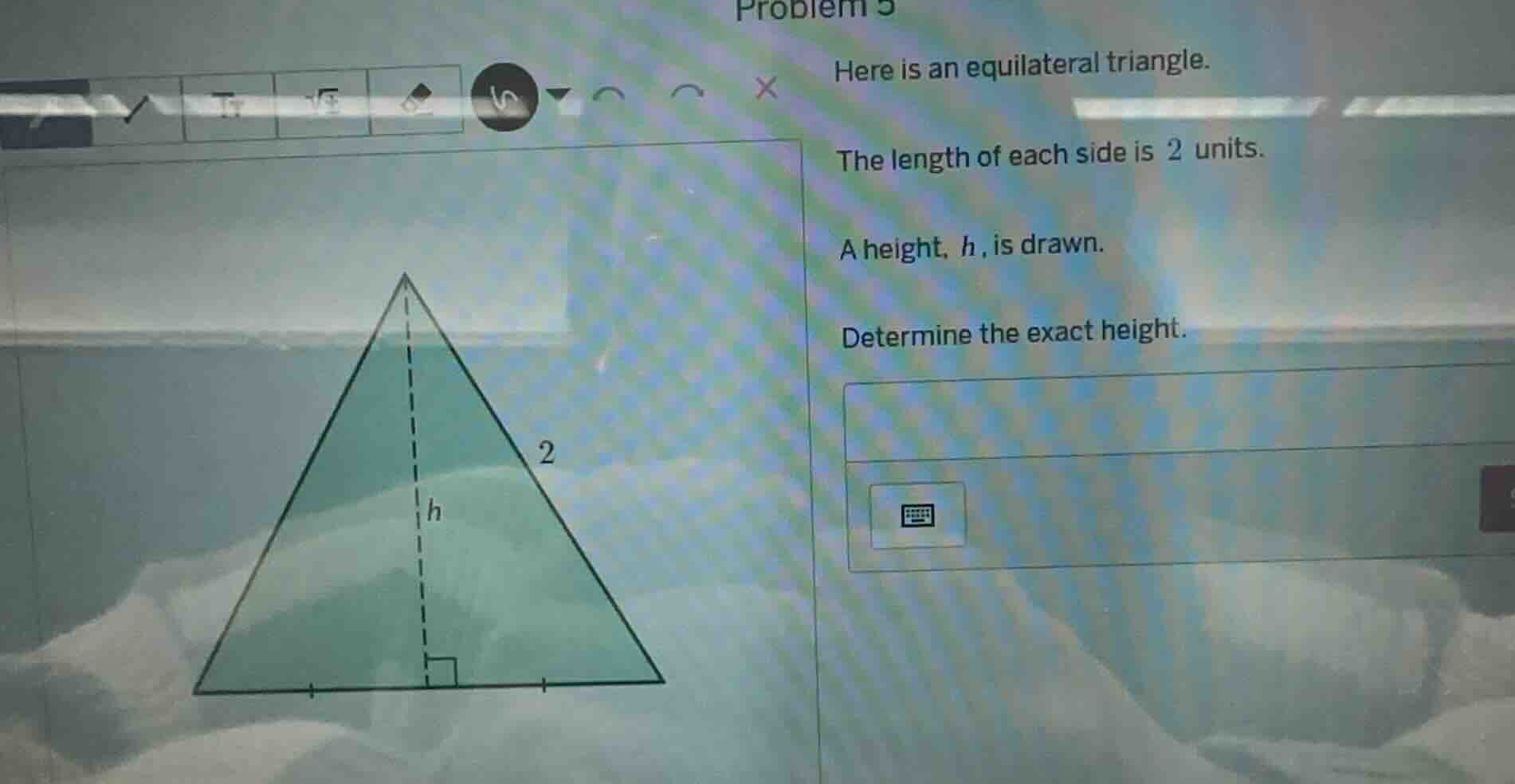
here is an equilateral triangle.
the length of each side is 2 units.
a height, h, is drawn.
determine the exact height.
Step1: Split the equilateral triangle
When we draw the height \( h \) in an equilateral triangle, it splits the triangle into two right - angled triangles. The hypotenuse of each right - angled triangle is equal to the side length of the equilateral triangle, which is \( 2 \) units. The base of each right - angled triangle is half of the side length of the equilateral triangle. So the base \( b=\frac{2}{2} = 1\) unit.
Step2: Apply the Pythagorean theorem
For a right - angled triangle, the Pythagorean theorem states that \( a^{2}+b^{2}=c^{2} \), where \( c \) is the hypotenuse, \( a \) is one of the legs (in this case, the height \( h \)) and \( b \) is the other leg. We know that \( c = 2\) and \( b=1 \), and we want to find \( h \). Rearranging the Pythagorean theorem to solve for \( h \), we get \( h=\sqrt{c^{2}-b^{2}} \). Substituting \( c = 2 \) and \( b = 1 \) into the formula, we have \( h=\sqrt{2^{2}-1^{2}}=\sqrt{4 - 1}=\sqrt{3} \).

Snap & solve any problem in the app
Get step-by-step solutions on Sovi AI
Photo-based solutions with guided steps
Explore more problems and detailed explanations
\(\sqrt{3}\)