QUESTION IMAGE
Question
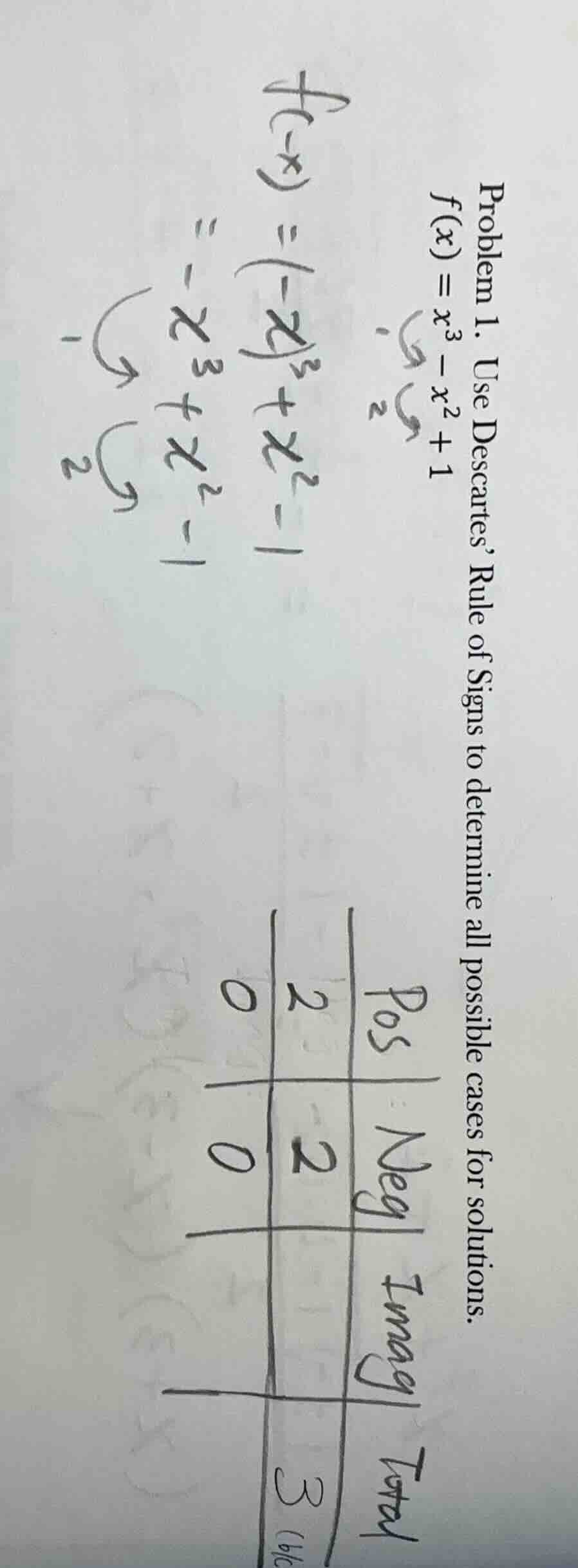
problem 1. use descartes’ rule of signs to determine all possible cases for solutions. f(x)=x³−x²+1
Step1: Analyze \( f(x) = x^3 - x^2 + 1 \) for positive roots
The coefficients of \( f(x) \) are \( 1, -1, 1 \). The sign changes: from \( 1 \) to \( -1 \) (1st change), from \( -1 \) to \( 1 \) (2nd change). By Descartes’ Rule, the number of positive real roots is either \( 2 \) or \( 2 - 2 = 0 \).
Step2: Analyze \( f(-x) = (-x)^3 - (-x)^2 + 1 = -x^3 - x^2 + 1 \) for negative roots
The coefficients of \( f(-x) \) are \( -1, -1, 1 \). The sign change: from \( -1 \) to \( 1 \) (1st change). So the number of negative real roots is \( 1 \) (since \( 1 - 2 = -1 \), we take the non - negative value, so only \( 1 \) possible negative real root).
Step3: Determine total roots
A cubic equation has \( 3 \) roots (real + imaginary). Let the number of positive real roots be \( p \), negative real roots be \( n \), and imaginary roots be \( i \). We know \( p + n + i = 3 \).
- Case 1: If \( p = 2 \), \( n = 1 \), then \( i = 3-(2 + 1)=0 \).
- Case 2: If \( p = 0 \), \( n = 1 \), then \( i = 3-(0 + 1)=2 \).

Snap & solve any problem in the app
Get step-by-step solutions on Sovi AI
Photo-based solutions with guided steps
Explore more problems and detailed explanations
Possible cases:
- Positive real roots: 2, Negative real roots: 1, Imaginary roots: 0.
- Positive real roots: 0, Negative real roots: 1, Imaginary roots: 2.