QUESTION IMAGE
Question
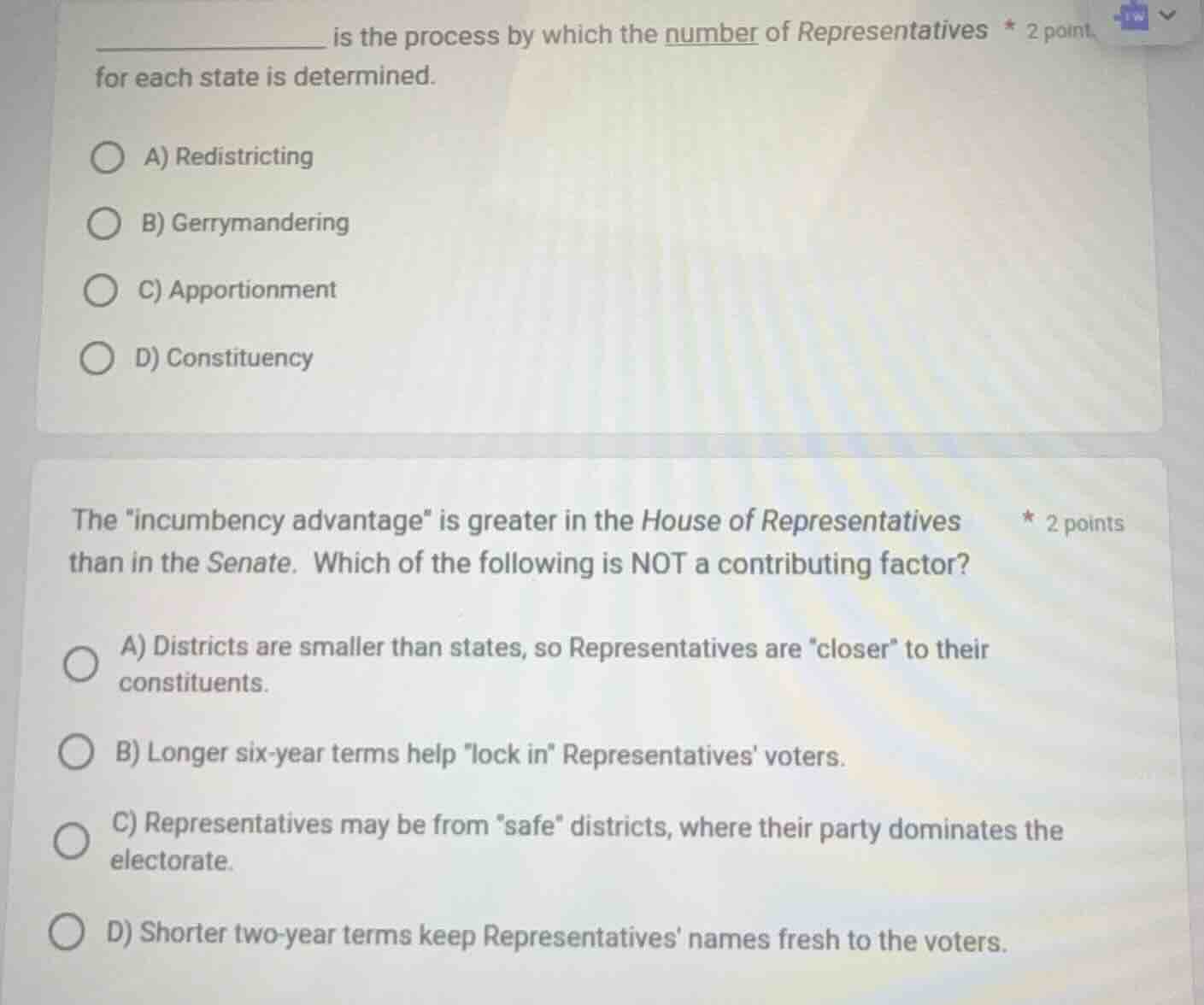
__________ is the process by which the number of representatives for each state is determined. 2 point a) redistricting b) gerrymandering c) apportionment d) constituency the \incumbency advantage\ is greater in the house of representatives than in the senate. which of the following is not a contributing factor? 2 points a) districts are smaller than states, so representatives are \closer\ to their constituents. b) longer six-year terms help \lock in\ representatives voters. c) representatives may be from \safe\ districts, where their party dominates the electorate. d) shorter two-year terms keep representatives names fresh to the voters.
For the first question:
- Redistricting refers to redrawing district boundaries, not setting the number of representatives.
- Gerrymandering is manipulating district boundaries for political gain, not determining representative counts.
- Apportionment is the specific process of allocating the number of U.S. House Representatives to each state based on population.
- Constituency is the group of voters represented, not a process of setting representative numbers.
For the second question:
- Smaller House districts let representatives connect more closely with constituents, boosting incumbency advantage.
- Six-year terms are for Senate members, not House Representatives (who serve two-year terms), so this does not contribute to House incumbency advantage.
- "Safe" districts for House members reduce competition, strengthening incumbency advantage.
- Shorter two-year terms mean House candidates campaign more often, keeping their names visible to voters, which aids incumbency.

Snap & solve any problem in the app
Get step-by-step solutions on Sovi AI
Photo-based solutions with guided steps
Explore more problems and detailed explanations
- C) Apportionment
- B) Longer six-year terms help "lock in" Representatives' voters.