QUESTION IMAGE
Question
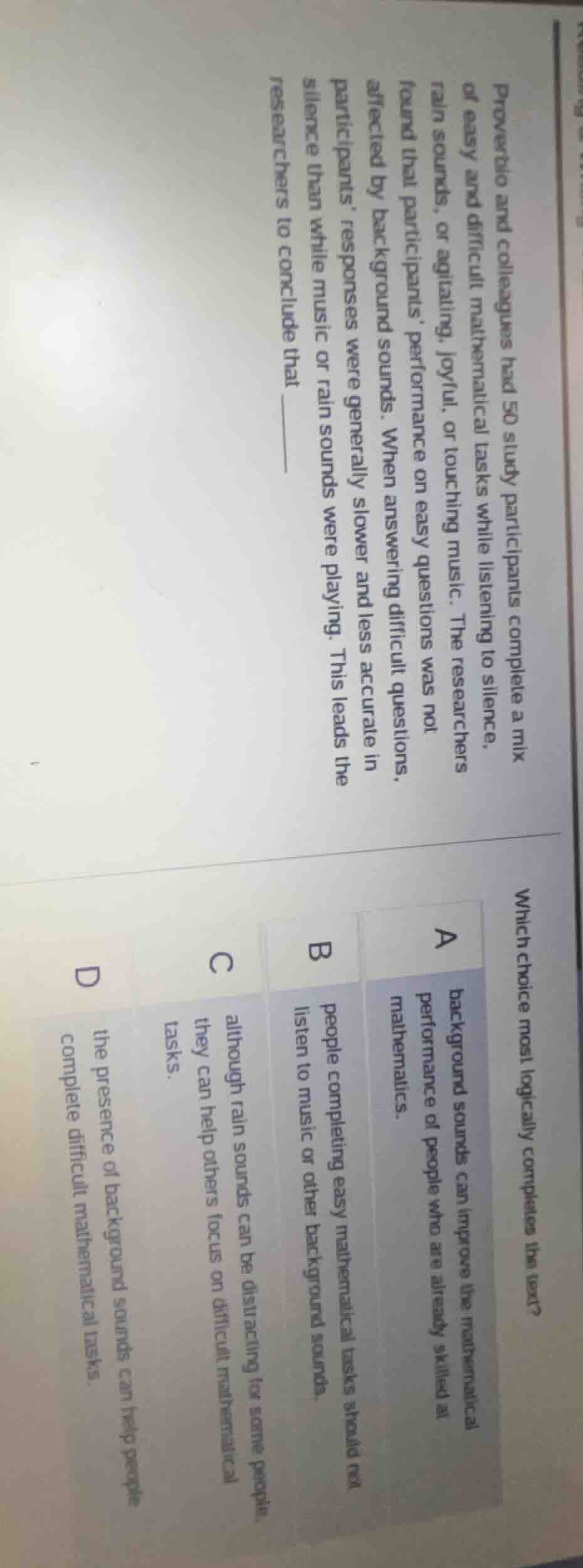
professor and colleagues had 50 study participants complete a mix of easy and difficult mathematical tasks while listening to silence, rain sounds, or agitating, joyful, or touching music. the researchers found that participants’ performance on easy questions was not affected by background sounds. when answering difficult questions, participants’ responses were generally slower and less accurate in silence than while music or rain sounds were playing. this leads the researchers to conclude that ______
which choice most logically completes the text?
a background sounds can improve the mathematical performance of people who are already skilled at mathematics.
b people completing easy mathematical tasks should not listen to music or other background sounds.
c although rain sounds can be distracting for some people, they can help others focus on difficult mathematical tasks.
d the presence of background sounds can help people complete difficult mathematical tasks.
The study shows easy math task performance was unaffected by background sounds, but difficult tasks were done slower and less accurately with music/rain sounds compared to silence. Option A is unsupported (no mention of skilled people). Option B is incorrect as easy tasks weren't harmed. Option C is wrong because rain sounds hurt, not help, difficult task focus. Option D aligns: background sounds (silence was better for hard tasks, so other sounds hinder, meaning silence (lack of those sounds) or the inverse is that the presence of non-silence sounds doesn't help, wait no—wait, the study found that during difficult questions, responses were worse with music/rain than silence. So the presence of those background sounds does NOT help, but wait no, the conclusion is that silence is better, so the presence of background sounds (music/rain) impairs difficult tasks, which means the opposite: the absence helps, so D says "the presence of background sounds can help people complete difficult mathematical tasks" no, wait wait no—wait no, let's recheck: the study says "When answering difficult questions, participants’ responses were generally slower and less accurate in silence than while music or rain sounds were playing." Wait no, no: "slower and less accurate in silence than while music or rain sounds were playing"—wait no, the text says: "When answering difficult questions, participants’ responses were generally slower and less accurate in silence than while music or rain sounds were playing." Wait no, no, the actual text: "When answering difficult questions, participants’ responses were generally slower and less accurate in silence than while music or rain sounds were playing." Wait no, I misread earlier. Oh right! The text says: "When answering difficult questions, participants’ responses were generally slower and less accurate in silence than while music or rain sounds were playing." Wait no, no, the original text: "When answering difficult questions, participants’ responses were generally slower and less accurate in silence than while music or rain sounds were playing." Wait no, let's read again: "The researchers found that participants’ performance on easy questions was not affected by background sounds. When answering difficult questions, participants’ responses were generally slower and less accurate in silence than while music or rain sounds were playing." Oh! So for difficult tasks, music/rain sounds made them faster and more accurate than silence. So the presence of those background sounds helps with difficult math tasks. That matches option D.

Snap & solve any problem in the app
Get step-by-step solutions on Sovi AI
Photo-based solutions with guided steps
Explore more problems and detailed explanations
D. the presence of background sounds can help people complete difficult mathematical tasks.