QUESTION IMAGE
Question
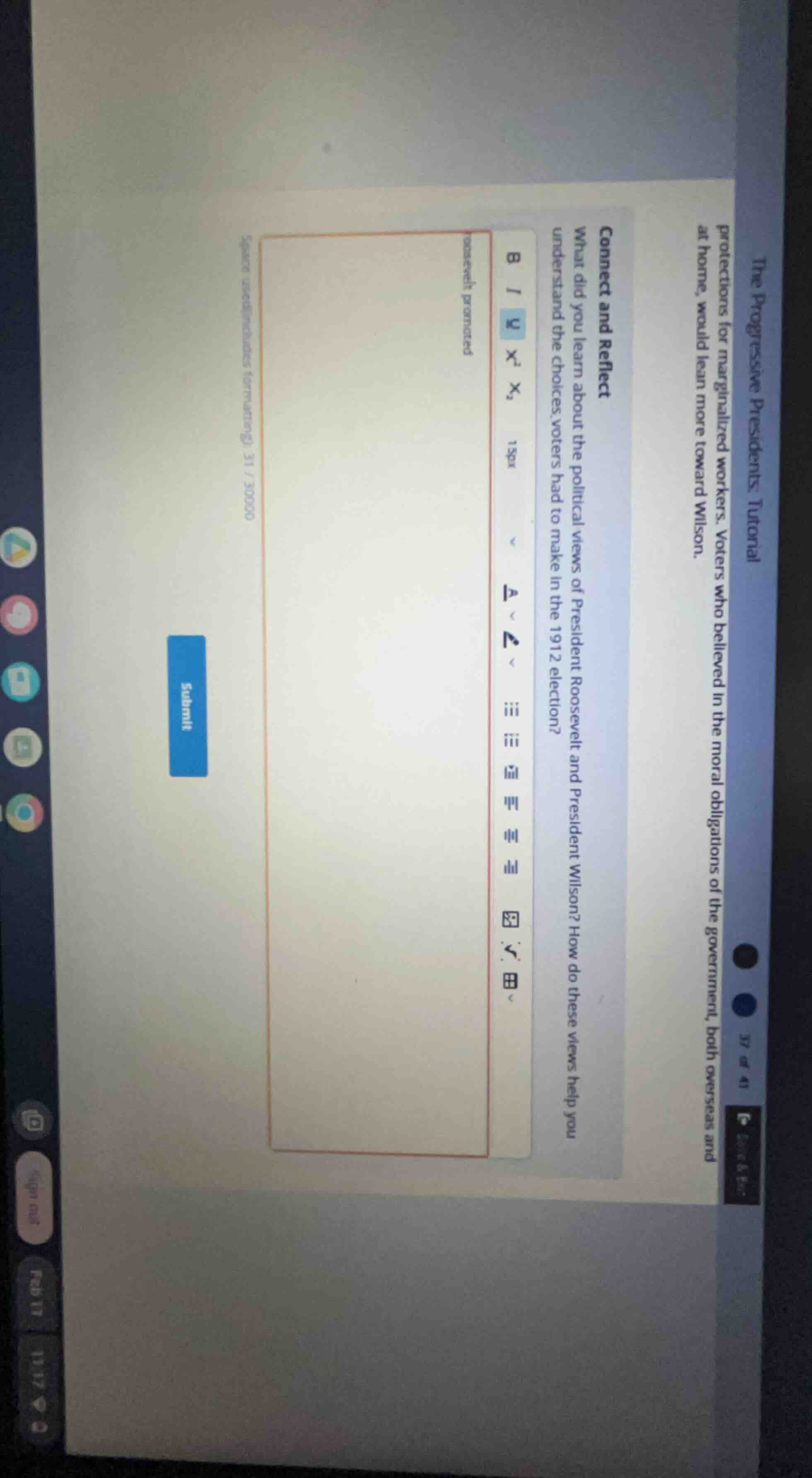
the progressive presidents: tutorial
37 of 41
protections for marginalized workers. voters who believed in the moral obligations of the government, both overseas and
at home, would lean more toward wilson.
connect and reflect
what did you learn about the political views of president roosevelt and president wilson? how do these views help you
understand the choices voters had to make in the 1912 election?
Brief Explanations
- Roosevelt's views: As a Progressive, Theodore Roosevelt (running as a Bull Moose Party candidate in 1912) advocated for a "New Nationalism"—a strong federal government that would regulate big business, protect workers (with minimum wage, safety laws, and union rights), and use its power to address social inequality. He framed this as expanding government authority to balance corporate power and protect the vulnerable.
- Wilson's views: Woodrow Wilson, the Democratic candidate, pushed for "New Freedom," which focused on breaking up monopolies rather than regulating them, to restore free market competition. He also supported worker protections but emphasized smaller government, states' rights, and framing government moral obligation as enabling individual opportunity rather than direct large-scale intervention.
- Voter choice context: Voters in 1912 chose between Roosevelt's vision of active, large-scale federal intervention to fix systemic inequality, and Wilson's more limited, market-focused approach that still included worker protections. Those prioritizing strong, direct government action to support marginalized groups leaned toward Roosevelt, while those who wanted government action but feared overreach and favored free-market solutions leaned toward Wilson.

Snap & solve any problem in the app
Get step-by-step solutions on Sovi AI
Photo-based solutions with guided steps
Explore more problems and detailed explanations
- Roosevelt's political views: He promoted the "New Nationalism" platform, calling for a powerful federal government to regulate corporations, establish robust worker protections (like safety standards and union rights), and use state power to reduce social and economic inequality.
- Wilson's political views: He advocated for "New Freedom," focusing on breaking up monopolies to restore free market competition, supporting targeted worker protections, and framing government's moral obligation as enabling individual economic opportunity rather than broad, centralized intervention.
- 1912 election voter choice: Voters choosing Roosevelt favored aggressive federal intervention to directly counter corporate power and protect marginalized groups. Voters choosing Wilson wanted government action for workers but preferred a more limited state that prioritized free markets and avoided large-scale federal overreach. The given hypothetical voter (valuing government moral obligation at home and abroad) would lean toward Wilson because his framework framed government duty as enabling opportunity rather than top-down control, aligning with a focus on moral obligation without embracing Roosevelt's expansive federal power.