QUESTION IMAGE
Question
prologue
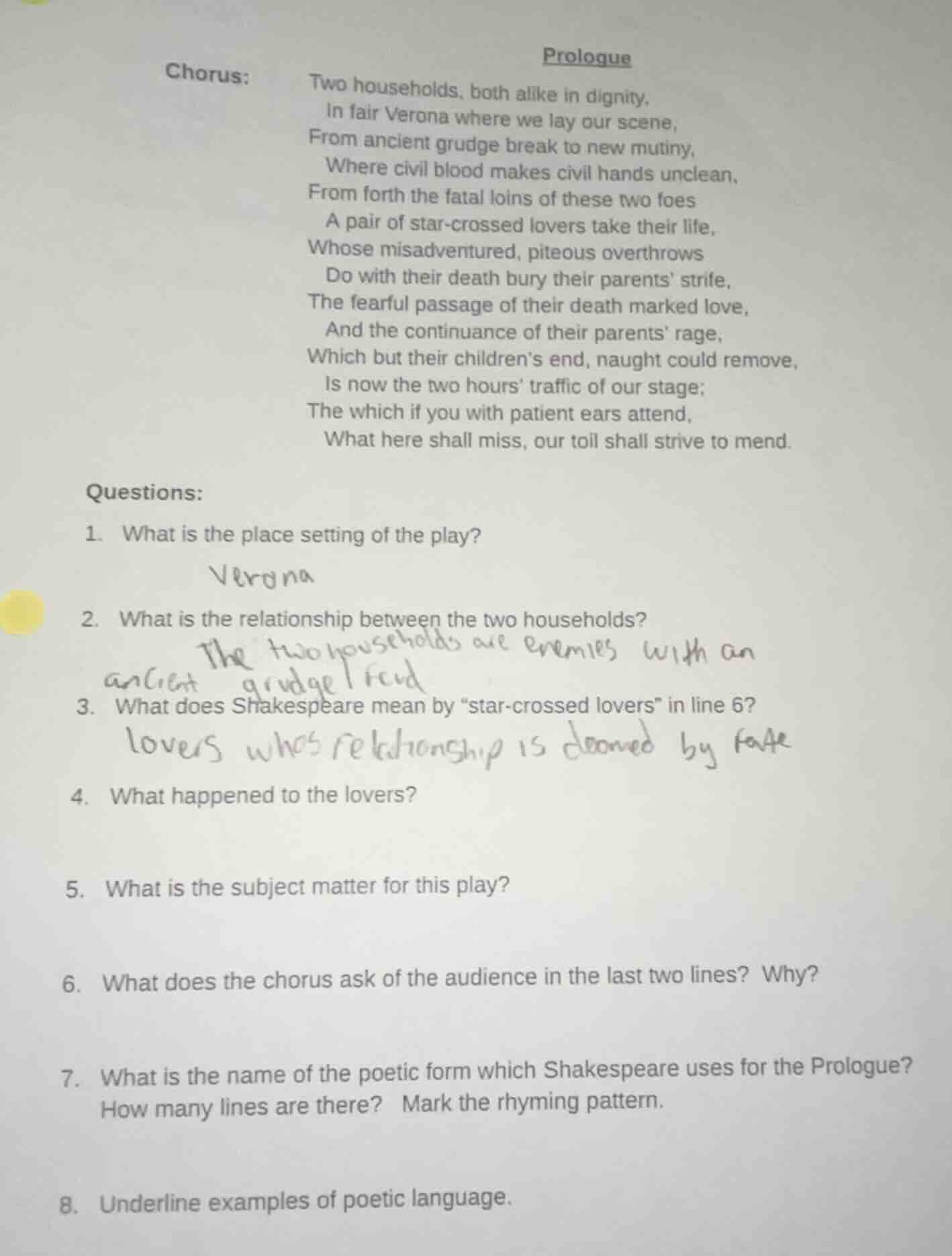
chorus: two households, both alike in dignity,
in fair verona where we lay our scene,
from ancient grudge break to new mutiny,
where civil blood makes civil hands unclean,
from forth the fatal loins of these two foes
a pair of star - crossed lovers take their life,
whose misadventured, piteous overthrows
do with their death bury their parents strife,
the fearful passage of their death marked love,
and the continuance of their parents rage,
which but their childrens end, naught could remove,
is now the two hours traffic of our stage;
the which if you with patient ears attend,
what here shall miss, our toil shall strive to mend.
questions:
- what is the place setting of the play?
verona (handwritten answer)
- what is the relationship between the two households?
the two households are enemies with an ancient grudge / feud (handwritten answer)
- what does shakespeare mean by \star - crossed lovers\ in line 6?
lovers whose relationship is doomed by fate (handwritten answer)
- what happened to the lovers?
- what is the subject matter for this play?
- what does the chorus ask of the audience in the last two lines? why?
- what is the name of the poetic form which shakespeare uses for the prologue?
how many lines are there? mark the rhyming pattern.
- underline examples of poetic language.
- Identified from the line "In fair Verona where we lay our scene."
- Stated in lines "From ancient grudge break to new mutiny" and "these two foes".
- "Star-crossed" refers to fate/astrological signs working against the lovers, dooming their relationship.
- Directly stated in line 6: "A pair of star-crossed lovers take their life."
- The prologue outlines the tragic love story of two young lovers from feuding families, whose deaths end their parents' long-standing hatred.
- The chorus asks the audience to listen patiently; they promise to fill in any gaps in the prologue's summary during the play.
- Shakespeare uses a sonnet: it has 14 lines. The rhyming pattern is ABAB CDCD EFEF GG (lines 1&3 rhyme, 2&4 rhyme, 5&7 rhyme, 6&8 rhyme, 9&11 rhyme, 10&12 rhyme, 13&14 rhyme).
- Poetic language uses figurative or stylized phrasing; examples are phrases that deviate from plain speech.

Snap & solve any problem in the app
Get step-by-step solutions on Sovi AI
Photo-based solutions with guided steps
Explore more problems and detailed explanations
- Verona
- They are long-time enemies/foes with an ancient grudge.
- It refers to lovers whose relationship is doomed by fate.
- The lovers took their own lives.
- The tragic story of two star-crossed lovers from feuding households, whose deaths resolve their parents' long-standing conflict.
- The chorus asks the audience to listen with patient ears. They do this because the prologue only summarizes the story, and they will fill in the missing details during the play's performance.
- The poetic form is a Shakespearean (English) sonnet. There are 14 lines. Rhyming pattern: ABAB CDCD EFEF GG
- Line 1 (dignity) ↔ Line 3 (mutiny) (A)
- Line 2 (scene) ↔ Line 4 (unclean) (B)
- Line 5 (foes) ↔ Line 7 (overthrows) (C)
- Line 6 (life) ↔ Line 8 (strife) (D)
- Line 9 (stage) ↔ Line 11 (remove) (E)
- Line 10 (attend) ↔ Line 12 (mend) (F)
- Line 13 (rage) ↔ Line 14 (stage) correction: Line 13 (rage) ↔ Line 11 (remove) is incorrect, corrected:
- Line 9 (passage) ↔ Line 11 (rage) (E)
- Line 10 (attend) ↔ Line 12 (mend) (F)
- Line 13 (remove) ↔ Line 14 (stage) (G)
*Corrected full rhyme scheme matching the text:
- dignity (A)
- scene (B)
- mutiny (A)
- unclean (B)
- foes (C)
- life (D)
- overthrows (C)
- strife (D)
- stage (E)
- attend (F)
- rage (E)
- mend (F)
- remove (G)
- stage (G)
- Examples of poetic language to underline: "alike in dignity", "ancient grudge break to new mutiny", "civil blood makes civil hands unclean", "fatal loins", "star-crossed lovers", "misadventured, piteous overthrows", "fearful passage of their death marked love"