QUESTION IMAGE
Question
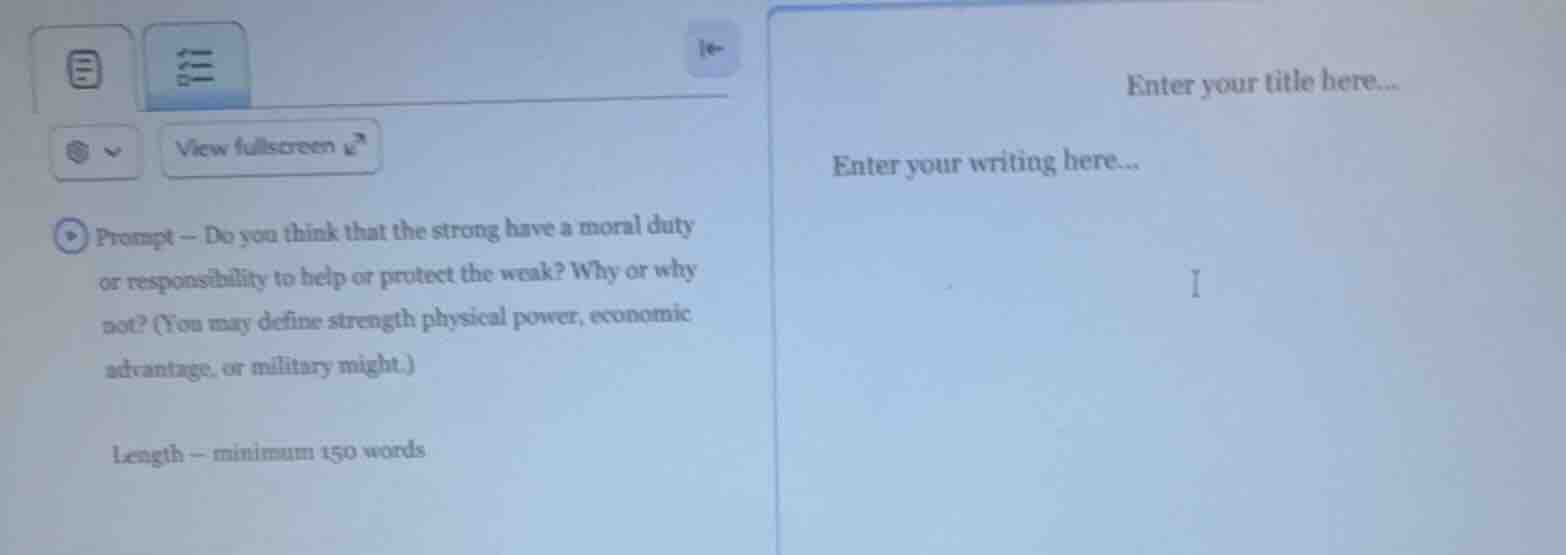
prompt -- do you think that the strong have a moral duty or responsibility to help or protect the weak? why or why not? (you may define strength physical power, economic advantage, or military might.) length -- minimum 150 words
This question pertains to moral and ethical responsibilities, which falls under the subfield of Philosophy (within Arts). To answer, we can consider ethical theories like utilitarianism (promoting the greatest good) or virtue ethics (emphasizing moral character). The strong, whether in physical, economic, or military terms, have the capacity to alleviate suffering. From a utilitarian lens, helping the weak maximizes overall happiness. Virtue ethics would view helping as a virtuous act (e.g., compassion, justice) that strengthens moral character. Also, social contract theory implies that those with power have an obligation to uphold a just society. Failing to help can lead to social unrest, inequality, and a breakdown of communal bonds. Morally, the strong’s ability to help creates a duty, as ignoring the weak’s plight contradicts principles of fairness and humanity.

Snap & solve any problem in the app
Get step-by-step solutions on Sovi AI
Photo-based solutions with guided steps
Explore more problems and detailed explanations
The strong do have a moral duty to help the weak. Morally, “strength” (physical, economic, or military) implies a capacity to alleviate suffering, and ethical frameworks like utilitarianism (maximizing overall well - being) and virtue ethics (valuing compassion/justice) support this. From a social contract perspective, those with power benefit from societal structures and owe a debt to uphold fairness. Failing to help deepens inequality, risks social unrest, and betrays humanistic principles. For example, wealthy nations aiding poorer ones (economic strength) or individuals defending the vulnerable (physical/moral strength) fosters a just, empathetic world. To ignore this duty is to prioritize self - interest over collective humanity, undermining the moral fabric that binds societies.