QUESTION IMAGE
Question
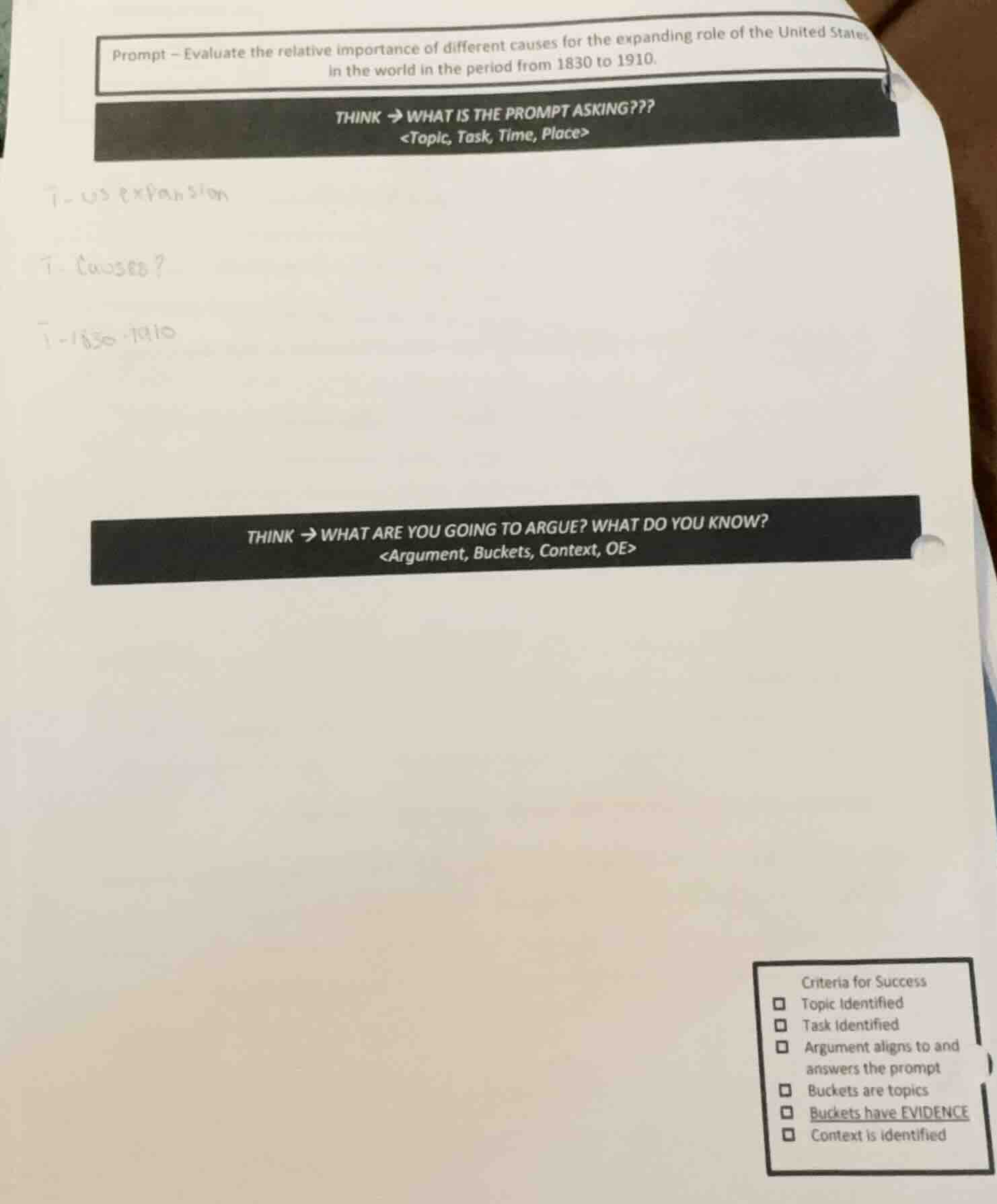
prompt - evaluate the relative importance of different causes for the expanding role of the united states in the world in the period from 1830 to 1910.
think → what is the prompt asking???
<topic, task, time, place>
think → what are you going to argue? what do you know?
<argument, buckets, context, oe>
criteria for success
☐ topic identified
☐ task identified
☐ argument aligns to and answers the prompt
☐ buckets are topics
☐ buckets have evidence
☐ context is identified
The prompt asks to evaluate the relative importance of different causes for the expanding role of the United States in the world from 1830 to 1910. To address this, we can identify key causes (buckets) such as economic growth (e.g., industrialization, westward expansion, trade), political developments (e.g., Manifest Destiny, foreign policy like the Monroe Doctrine, imperialism), and social/cultural factors (e.g., nationalism, technological advancements). We can argue that economic growth was a primary driver as industrialization (e.g., rise of factories, railroads) enabled resource exploitation and trade expansion, which funded military and political influence. Political factors like Manifest Destiny justified territorial expansion (e.g., Texas annexation, Oregon Treaty), and imperialism (e.g., Spanish - American War) extended US influence globally. Social factors like nationalism and technological innovation (e.g., telegraph, steamships) supported these efforts. Evidence for economic growth includes the growth of the railroad network (e.g., transcontinental railroad), industrial output, and increased trade. For politics, documents like the Monroe Doctrine and events like the annexation of Hawaii. For social, the spread of American cultural ideals and technological patents.

Snap & solve any problem in the app
Get step-by-step solutions on Sovi AI
Photo-based solutions with guided steps
Explore more problems and detailed explanations
To evaluate the relative importance of causes for the US's expanding role (1830 - 1910):
1. Topic Identified:
Expanding role of the United States in the world, 1830 - 1910.
2. Task Identified:
Evaluate the relative importance of different causes.
3. Argument:
Economic growth (industrialization, westward expansion, trade) was the most important cause, with political (Manifest Destiny, imperialism) and social (nationalism, technology) factors also significant but secondary.
4. Buckets (with Evidence):
- Economic Growth
- Industrialization: Growth of factories (e.g., in the Northeast), increased production of goods. Railroads (e.g., transcontinental railroad, 1869) connected markets, enabling resource extraction (e.g., coal, iron) and trade expansion.
- Westward Expansion: Acquisition of land (e.g., Louisiana Purchase, Oregon Treaty, Texas annexation) provided resources (agriculture, minerals) and new markets, fueling economic growth.
- Trade: Expansion of trade with Europe and Asia, supported by technological advancements (e.g., steamships, telegraph), increased US economic influence.
- Political Developments
- Manifest Destiny: Ideology justifying territorial expansion, leading to annexation of Texas (1845), Oregon (1846), and Mexican Cession (1848).
- Foreign Policy/Imperialism: Monroe Doctrine (1823) established US dominance in the Americas. Spanish - American War (1898) led to acquisition of territories (Puerto Rico, Philippines, Guam), expanding global influence.
- Social/Cultural Factors
- Nationalism: Sense of American exceptionalism, driving expansionist efforts.
- Technological Innovation: Advancements like the telegraph (improved communication) and steamships (faster transportation) supported economic and political expansion.
5. Context:
The period 1830 - 1910 saw the US transition from a regional power to a global one, with industrialization, territorial growth, and increasing involvement in international affairs.