QUESTION IMAGE
Question
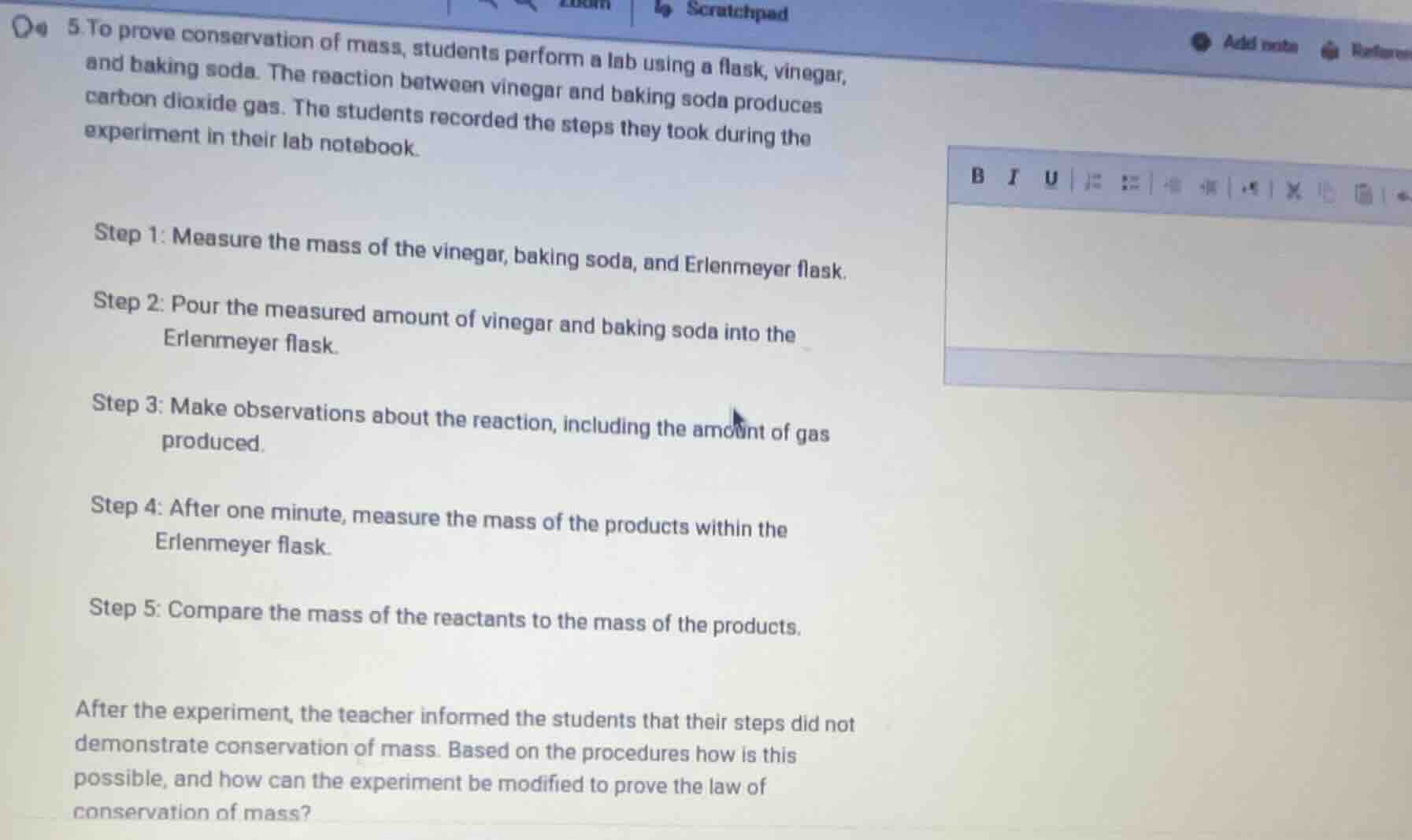
- to prove conservation of mass, students perform a lab using a flask, vinegar, and baking soda. the reaction between vinegar and baking soda produces carbon dioxide gas. the students recorded the steps they took during the experiment in their lab notebook. step 1: measure the mass of the vinegar, baking soda, and erlenmeyer flask. step 2: pour the measured amount of vinegar and baking soda into the erlenmeyer flask. step 3: make observations about the reaction, including the amount of gas produced. step 4: after one minute, measure the mass of the products within the erlenmeyer flask. step 5: compare the mass of the reactants to the mass of the products. after the experiment, the teacher informed the students that their steps did not demonstrate conservation of mass. based on the procedures how is this possible, and how can the experiment be modified to prove the law of conservation of mass?
Brief Explanations
The law of conservation of mass states that mass is neither created nor destroyed in a chemical reaction, so the total mass of reactants equals the total mass of products. In the original open flask setup, the gaseous CO₂ product leaves the system, making the measured product mass lower than the reactant mass. Sealing the flask contains all products (including the gas) within the system, ensuring the total mass remains constant and can be accurately compared before and after the reaction.

Snap & solve any problem in the app
Get step-by-step solutions on Sovi AI
Photo-based solutions with guided steps
Explore more problems and detailed explanations
- The experiment fails to prove conservation of mass because the carbon dioxide gas produced escapes from the open Erlenmeyer flask, so it is not included in the final mass measurement of products.
- To modify the experiment: Seal the Erlenmeyer flask (e.g., with a stopper) before the reaction occurs, so no gas can escape. Measure the total mass of the sealed system (flask + reactants) before the reaction, then measure the total mass of the sealed system (flask + products) after the reaction, and compare the two masses.