QUESTION IMAGE
Question
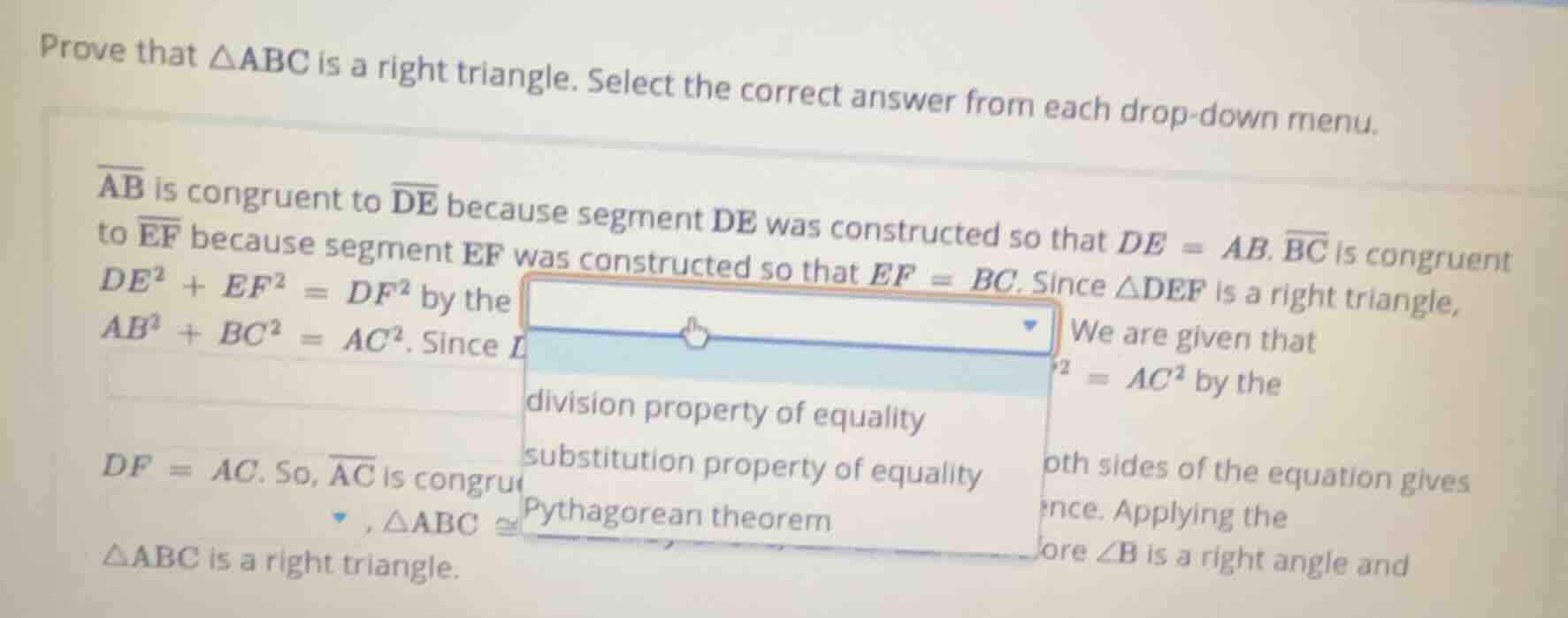
prove that $\triangle abc$ is a right triangle. select the correct answer from each drop - down menu.
$\overline{ab}$ is congruent to $\overline{de}$ because segment $de$ was constructed so that $de = ab$. $\overline{bc}$ is congruent to $\overline{ef}$ because segment $ef$ was constructed so that $ef = bc$. since $\triangle def$ is a right triangle, $de^{2}+ef^{2}=df^{2}$ by the drop - down menu. we are given that $ab^{2}+bc^{2}=ac^{2}$. since drop - down menu $=ac^{2}$ by the
division property of equality
substitution property of equality
pythagorean theorem
$df = ac$. so, $\overline{ac}$ is congruent drop - down menu, $\triangle abc\cong$ drop - down menu. $\triangle abc$ is a right triangle.
oth sides of the equation gives
ence. applying the
ore $\angle b$ is a right angle and
Step1: Recall the Pythagorean theorem
The Pythagorean theorem states that in a right triangle, the square of the hypotenuse (the side opposite the right angle) is equal to the sum of the squares of the other two sides. So, for a right triangle \( \triangle DEF \) with right angle (let's assume at \( E \)), we have \( DE^2 + EF^2 = DF^2 \) by the Pythagorean theorem.
Step2: Analyze the substitution property
We are given that \( DE = AB \) and \( EF = BC \), and we need to show \( AB^2 + BC^2 = AC^2 \). Since \( DE = AB \) and \( EF = BC \), we can substitute \( DE \) with \( AB \) and \( EF \) with \( BC \) in the equation \( DE^2 + EF^2 = DF^2 \), which gives \( AB^2 + BC^2 = DF^2 \). Then, we are also given that \( DF = AC \), so substituting \( DF \) with \( AC \) gives \( AB^2 + BC^2 = AC^2 \). But the first drop - down is about why \( DE^2+EF^2 = DF^2 \), which is the Pythagorean theorem. The second part (the other drop - down related to substitution) is about substituting equal lengths. But for the first blank (why \( DE^2 + EF^2=DF^2 \)), the answer is the Pythagorean theorem. For the substitution part, when we replace \( DE \) with \( AB \) and \( EF \) with \( BC \), we use the substitution property of equality. But let's focus on the first drop - down in the image. The equation \( DE^2+EF^2 = DF^2 \) for right triangle \( \triangle DEF \) is from the Pythagorean theorem. Then, when we replace \( DE \) with \( AB \) and \( EF \) with \( BC \), we use substitution property. But the first blank (the one with the drop - down for \( DE^2 + EF^2=DF^2 \)) is filled by the Pythagorean theorem, and the next substitution (for \( DF = AC \)) is substitution property. But let's answer the first part:
The reason \( DE^2 + EF^2=DF^2 \) for right triangle \( \triangle DEF \) is the Pythagorean theorem. Then, when we substitute \( DE = AB \) and \( EF = BC \) into \( DE^2+EF^2 = DF^2 \) to get \( AB^2 + BC^2=DF^2 \), and then substitute \( DF = AC \) to get \( AB^2 + BC^2 = AC^2 \), we use the substitution property of equality. But the first drop - down (the one for \( DE^2 + EF^2=DF^2 \)) is the Pythagorean theorem.

Snap & solve any problem in the app
Get step-by-step solutions on Sovi AI
Photo-based solutions with guided steps
Explore more problems and detailed explanations
For the first drop - down (reason for \( DE^2 + EF^2 = DF^2 \)): Pythagorean theorem
For the substitution part (when replacing \( DE \) with \( AB \), \( EF \) with \( BC \), and \( DF \) with \( AC \)): substitution property of equality