QUESTION IMAGE
Question
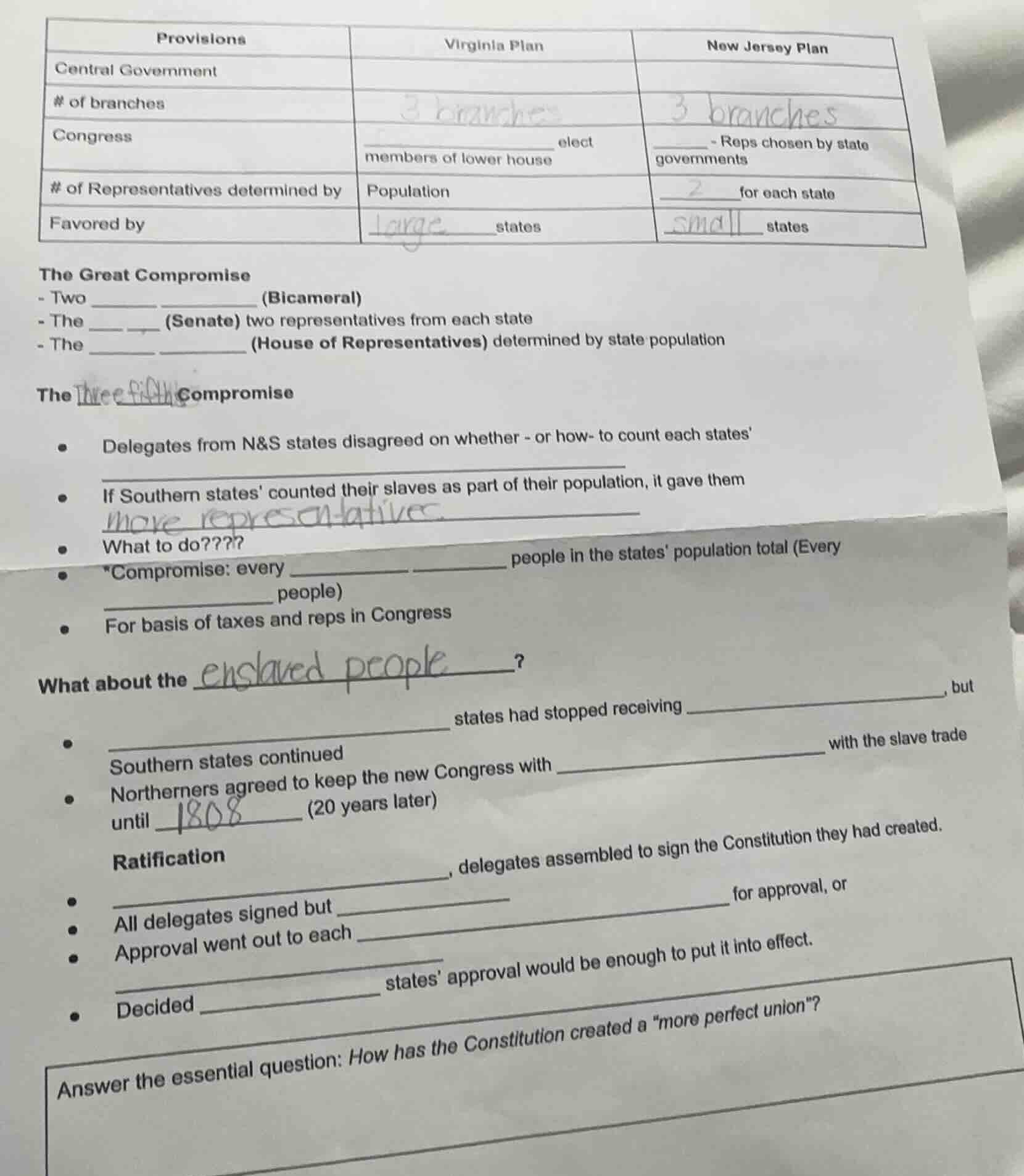
provisions virginia plan new jersey plan central government # of branches congress ____ elect members of lower house __ - reps chosen by state governments # of representatives determined by population __ for each state favored by __ states __ states the great compromise - two __ __ (bicameral) - the (senate) two representatives from each state - the __ __ (house of representatives) determined by state population the __ compromise - delegates from n&s states disagreed on whether - or how- to count each states’ __ - if southern states’ counted their slaves as part of their population, it gave them __ - what to do???? - *compromise: every __ __ people in the states’ population total (every __ people) - for basis of taxes and reps in congress what about the __? - __ states had stopped receiving __, but southern states continued - northerners agreed to keep the new congress with __ with the slave trade until __ (20 years later) ratification - __, delegates assembled to sign the constitution they had created. - all delegates signed but __ - approval went out to each __ for approval, or __ - decided ____ states’ approval would be enough to put it into effect. answer the essential question: how has the constitution created a \more perfect union\?
Filled in the missing content based on U.S. Constitutional Convention history and compromise details:
- For the Virginia Plan's Congress: Upper house members were elected by the lower house.
- For the New Jersey Plan: Each state got equal (2) representatives.
- Great Compromise: Established a bicameral (two-house) legislature, with the Senate (equal representation) and House of Representatives (population-based).
- Three-Fifths Compromise: Addressed counting enslaved people; 3 out of every 5 enslaved people were counted for taxes and representation.
- Slave Trade Compromise: Northern states had stopped receiving enslaved people; Northerners agreed not to interfere with the slave trade until 1808.
- Ratification: Delegates signed the Constitution in 1787; Rhode Island did not sign. Approval was sought from each state's convention, and 9 states' approval was required to enact it.
- Essential question: The Constitution created a more perfect union by balancing state and federal power, resolving representation disputes via compromises, establishing a structured government with checks and balances, and creating a framework that could adapt over time.

Snap & solve any problem in the app
Get step-by-step solutions on Sovi AI
Photo-based solutions with guided steps
Explore more problems and detailed explanations
Virginia & New Jersey Plans Table
| Provisions | Virginia Plan | New Jersey Plan |
|---|---|---|
| # of Representatives determined by | Population | Equal (2) for each state |
The Great Compromise
- Two houses of Congress (Bicameral)
- The upper house (Senate) two representatives from each state
- The lower house (House of Representatives) determined by state population
The Three-Fifths Compromise
- Delegates from N&S states disagreed on whether - or how- to count each states' enslaved population
- If Southern states' counted their slaves as part of their population, it gave them more congressional representatives
- Compromise: every three out of five people in the states' population total (Every 5 people, 3 are counted)
- For basis of taxes and reps in Congress
What about the enslaved people?
- Northern states had stopped receiving enslaved people, but Southern states continued
- Northerners agreed to keep the new Congress with no interference with the slave trade until 1808 (20 years later)
Ratification
- In September 1787, delegates assembled to sign the Constitution they had created.
- All delegates signed but Rhode Island
- Approval went out to each state ratifying convention for approval, or ratification
- Decided 9 states' approval would be enough to put it into effect.
Essential Question Answer:
The Constitution created a "more perfect union" by resolving conflicts between large and small states with the Great Compromise (balancing equal and population-based representation), addressing sectional tensions over enslaved people with temporary compromises, establishing a strong but limited federal government with three separate branches (executive, legislative, judicial) that provide checks and balances to prevent tyranny, and creating an amendable framework that allowed the nation to adapt to changing needs over time.