QUESTION IMAGE
Question
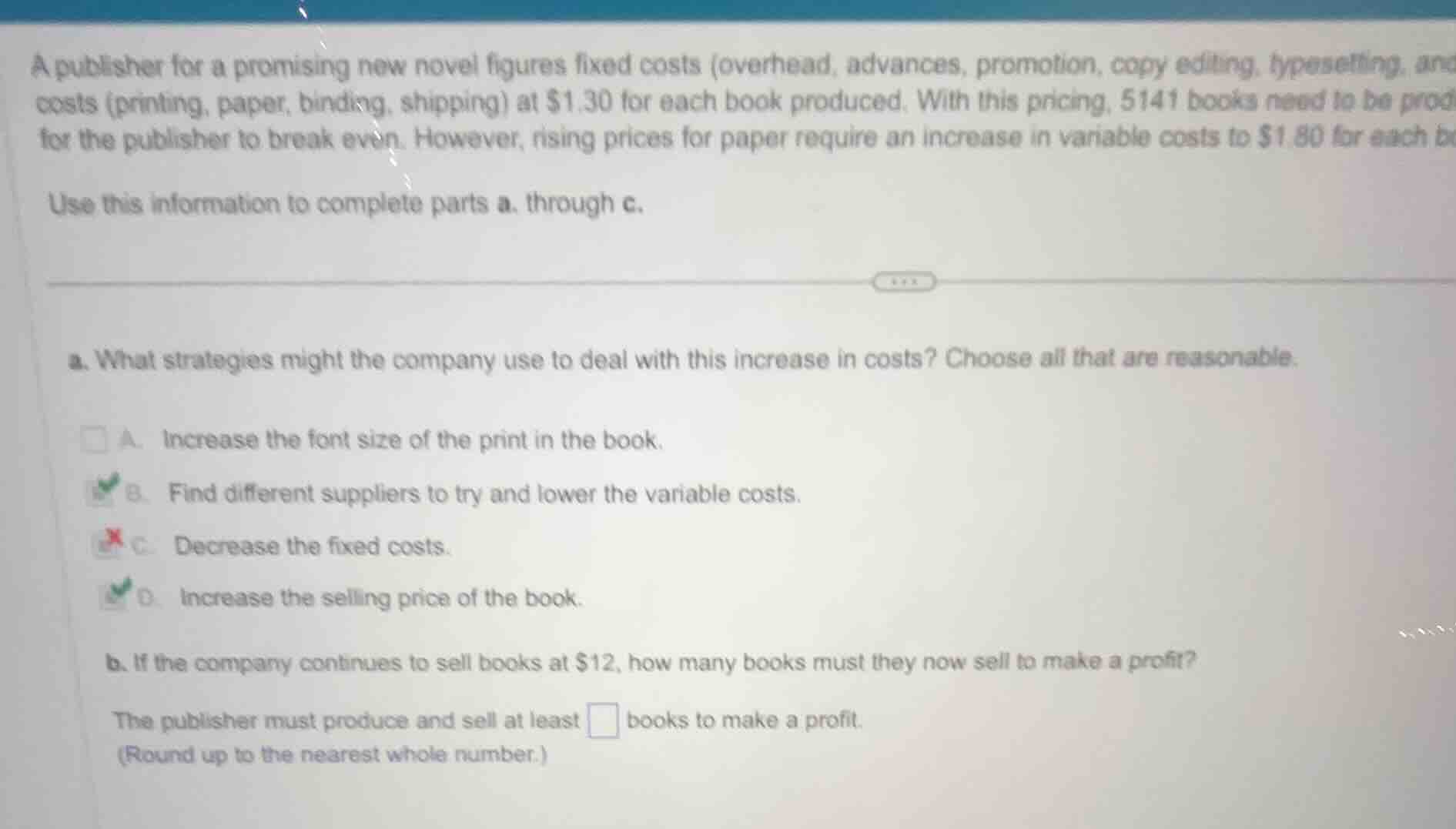
a publisher for a promising new novel figures fixed costs (overhead, advances, promotion, copy editing, typesetting, and costs (printing, paper, binding, shipping) at $1.30 for each book produced. with this pricing, 5141 books need to be prod for the publisher to break even. however, rising prices for paper require an increase in variable costs to $1.80 for each bo use this information to complete parts a. through c. a. what strategies might the company use to deal with this increase in costs? choose all that are reasonable. a. increase the font size of the print in the book. b. find different suppliers to try and lower the variable costs. c. decrease the fixed costs. d. increase the selling price of the book. b. if the company continues to sell books at $12, how many books must they now sell to make a profit? the publisher must produce and sell at least \\(\square\\) books to make a profit. (round up to the nearest whole number.)
Part a
- Option A: Increasing font size would likely increase page count and thus variable costs (paper, printing), so it's not a cost - reducing strategy.
- Option B: Finding different suppliers can help lower variable costs (like paper, printing costs), which is a reasonable way to deal with increased variable costs.
- Option C: Fixed costs (overhead, advances, etc.) are not directly related to the increase in variable costs (paper - related). Reducing fixed costs is not a direct response to variable cost increase, but it can still help in overall cost management and is a reasonable business strategy.
- Option D: Increasing the selling price can increase revenue, which can offset the increased variable costs and help in making a profit or breaking even.
Step 1: Find the fixed cost
First, we know that the break - even formula is \( \text{Break - even quantity}=\frac{\text{Fixed Cost}}{\text{Selling Price per unit}-\text{Variable Cost per unit}} \). Initially, the variable cost \( v_1 = 1.30\), the selling price \( p = 12\), and the break - even quantity \( q_1=5141\). Let the fixed cost be \( FC\). Using the break - even formula \( q_1=\frac{FC}{p - v_1}\), we can solve for \( FC\).
\( FC=q_1\times(p - v_1)\)
Substitute \( q_1 = 5141\), \( p = 12\), and \( v_1=1.30\) into the formula:
\( FC = 5141\times(12 - 1.30)=5141\times10.7\)
\( 5141\times10.7=(5000 + 141)\times10.7=5000\times10.7+141\times10.7=53500+1508.7 = 55008.7\)
Step 2: Calculate the new break - even quantity
Now, the new variable cost \( v_2 = 1.80\), the selling price \( p = 12\), and the fixed cost \( FC = 55008.7\). The break - even formula is still \( q=\frac{FC}{p - v_2}\)
Substitute the values:
\( q=\frac{55008.7}{12 - 1.80}=\frac{55008.7}{10.2}\approx5393.01\)
Since we need to make a profit, we need to sell more than the break - even quantity. So we round up to the nearest whole number.

Snap & solve any problem in the app
Get step-by-step solutions on Sovi AI
Photo-based solutions with guided steps
Explore more problems and detailed explanations
B. Find different suppliers to try and lower the variable costs, C. Decrease the fixed costs, D. Increase the selling price of the book