QUESTION IMAGE
Question
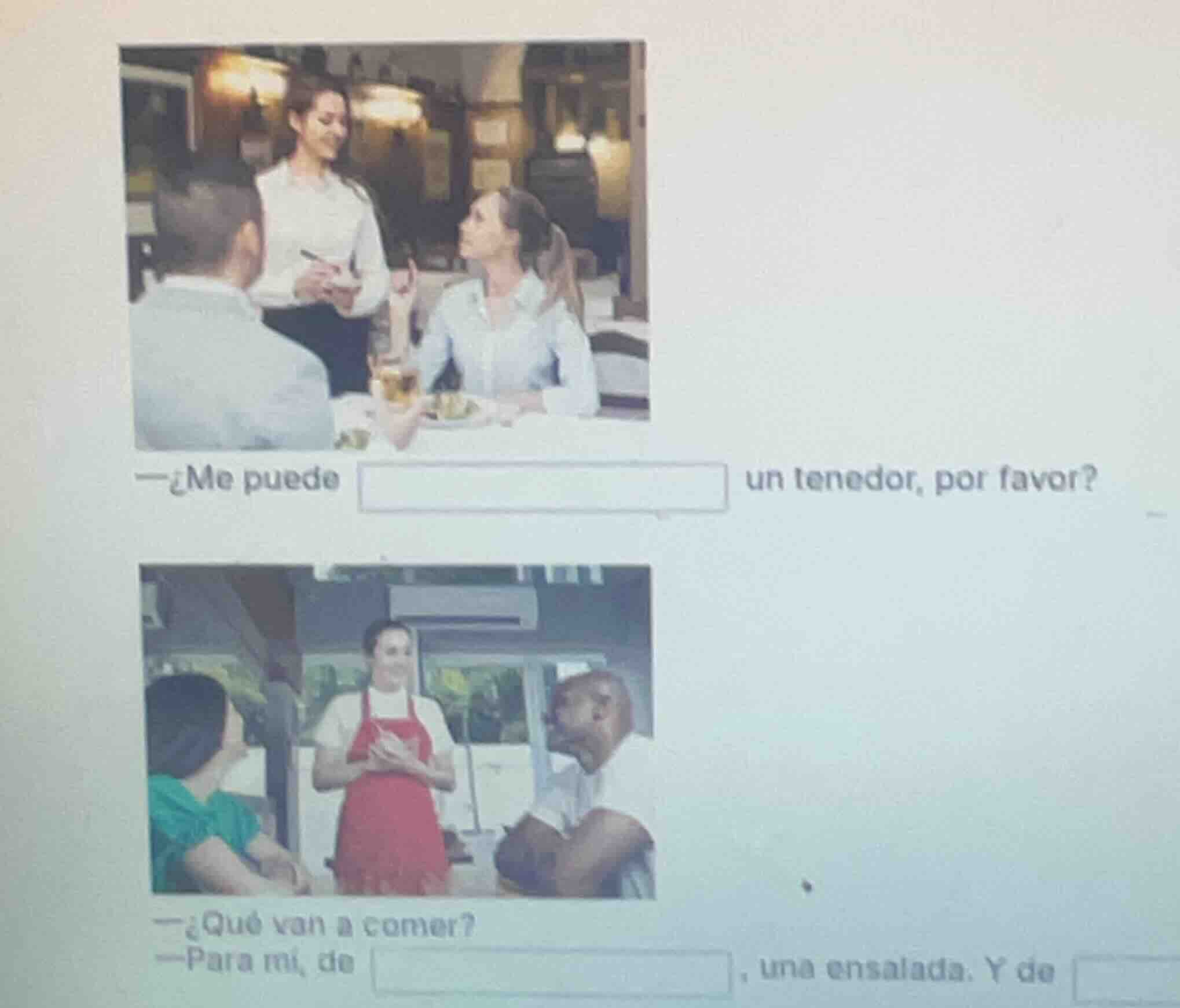
—¿me puede un tenedor, por favor?
—¿qué van a comer?
—para mí, de , una ensalada. y de
The first sentence “¿Me puede ____ un tenedor, por favor?” is a request for the waiter to bring a fork. In Spanish, the verb “traer” (to bring) is used in the formal “usted” form, so “traer” conjugated as “traer” in the infinitive after “puede” (since “poder” + infinitive) would be “traer”, but wait, actually, the correct form here is “traer” in the infinitive? Wait, no, “puede” is the third - person singular of “poder” (to be able to), and we need the infinitive of the verb “traer” (to bring) because “poder” is followed by an infinitive. So the first blank should be “traer”.
For the second part, “Para mí, de __, una ensalada. Y de __” – this is about ordering food. Common phrases for ordering food in Spanish, like “de primero” (first course), “de segundo” (second course), but maybe more likely “de entrada” (appetizer) for the salad? Wait, maybe the first blank in the second sentence is about the type of dish. But given the context of a restaurant order, the first blank in the first sentence is “traer” (to bring).

Snap & solve any problem in the app
Get step-by-step solutions on Sovi AI
Photo-based solutions with guided steps
Explore more problems and detailed explanations
First blank: traer