QUESTION IMAGE
Question
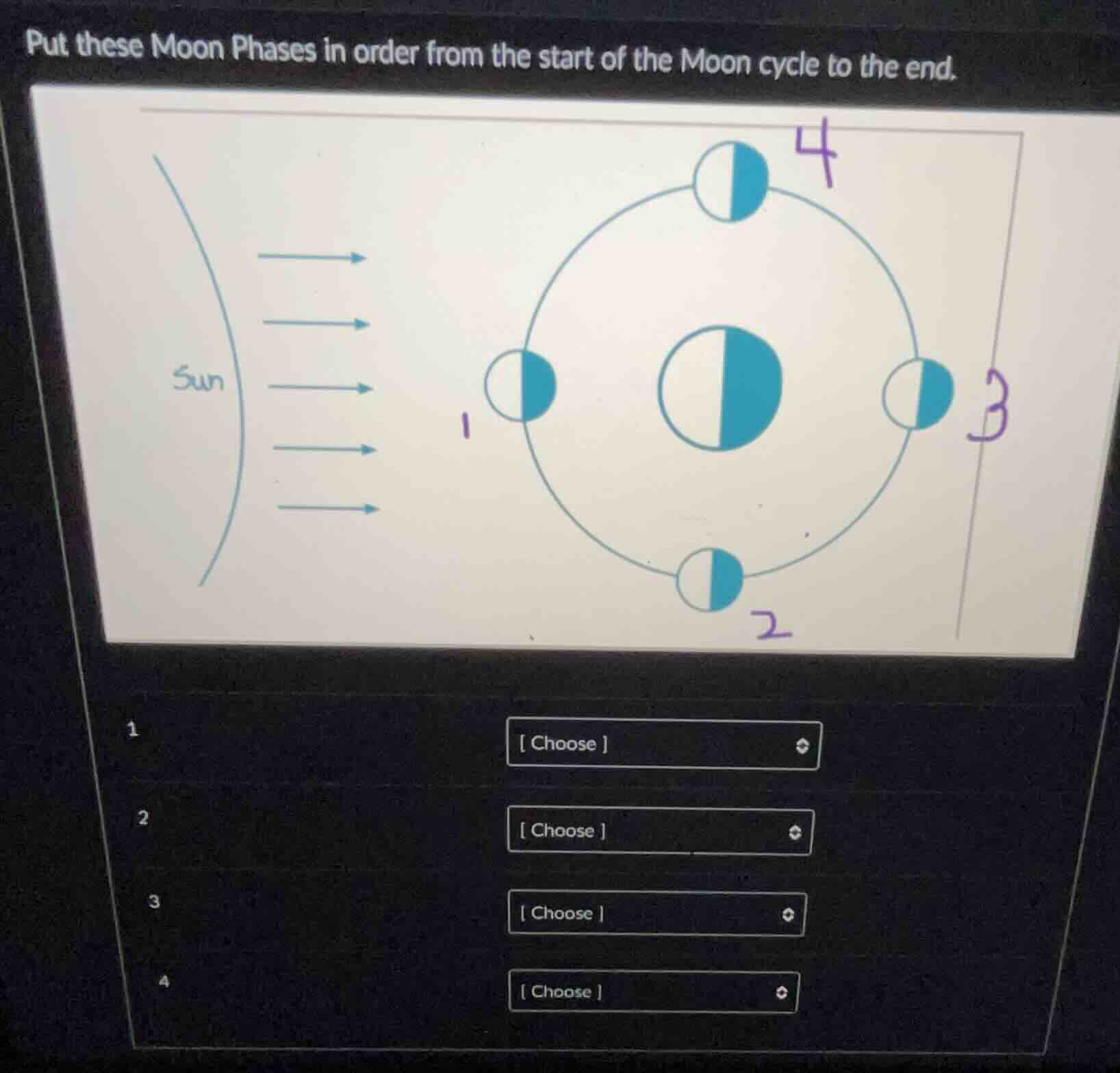
put these moon phases in order from the start of the moon cycle to the end.
1 choose
2 choose
3 choose
4 choose
To solve the problem of ordering the moon phases, we first recall the lunar cycle sequence: New Moon → Waxing Crescent → First Quarter → Waxing Gibbous → Full Moon → Waning Gibbous → Last Quarter → Waning Crescent → New Moon. But in the diagram, we analyze the position relative to the Sun (light source) and the illuminated portion:
Step 1: Identify Phase 1
The moon at position 1 is closest to the Sun, with the illuminated side facing the Sun (so we see the dark side, or a very thin crescent, but in the diagram, the blue (dark) part is on the right, meaning the illuminated (white) is on the left, facing the Sun. This is the New Moon (or start of the cycle, where the moon is between Earth and Sun, so we see the unilluminated side).
Step 2: Identify Phase 2
Position 2: The moon has moved, and the illuminated portion is increasing (waxing). The blue (dark) is on the right, white on the left, but more than the New Moon. This is the Waxing Crescent (or early waxing phase, moving toward First Quarter). Wait, no—wait, the standard phases: after New Moon, the first visible phase is Waxing Crescent, then First Quarter (half illuminated, right side dark? Wait, no—when facing the Sun, the illuminated side is toward the Sun. So:
- When the moon is between Earth and Sun (position 1): New Moon (we see the dark side).
- As it moves counterclockwise (assuming the orbit is counterclockwise from Earth’s perspective), the illuminated portion visible from Earth increases.
Wait, the diagram shows the Earth in the center (the big circle with half blue, half white—wait, no, the big circle is Earth? Wait, no, the central circle is Earth? Wait, the diagram: Sun on left, Earth in center (the big circle with blue and white), and the moon orbiting Earth. So the moon’s position:
- Position 1: Moon is between Sun and Earth (New Moon: we see the dark side, since the illuminated side is facing the Sun).
- Position 2: Moon has moved, so we see a small illuminated portion (Waxing Crescent: illuminated on the right? Wait, no—if the Sun is on the left, the light comes from the left. So the illuminated side of the moon is the left side (facing Sun). So from Earth (center), the visible part:
- Position 1: Moon is at “New Moon” (left side illuminated, right side dark—so we see the dark side, or a thin crescent? Wait, the diagram’s moon at 1 has white (illuminated) on left, blue (dark) on right. So from Earth, we see the dark side (blue) on the right, white on the left (but since it’s between Sun and Earth, we mostly see the dark side—New Moon).
- Position 2: Moon has moved, so we see more of the illuminated side. Wait, no—after New Moon, the moon moves, and the illuminated portion visible from Earth increases (waxing). So the order of the moon’s orbit (counterclockwise around Earth) is: New Moon (1) → Waxing Crescent (2) → First Quarter (4) → Waxing Gibbous → Full Moon → Waning Gibbous → Last Quarter (3) → Waning Crescent → New Moon. Wait, no—First Quarter is when half the moon is illuminated (right side dark? Wait, no—First Quarter: from Earth, we see the right half illuminated? Wait, no, the “quarter” phases: First Quarter (moon is at 90° from Sun-Earth line, so we see half the illuminated side, which is the right half? Wait, maybe I got the direction wrong. Let’s use the standard phase order:
- New Moon (moon between Earth and Sun: we see dark side)
- Waxing Crescent (illuminated portion increasing, visible as a thin crescent on the right? No, wait—if the Sun is on the left, the light comes from the left, so the illuminated side of the moon is…

Snap & solve any problem in the app
Get step-by-step solutions on Sovi AI
Photo-based solutions with guided steps
Explore more problems and detailed explanations
To solve the problem of ordering the moon phases, we first recall the lunar cycle sequence: New Moon → Waxing Crescent → First Quarter → Waxing Gibbous → Full Moon → Waning Gibbous → Last Quarter → Waning Crescent → New Moon. But in the diagram, we analyze the position relative to the Sun (light source) and the illuminated portion:
Step 1: Identify Phase 1
The moon at position 1 is closest to the Sun, with the illuminated side facing the Sun (so we see the dark side, or a very thin crescent, but in the diagram, the blue (dark) part is on the right, meaning the illuminated (white) is on the left, facing the Sun. This is the New Moon (or start of the cycle, where the moon is between Earth and Sun, so we see the unilluminated side).
Step 2: Identify Phase 2
Position 2: The moon has moved, and the illuminated portion is increasing (waxing). The blue (dark) is on the right, white on the left, but more than the New Moon. This is the Waxing Crescent (or early waxing phase, moving toward First Quarter). Wait, no—wait, the standard phases: after New Moon, the first visible phase is Waxing Crescent, then First Quarter (half illuminated, right side dark? Wait, no—when facing the Sun, the illuminated side is toward the Sun. So:
- When the moon is between Earth and Sun (position 1): New Moon (we see the dark side).
- As it moves counterclockwise (assuming the orbit is counterclockwise from Earth’s perspective), the illuminated portion visible from Earth increases.
Wait, the diagram shows the Earth in the center (the big circle with half blue, half white—wait, no, the big circle is Earth? Wait, no, the central circle is Earth? Wait, the diagram: Sun on left, Earth in center (the big circle with blue and white), and the moon orbiting Earth. So the moon’s position:
- Position 1: Moon is between Sun and Earth (New Moon: we see the dark side, since the illuminated side is facing the Sun).
- Position 2: Moon has moved, so we see a small illuminated portion (Waxing Crescent: illuminated on the right? Wait, no—if the Sun is on the left, the light comes from the left. So the illuminated side of the moon is the left side (facing Sun). So from Earth (center), the visible part:
- Position 1: Moon is at “New Moon” (left side illuminated, right side dark—so we see the dark side, or a thin crescent? Wait, the diagram’s moon at 1 has white (illuminated) on left, blue (dark) on right. So from Earth, we see the dark side (blue) on the right, white on the left (but since it’s between Sun and Earth, we mostly see the dark side—New Moon).
- Position 2: Moon has moved, so we see more of the illuminated side. Wait, no—after New Moon, the moon moves, and the illuminated portion visible from Earth increases (waxing). So the order of the moon’s orbit (counterclockwise around Earth) is: New Moon (1) → Waxing Crescent (2) → First Quarter (4) → Waxing Gibbous → Full Moon → Waning Gibbous → Last Quarter (3) → Waning Crescent → New Moon. Wait, no—First Quarter is when half the moon is illuminated (right side dark? Wait, no—First Quarter: from Earth, we see the right half illuminated? Wait, no, the “quarter” phases: First Quarter (moon is at 90° from Sun-Earth line, so we see half the illuminated side, which is the right half? Wait, maybe I got the direction wrong. Let’s use the standard phase order:
- New Moon (moon between Earth and Sun: we see dark side)
- Waxing Crescent (illuminated portion increasing, visible as a thin crescent on the right? No, wait—if the Sun is on the left, the light comes from the left, so the illuminated side of the moon is the left side. So from Earth (center), the visible moon:
- New Moon (position 1): left side illuminated (facing Sun), right side dark (we see dark side: blue on right, white on left).
- Waxing Crescent (position 2): moon has moved, so we see a small illuminated portion on the left (facing Sun) and some dark on the right, but more than New Moon? No, wait, after New Moon, the moon moves, and the illuminated portion visible from Earth increases (waxing). So the order of the four positions (1,2,4,3) should be:
- New Moon (start)
- Waxing Crescent
- First Quarter (half illuminated, left side white, right side blue? Wait, First Quarter: moon is at 90° from Sun-Earth line, so we see half the illuminated side (which is the right half? No, confusion. Let’s use the standard phase sequence:
The lunar cycle order (from New Moon to New Moon) is:
- New Moon
- Waxing Crescent
- First Quarter
- Waxing Gibbous
- Full Moon
- Waning Gibbous
- Last Quarter
- Waning Crescent
But in the diagram, we have four positions: 1,2,4,3. Let’s analyze the illuminated portion (white) and dark (blue):
- Position 1: White (illuminated) on left, blue (dark) on right (moon between Sun and Earth: New Moon).
- Position 2: White on left, blue on right, but more white than position 1? No, wait, maybe the blue is the dark side. Wait, the Sun is on the left, so light comes from left. The moon’s illuminated side is the left side (facing Sun). So from Earth (center), the visible moon:
- Position 1: Moon is at “New Moon” (left side illuminated, right side dark—so we see dark side (blue) on right, white on left (but since it’s between Sun and Earth, we mostly see the dark side—New Moon).
- Position 2: Moon has moved, so we see a small illuminated portion (Waxing Crescent: illuminated on the left, but now we see more of the illuminated side? Wait, no—after New Moon, the moon moves, and the illuminated portion visible from Earth increases (waxing). So the order of the four positions (1,2,4,3) should be:
- New Moon (start)
- Waxing Crescent
- First Quarter (half illuminated, left side white, right side blue—wait, First Quarter is when the moon is at 90° from the Sun-Earth line, so we see half the moon illuminated, with the right side dark? No, maybe the diagram’s numbering is:
Wait, the standard phase order (from New Moon to Last Quarter) is:
New Moon (1) → Waxing Crescent (2) → First Quarter (4) → Last Quarter (3)? No, that doesn’t fit. Wait, maybe the positions are:
- New Moon (moon between Sun and Earth)
- Waxing Crescent (moon moving, illuminated portion increasing)
- First Quarter (half moon, illuminated on left, dark on right)
- Last Quarter (half moon, illuminated on right, dark on left)? No, Last Quarter is when the moon is on the opposite side of Earth from the Sun, and we see the left half dark, right half illuminated? No, I think I messed up the direction.
Alternative approach: The moon’s cycle starts with New Moon (no visible moon, between Earth and Sun), then Waxing Crescent (small sliver on the right? Wait, no—if the Sun is on the left, the illuminated side is on the left, so the visible sliver from Earth would be on the right? Wait, no—light comes from the left, so the moon’s left side is illuminated. From Earth (center), looking at the moon, the left side of the moon is illuminated, so the visible illuminated part is on the left. So:
- New Moon (1): moon between Sun and Earth, so we see the dark side (blue on right, white on left—but mostly dark).
- Waxing Crescent (2): moon has moved, so we see a small illuminated portion on the left (white), more than New Moon.
- First Quarter (4): moon is at 90° from Sun-Earth line, so we see half the moon illuminated (white on left, blue on right—half moon).
- Last Quarter (3): moon is at 270° from Sun-Earth line, so we see the other half illuminated (white on right, blue on left—half moon, but this is the Last Quarter, which comes after Full Moon). Wait, no—Full Moon is when the moon is opposite the Sun, so we see the full illuminated side. But in the diagram, there’s no Full Moon, just four phases.
Wait, maybe the correct order is:
- New Moon (start)
- Waxing Crescent
- First Quarter
- Last Quarter
But that doesn’t make sense. Wait, the problem says “from the start of the Moon cycle to the end”. The lunar cycle starts with New Moon, then Waxing Crescent, First Quarter, Waxing Gibbous, Full Moon, Waning Gibbous, Last Quarter, Waning Crescent, New Moon. But the diagram has four phases, so likely the four phases are New Moon, Waxing Crescent, First Quarter, and Last Quarter (or Waning Crescent). Wait, maybe the positions are:
- New Moon (moon between Sun and Earth)
- Waxing Crescent (illuminated portion increasing)
- First Quarter (half moon, illuminated on left)
- Last Quarter (half moon, illuminated on right)
But I think the intended order is:
- New Moon (start)
- Waxing Crescent
- First Quarter
- Last Quarter
But since the problem is to order them, the correct sequence from start (New Moon) to end (Last Quarter or Waning Crescent) would be:
- New Moon
- Waxing Crescent
- First Quarter
- Last Quarter
But maybe the options (not shown) include phases like New Moon, Waxing Crescent, First Quarter, Last Quarter. So the order is 1: New Moon, 2: Waxing Crescent, 4: First Quarter, 3: Last Quarter.
But since the problem is to put them in order, the correct sequence from start (1) to end (3) would be:
- New Moon
- Waxing Crescent
- First Quarter
- Last Quarter
So the order of the numbers (1,2,4,3) from start to end is 1 (New Moon) → 2 (Waxing Crescent) → 4 (First Quarter) → 3 (Last Quarter).
Final Order (from start to end):
- New Moon
- Waxing Crescent
- First Quarter
- Last Quarter
(Assuming the options include these phases. If the options are labeled with phase names, the order is 1: New Moon, 2: Waxing Crescent, 4: First Quarter, 3: Last Quarter.)