QUESTION IMAGE
Question
the pythagorean theorem on a coordinate grid
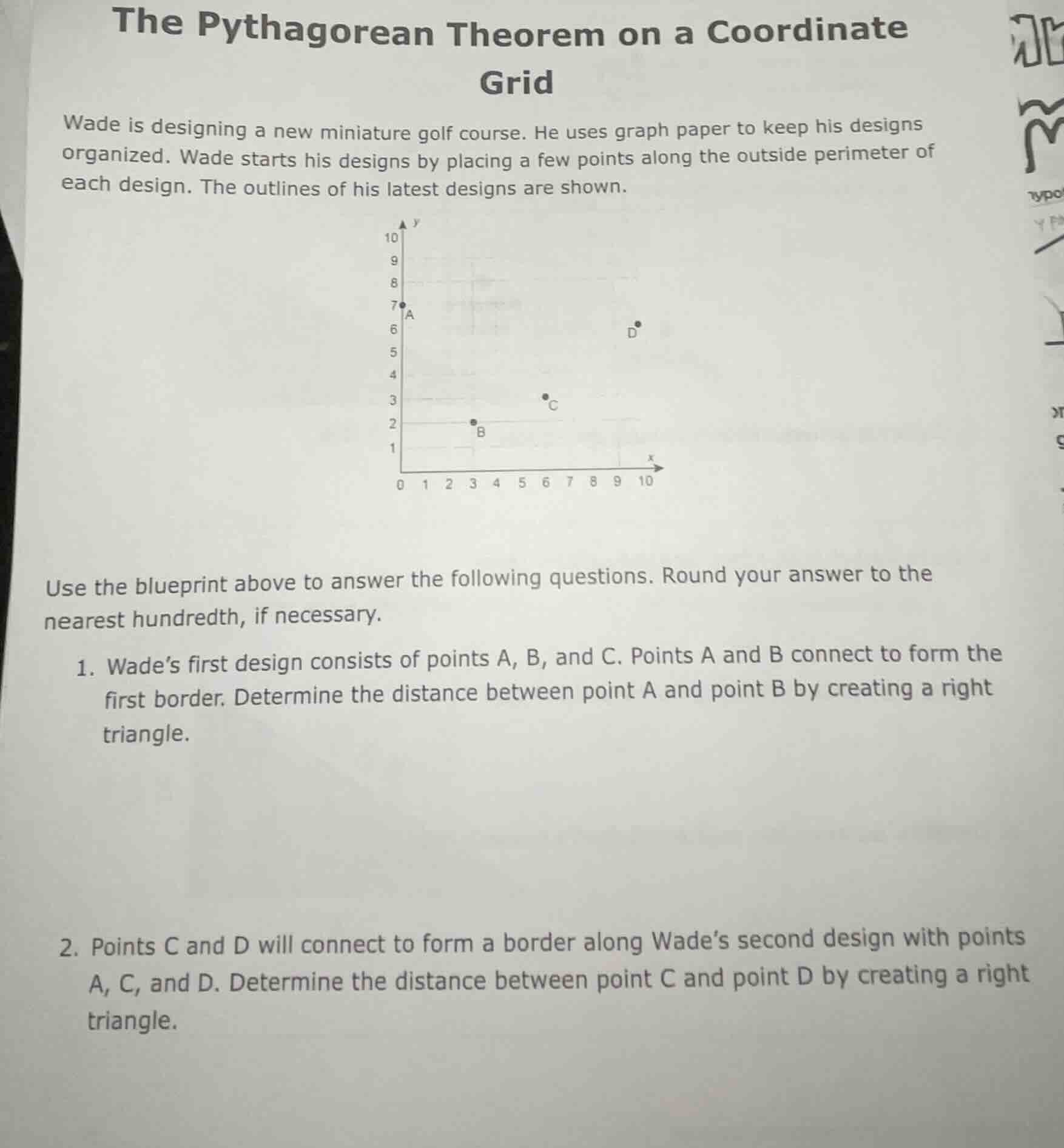
wade is designing a new miniature golf course. he uses graph paper to keep his designs organized. wade starts his designs by placing a few points along the outside perimeter of each design. the outlines of his latest designs are shown.
use the blueprint above to answer the following questions. round your answer to the nearest hundredth, if necessary.
- wade’s first design consists of points a, b, and c. points a and b connect to form the first border. determine the distance between point a and point b by creating a right triangle.
- points c and d will connect to form a border along wade’s second design with points a, c, and d. determine the distance between point c and point d by creating a right triangle.
Problem 1: Distance between A and B
Step1: Identify coordinates of A and B
Point A: \((0, 7)\), Point B: \((3, 2)\)
To form a right triangle, the horizontal distance (run) is \(|3 - 0| = 3\), vertical distance (rise) is \(|2 - 7| = 5\)
Step2: Apply Pythagorean theorem
Distance \(d = \sqrt{(3)^2 + (5)^2} = \sqrt{9 + 25} = \sqrt{34} \approx 5.83\)
Step1: Identify coordinates of C and D
Point C: \((6, 3)\), Point D: \((9, 6)\)
Horizontal distance: \(|9 - 6| = 3\), vertical distance: \(|6 - 3| = 3\)
Step2: Apply Pythagorean theorem
Distance \(d = \sqrt{(3)^2 + (3)^2} = \sqrt{9 + 9} = \sqrt{18} \approx 4.24\)

Snap & solve any problem in the app
Get step-by-step solutions on Sovi AI
Photo-based solutions with guided steps
Explore more problems and detailed explanations
\(\approx 5.83\)