QUESTION IMAGE
Question
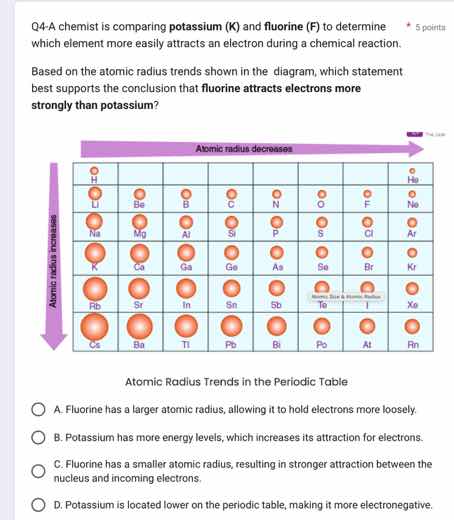
q-4 a chemist is comparing potassium (k) and fluorine (f) to determine which element more easily attracts an electron during a chemical reaction. based on the atomic radius trends shown in the diagram, which statement best supports the conclusion that fluorine attracts electrons more strongly than potassium? atomic radius trends in the periodic table a. fluorine has a larger atomic radius, allowing it to hold electrons more loosely. b. potassium has more energy levels, which increases its attraction for electrons. c. fluorine has a smaller atomic radius, resulting in stronger attraction between the nucleus and incoming electrons. d. potassium is located lower on the periodic table, making it more electronegative.
To solve this, we analyze each option:
- Option A: A larger atomic radius would mean weaker electron attraction, so this is incorrect.
- Option B: More energy levels (as in potassium, being lower in the group) increase distance from nucleus, reducing electron attraction, so this is wrong.
- Option C: Fluorine is smaller (right in period, up in group), so nucleus is closer to outer electrons, increasing attraction. This matches the concept of electronegativity (attraction for electrons).
- Option D: Lower on the table (like potassium) means larger radius, less electronegative, so this is incorrect.

Snap & solve any problem in the app
Get step-by-step solutions on Sovi AI
Photo-based solutions with guided steps
Explore more problems and detailed explanations
C. Fluorine has a smaller atomic radius, resulting in stronger attraction between the nucleus and incoming electrons.