QUESTION IMAGE
Question
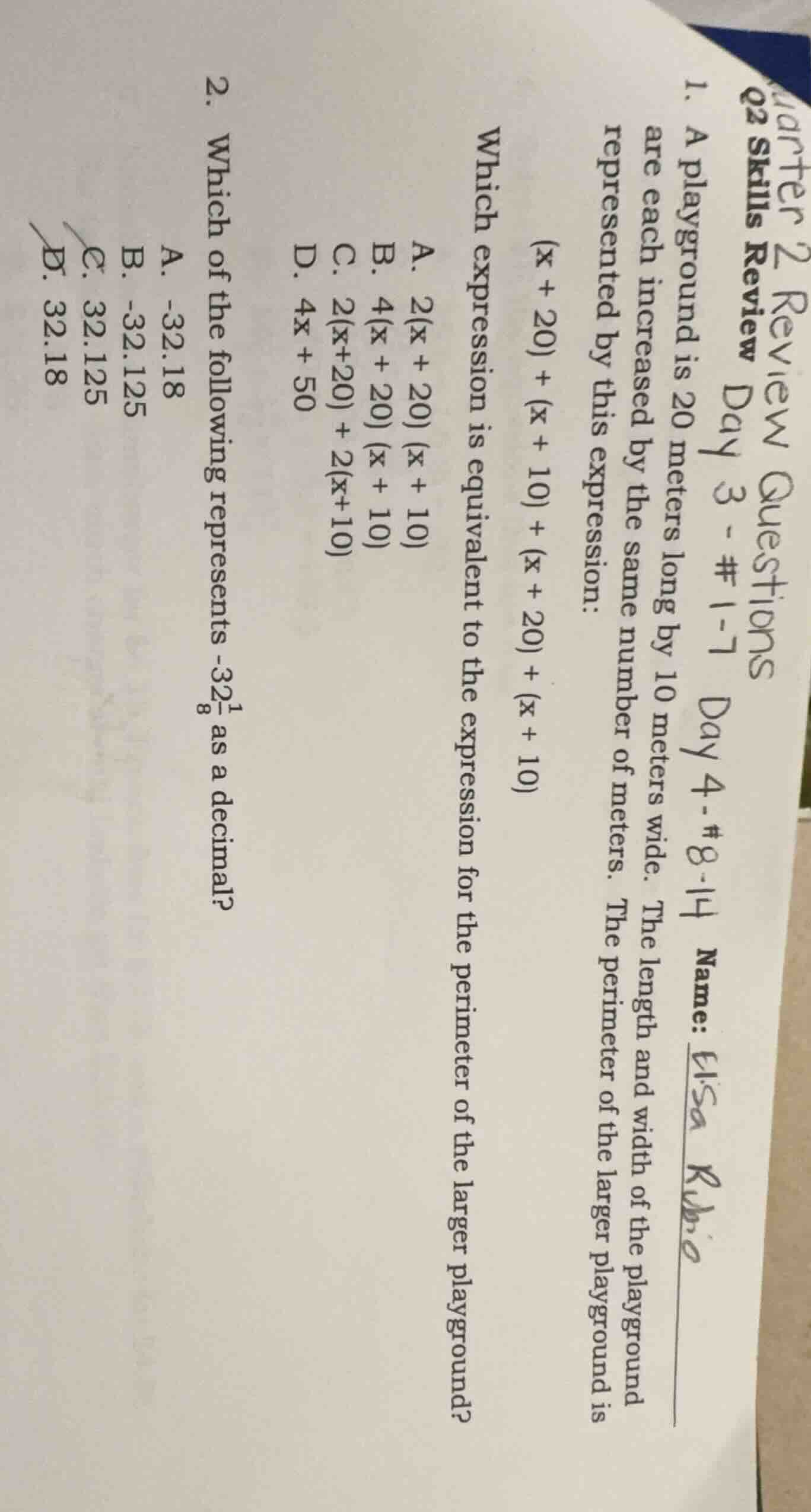
q2 skills review day 3 - #1-7 day 4 - #8-14 name: elisa ribao 1. a playground is 20 meters long by 10 meters wide. the length and width of the playground are each increased by the same number of meters. the perimeter of the larger playground is represented by this expression: (x + 20) + (x + 10) + (x + 20) + (x + 10) which expression is equivalent to the expression for the perimeter of the larger playground? a. 2(x + 20) (x + 10) b. 4(x + 20) (x + 10) c. 2(x+20) + 2(x+10) d. 4x + 50 2. which of the following represents -32\frac{1}{8} as a decimal? a. -32.18 b. -32.125 c. 32.125 d. 32.18
Problem 1:
Step1: Recall perimeter formula
The perimeter \( P \) of a rectangle is \( P = 2\times(\text{length} + \text{width}) \). The original length is \( x + 20 \) and width is \( x + 10 \), but after increasing, the new length and width are still \( x + 20 \) and \( x + 10 \) (wait, no, the problem says "a playground is 20 meters long by 10 meters wide. The length and width of the playground are each increased by the same number of meters, represented by \( x \)". So new length is \( 20 + x \), new width is \( 10 + x \). The perimeter formula is \( P = 2\times(\text{length} + \text{width}) \), so substitute length \( = x + 20 \), width \( = x + 10 \) into the formula: \( P = 2\times((x + 20)+(x + 10)) \). Simplify the expression inside the parentheses: \( (x + 20)+(x + 10)=2x + 30 \), then multiply by 2: \( 2\times(2x + 30)=4x + 60 \)? Wait, no, wait the original expression given is \( (x + 20)+(x + 10)+(x + 20)+(x + 10) \), which is the sum of all four sides (length + width + length + width). Let's simplify that: combine like terms. \( x + 20 + x + 10 + x + 20 + x + 10 = (x + x + x + x)+(20 + 10 + 20 + 10)=4x + 60 \). Now let's check the options:
Option A: \( 2(x + 20)(x + 10) \) – this is the area formula (length × width) multiplied by 2, not perimeter. So A is wrong.
Option B: \( 4(x + 20)(x + 10) \) – this is 4 times the area, not perimeter. Wrong.
Option C: \( 2(x + 20)+2(x + 10) \) – this is \( 2x + 40 + 2x + 20 = 4x + 60 \), which matches the simplified original expression. Let's check:
Original expression: \( (x + 20)+(x + 10)+(x + 20)+(x + 10) = (x + 20)+(x + 20)+(x + 10)+(x + 10)=2(x + 20)+2(x + 10) \). Yes, that's correct.
Option D: \( 4x + 50 \) – \( 4x + 60
eq 4x + 50 \), so D is wrong. So the correct option is C.
Step2: Verify each option
- Option A: \( 2(x + 20)(x + 10) \) is area-related, not perimeter. Eliminate.
- Option B: \( 4(x + 20)(x + 10) \) is not perimeter. Eliminate.
- Option C: \( 2(x + 20)+2(x + 10) = 2x + 40 + 2x + 20 = 4x + 60 \), which matches the simplified original expression \( 4x + 60 \). Correct.
- Option D: \( 4x + 50 \) does not match \( 4x + 60 \). Eliminate.
Step1: Understand the expression
The expression is \( -32\frac{1}{8} \) (wait, the original says \( -32\frac{1}{8} \)? Wait the problem says "Which of the following represents \( -32\frac{1}{8} \) as a decimal?". Let's convert the fraction \( \frac{1}{8} \) to decimal. \( \frac{1}{8}=0.125 \), so \( -32\frac{1}{8} = - (32 + \frac{1}{8}) = -32 - 0.125 = -32.125 \)? Wait no, wait the options: A. -32.18, B. -32.125, C. 32.125, D. 32.18. Wait, \( \frac{1}{8}=0.125 \), so \( 32\frac{1}{8}=32.125 \), but with a negative sign? Wait the problem says \( -32\frac{1}{8} \)? Wait the original problem: "Which of the following represents \( -32\frac{1}{8} \) as a decimal?". So \( \frac{1}{8}=0.125 \), so \( -32\frac{1}{8} = -32 - 0.125 = -32.125 \), which is option B. Wait, but let's check: \( \frac{1}{8}=0.125 \), so \( 32\frac{1}{8}=32 + 0.125 = 32.125 \), so with a negative sign, it's \( -32.125 \), which is option B.
Step2: Convert the fraction to decimal
\( \frac{1}{8} = 1\div8 = 0.125 \). So \( -32\frac{1}{8} = - (32 + 0.125) = -32.125 \).

Snap & solve any problem in the app
Get step-by-step solutions on Sovi AI
Photo-based solutions with guided steps
Explore more problems and detailed explanations
C. \( 2(x + 20)+2(x + 10) \)