QUESTION IMAGE
Question
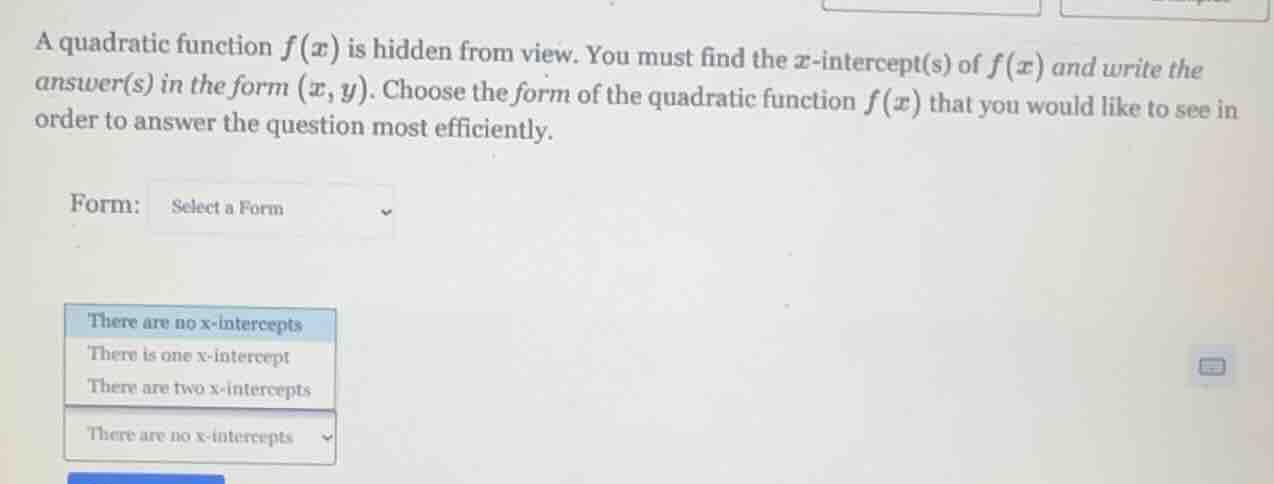
a quadratic function $f(x)$ is hidden from view. you must find the $x$-intercept(s) of $f(x)$ and write the answer(s) in the form $(x, y)$. choose the form of the quadratic function $f(x)$ that you would like to see in order to answer the question most efficiently.
form: select a form
there are no x-intercepts
there is one x-intercept
there are two x-intercepts
there are no x-intercepts
To find the \( x \)-intercepts of a quadratic function \( f(x) \), the most efficient form of the quadratic function to use is the factored form (also known as the intercept form), which is \( f(x) = a(x - r_1)(x - r_2) \), where \( r_1 \) and \( r_2 \) are the roots ( \( x \)-intercepts) of the quadratic function. Here's why:
Step 1: Understand the purpose of different quadratic forms
- Standard form: \( f(x) = ax^2 + bx + c \). This form is useful for finding the vertex (using \( x = -\frac{b}{2a} \)) or for applying the quadratic formula, but it's not the most direct way to find \( x \)-intercepts.
- Vertex form: \( f(x) = a(x - h)^2 + k \). This form is useful for identifying the vertex \((h, k)\) and the direction the parabola opens, but it doesn't directly show the \( x \)-intercepts.
- Factored form: \( f(x) = a(x - r_1)(x - r_2) \). In this form, the \( x \)-intercepts are immediately visible as \( (r_1, 0) \) and \( (r_2, 0) \) (or a single \( x \)-intercept if \( r_1 = r_2 \), indicating a repeated root). If the quadratic has no real \( x \)-intercepts, the factored form will not have real roots (it will involve complex numbers), but for the purpose of identifying real \( x \)-intercepts, the factored form is the most straightforward.
Step 2: Select the appropriate form
Given that we need to find the \( x \)-intercepts, we should select the factored form from the dropdown menu. This form will allow us to directly identify the \( x \)-intercepts (if they exist) by looking at the roots \( r_1 \) and \( r_2 \) in the factored expression.

Snap & solve any problem in the app
Get step-by-step solutions on Sovi AI
Photo-based solutions with guided steps
Explore more problems and detailed explanations
To find the \( x \)-intercepts of the quadratic function \( f(x) \) most efficiently, we should select the factored form (also known as the intercept form) of the quadratic function from the "Form" dropdown menu. This form is \( f(x) = a(x - r_1)(x - r_2) \), where \( r_1 \) and \( r_2 \) are the \( x \)-intercepts (roots) of the quadratic function.