QUESTION IMAGE
Question
quadratic function
$f(x) = ax^2 + bx + c$, where $a \
eq 0$
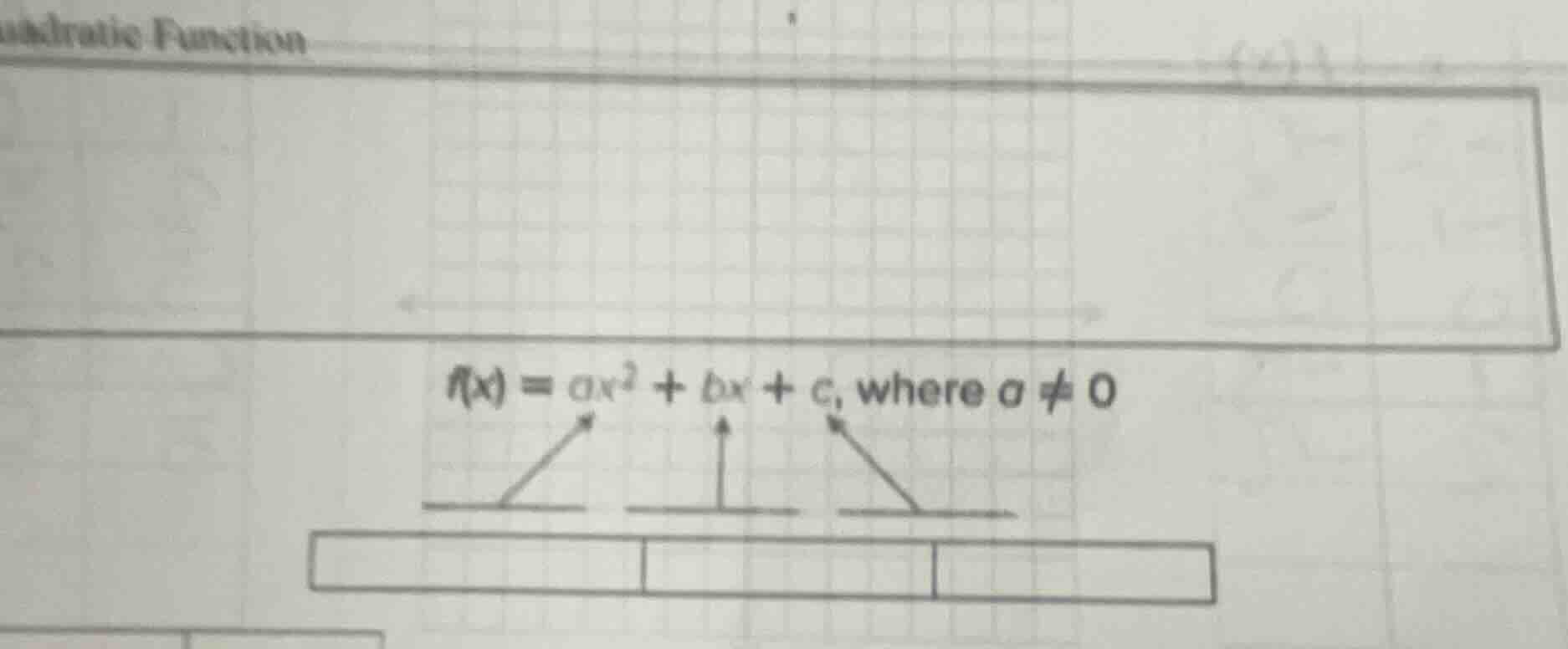
To determine the parts of the quadratic function \( f(x) = ax^2 + bx + c \) (where \( a
eq 0 \)):
Step 1: Identify the coefficient of \( x^2 \)
The term \( ax^2 \) has \( a \) as the coefficient of \( x^2 \). In the standard form of a quadratic function, \( a \) is the leading coefficient (and \( a
eq 0 \) to ensure it is quadratic).
Step 2: Identify the coefficient of \( x \)
The term \( bx \) has \( b \) as the coefficient of \( x \). This is the linear coefficient.
Step 3: Identify the constant term
The term \( c \) is the constant term (it has no variable attached).
If the question is to label the blanks (from left to right under the formula):
- First blank (under \( ax^2 \)): \( \boldsymbol{a} \) (leading coefficient, coefficient of \( x^2 \))
- Second blank (under \( bx \)): \( \boldsymbol{b} \) (coefficient of \( x \))
- Third blank (under \( c \)): \( \boldsymbol{c} \) (constant term)
For example, if the blanks are to be filled with the names/roles:
- First: "Leading coefficient (coefficient of \( x^2 \))"
- Second: "Coefficient of \( x \) (linear term coefficient)"
- Third: "Constant term"
If you need to confirm the parts of the quadratic function, the three components are:
- \( a \): Coefficient of \( x^2 \) (leading coefficient, \( a
eq 0 \))
- \( b \): Coefficient of \( x \) (linear coefficient)
- \( c \): Constant term
Final Answer (if filling the blanks with \( a \), \( b \), \( c \) in order):
From left to right: \( \boldsymbol{a} \), \( \boldsymbol{b} \), \( \boldsymbol{c} \)

Snap & solve any problem in the app
Get step-by-step solutions on Sovi AI
Photo-based solutions with guided steps
Explore more problems and detailed explanations
To determine the parts of the quadratic function \( f(x) = ax^2 + bx + c \) (where \( a
eq 0 \)):
Step 1: Identify the coefficient of \( x^2 \)
The term \( ax^2 \) has \( a \) as the coefficient of \( x^2 \). In the standard form of a quadratic function, \( a \) is the leading coefficient (and \( a
eq 0 \) to ensure it is quadratic).
Step 2: Identify the coefficient of \( x \)
The term \( bx \) has \( b \) as the coefficient of \( x \). This is the linear coefficient.
Step 3: Identify the constant term
The term \( c \) is the constant term (it has no variable attached).
If the question is to label the blanks (from left to right under the formula):
- First blank (under \( ax^2 \)): \( \boldsymbol{a} \) (leading coefficient, coefficient of \( x^2 \))
- Second blank (under \( bx \)): \( \boldsymbol{b} \) (coefficient of \( x \))
- Third blank (under \( c \)): \( \boldsymbol{c} \) (constant term)
For example, if the blanks are to be filled with the names/roles:
- First: "Leading coefficient (coefficient of \( x^2 \))"
- Second: "Coefficient of \( x \) (linear term coefficient)"
- Third: "Constant term"
If you need to confirm the parts of the quadratic function, the three components are:
- \( a \): Coefficient of \( x^2 \) (leading coefficient, \( a
eq 0 \))
- \( b \): Coefficient of \( x \) (linear coefficient)
- \( c \): Constant term
Final Answer (if filling the blanks with \( a \), \( b \), \( c \) in order):
From left to right: \( \boldsymbol{a} \), \( \boldsymbol{b} \), \( \boldsymbol{c} \)