QUESTION IMAGE
Question
quadratic functions and equations
rewriting a quadratic function to find its vertex and sketch its...
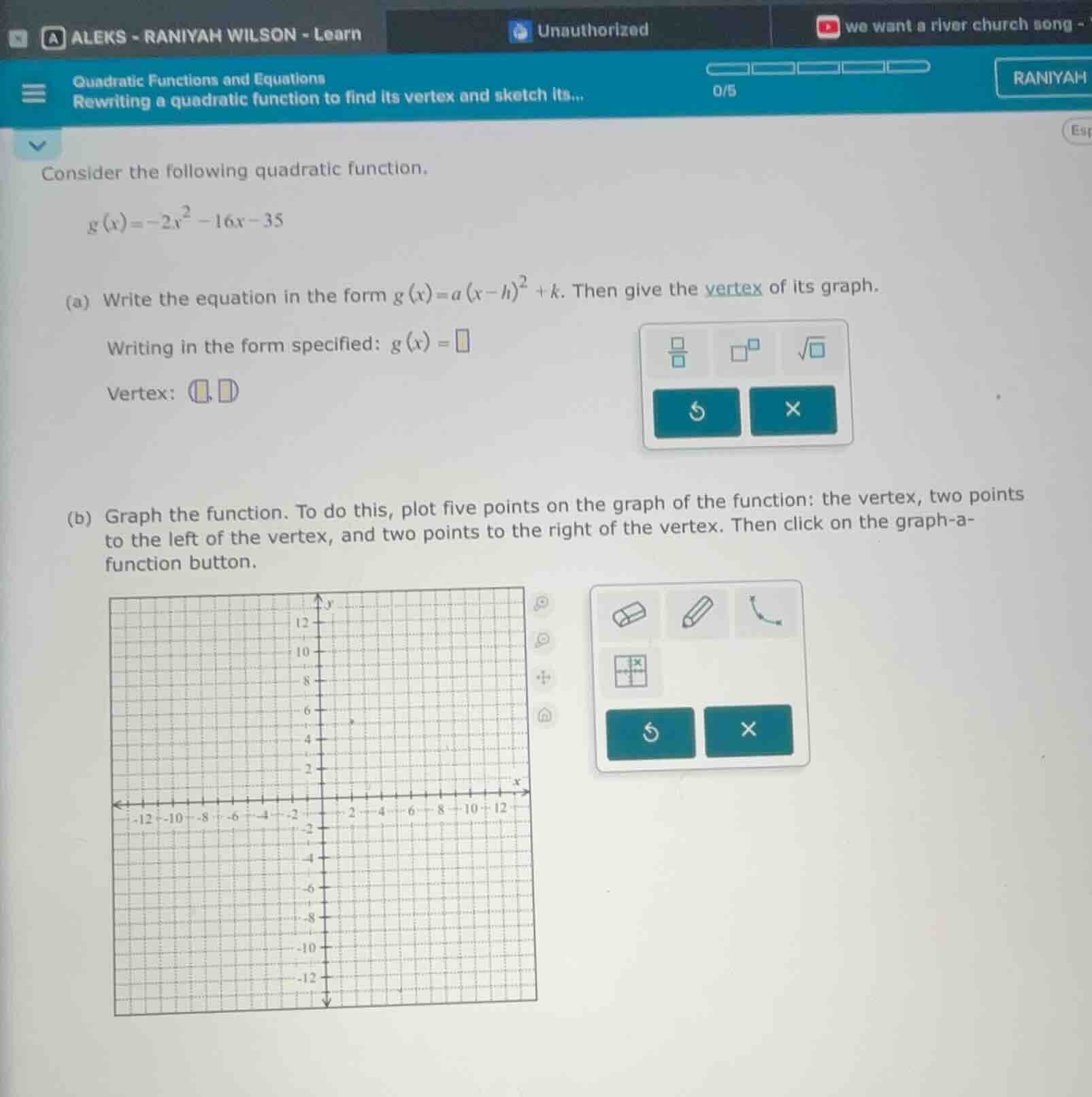
consider the following quadratic function.
\\( g(x) = -2x^2 - 16x - 35 \\)
(a) write the equation in the form \\( g(x) = a(x - h)^2 + k \\). then give the vertex of its graph.
writing in the form specified: \\( g(x) = \\)
vertex: \\( (\quad, \quad) \\)
(b) graph the function. to do this, plot five points on the graph of the function: the vertex, two points to the left of the vertex, and two points to the right of the vertex. then click on the graph - a - function button.
Part (a)
Step 1: Factor out the coefficient of \(x^2\) from the first two terms.
Given \(g(x) = -2x^2 - 16x - 35\), factor out \(-2\) from the first two terms:
\(g(x) = -2(x^2 + 8x) - 35\)
Step 2: Complete the square inside the parentheses.
To complete the square for \(x^2 + 8x\), take half of \(8\) (which is \(4\)), square it (\(4^2 = 16\)), and add/subtract it inside the parentheses. But since there's a factor of \(-2\) outside, we add \(16\) inside and compensate by subtracting \(-2 \times 16\) (because adding \(16\) inside the parentheses is like adding \(-2 \times 16\) to the entire expression).
So:
\(g(x) = -2(x^2 + 8x + 16 - 16) - 35\)
\(g(x) = -2((x + 4)^2 - 16) - 35\)
Step 3: Distribute and simplify.
Distribute the \(-2\):
\(g(x) = -2(x + 4)^2 + 32 - 35\)
Simplify \(32 - 35\):
\(g(x) = -2(x + 4)^2 - 3\)
The vertex form of a quadratic is \(g(x) = a(x - h)^2 + k\), where the vertex is \((h, k)\). Here, \(h = -4\) (since \(x - h = x + 4\) implies \(h = -4\)) and \(k = -3\).

Snap & solve any problem in the app
Get step-by-step solutions on Sovi AI
Photo-based solutions with guided steps
Explore more problems and detailed explanations
(Part a):
Writing in the form specified: \(g(x) = \boldsymbol{-2(x + 4)^2 - 3}\)
Vertex: \(\boldsymbol{(-4, -3)}\)
Part (b)
To graph the function, we use the vertex \((-4, -3)\) and find two points to the left and two to the right of \(x = -4\):
- Left of the vertex (choose \(x = -5\) and \(x = -6\)):
For \(x = -5\):
\(g(-5) = -2(-5 + 4)^2 - 3 = -2(-1)^2 - 3 = -2 - 3 = -5\) → Point: \((-5, -5)\)
For \(x = -6\):
\(g(-6) = -2(-6 + 4)^2 - 3 = -2(-2)^2 - 3 = -8 - 3 = -11\) → Point: \((-6, -11)\)
- Right of the vertex (choose \(x = -3\) and \(x = -2\)):
For \(x = -3\):
\(g(-3) = -2(-3 + 4)^2 - 3 = -2(1)^2 - 3 = -2 - 3 = -5\) → Point: \((-3, -5)\)
For \(x = -2\):
\(g(-2) = -2(-2 + 4)^2 - 3 = -2(2)^2 - 3 = -8 - 3 = -11\) → Point: \((-2, -11)\)
Plot the five points: \((-6, -11)\), \((-5, -5)\), \((-4, -3)\), \((-3, -5)\), \((-2, -11)\), then sketch the parabola (opening downward, since \(a = -2 < 0\)).