QUESTION IMAGE
Question
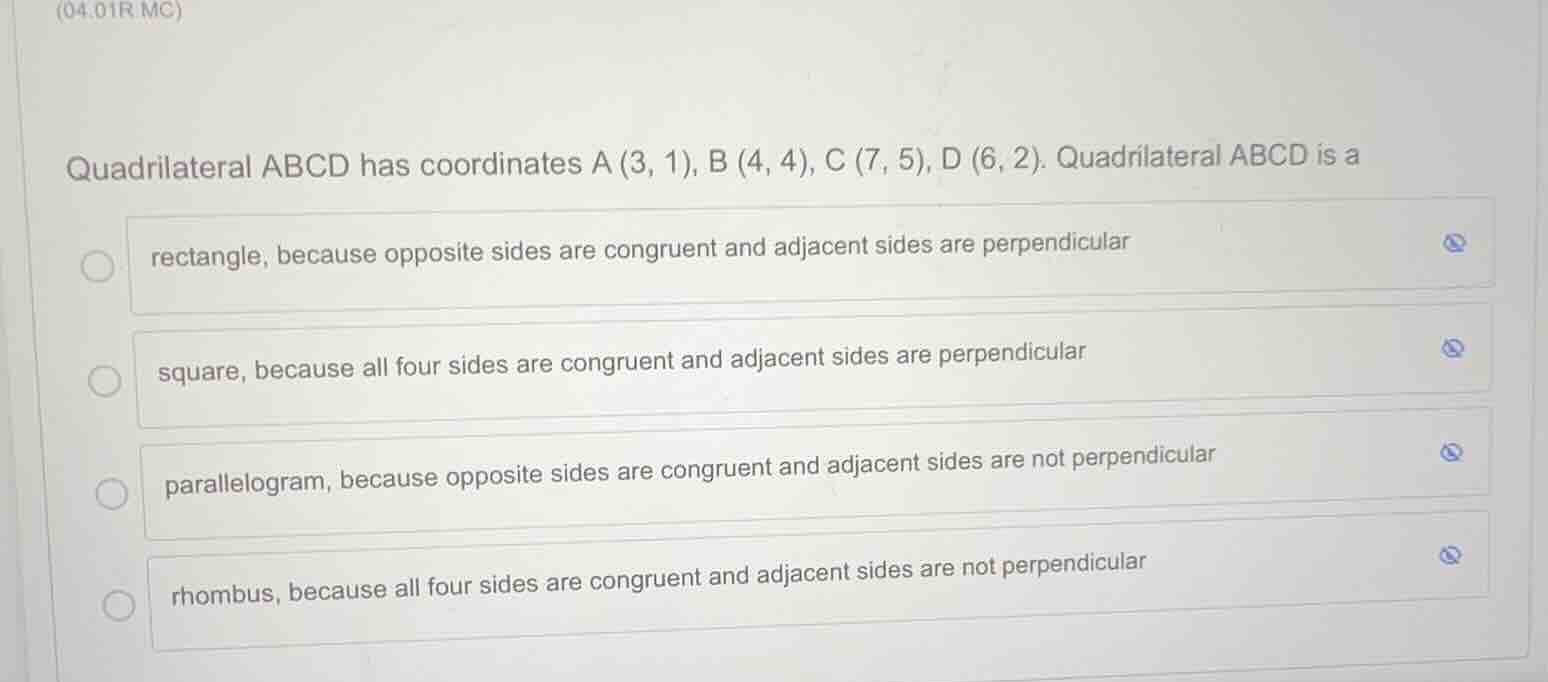
quadrilateral abcd has coordinates a (3, 1), b (4, 4), c (7, 5), d (6, 2). quadrilateral abcd is a
rectangle, because opposite sides are congruent and adjacent sides are perpendicular
square, because all four sides are congruent and adjacent sides are perpendicular
parallelogram, because opposite sides are congruent and adjacent sides are not perpendicular
rhombus, because all four sides are congruent and adjacent sides are not perpendicular
Step1: Calculate side lengths
Use distance formula $d=\sqrt{(x_2-x_1)^2+(y_2-y_1)^2}$:
- $AB=\sqrt{(4-3)^2+(4-1)^2}=\sqrt{1+9}=\sqrt{10}$
- $BC=\sqrt{(7-4)^2+(5-4)^2}=\sqrt{9+1}=\sqrt{10}$
- $CD=\sqrt{(6-7)^2+(2-5)^2}=\sqrt{1+9}=\sqrt{10}$
- $DA=\sqrt{(3-6)^2+(1-2)^2}=\sqrt{9+1}=\sqrt{10}$
Step2: Calculate side slopes
Use slope formula $m=\frac{y_2-y_1}{x_2-x_1}$:
- Slope of $AB$: $m_{AB}=\frac{4-1}{4-3}=3$
- Slope of $BC$: $m_{BC}=\frac{5-4}{7-4}=\frac{1}{3}$
Step3: Check perpendicularity
Perpendicular lines have slopes with product $-1$.
$m_{AB} \times m_{BC}=3 \times \frac{1}{3}=1
eq -1$, so adjacent sides are not perpendicular.

Snap & solve any problem in the app
Get step-by-step solutions on Sovi AI
Photo-based solutions with guided steps
Explore more problems and detailed explanations
D. rhombus, because all four sides are congruent and adjacent sides are not perpendicular