QUESTION IMAGE
Question
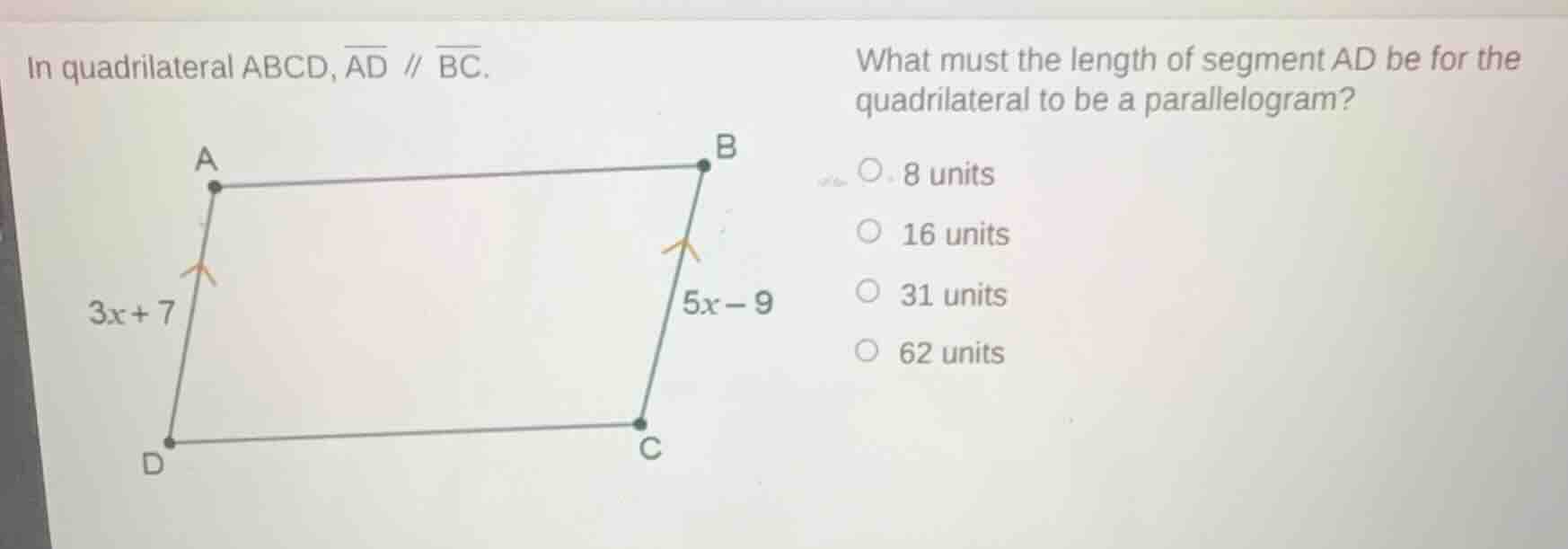
in quadrilateral abcd, \\(overline{ad} \parallel overline{bc}\\). what must the length of segment ad be for the quadrilateral to be a parallelogram? \\(3x + 7\\) \\(5x - 9\\) \\(\circ\\) 8 units \\(\circ\\) 16 units \\(\circ\\) 31 units \\(\circ\\) 62 units
Step1: Recall parallelogram property
In a parallelogram, if one pair of sides is parallel, the other pair of sides (the non - parallel sides) must be equal in length. Since \(\overline{AD}\parallel\overline{BC}\), for \(ABCD\) to be a parallelogram, \(AD = BC\). So we set the expressions for \(AD\) and \(BC\) equal: \(3x + 7=5x - 9\).
Step2: Solve for \(x\)
Subtract \(3x\) from both sides: \(3x+7 - 3x=5x - 9-3x\), which simplifies to \(7 = 2x-9\). Then add 9 to both sides: \(7 + 9=2x-9 + 9\), so \(16 = 2x\). Divide both sides by 2: \(x=\frac{16}{2}=8\).
Step3: Find the length of \(AD\)
Substitute \(x = 8\) into the expression for \(AD\) (which is \(3x + 7\)): \(3\times8+7=24 + 7=31\).

Snap & solve any problem in the app
Get step-by-step solutions on Sovi AI
Photo-based solutions with guided steps
Explore more problems and detailed explanations
31 units