QUESTION IMAGE
Question
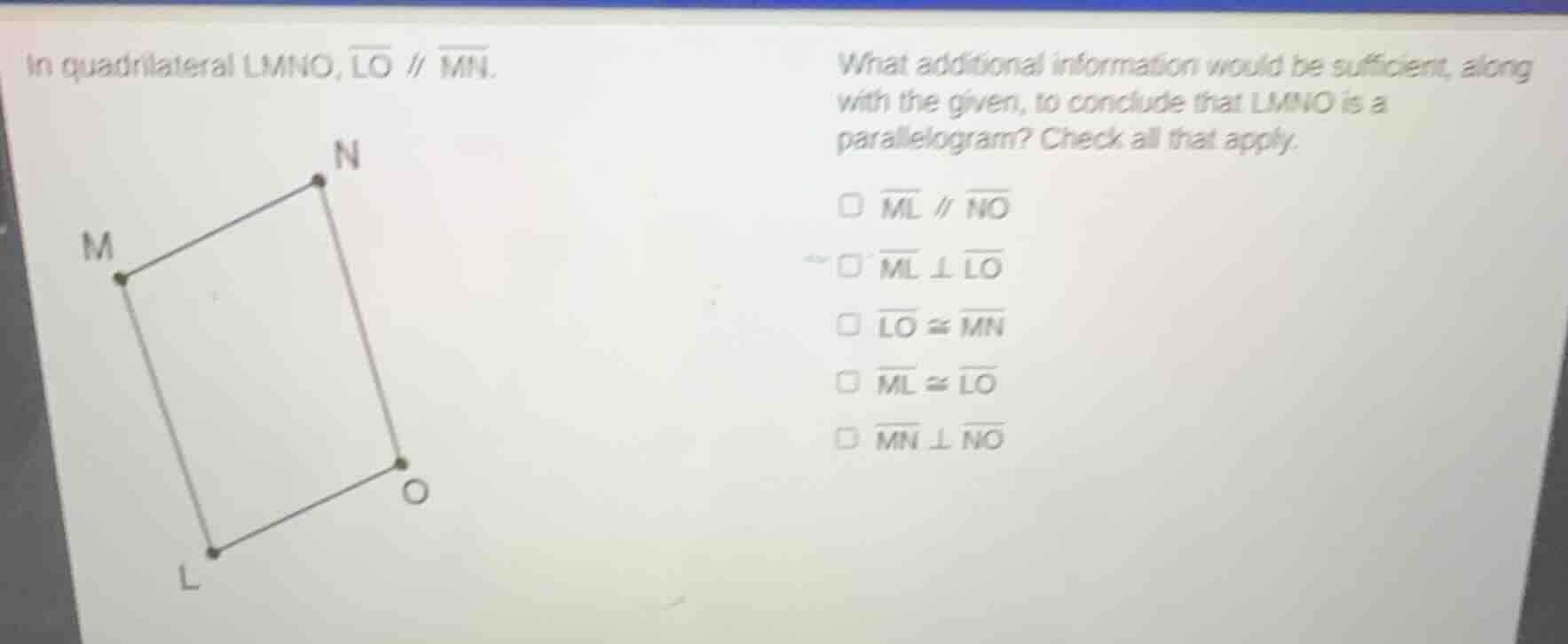
in quadrilateral lmno, \\(\overline{lo} \parallel \overline{mn}\\). what additional information would be sufficient, along with the given, to conclude that lmno is a parallelogram? check all that apply. \\(\square \overline{ml} \parallel \overline{no}\\) \\(\square \overline{ml} \perp \overline{lo}\\) \\(\square \overline{lo} \cong \overline{mn}\\) \\(\square \overline{ml} \cong \overline{lo}\\) \\(\square \overline{mn} \perp \overline{no}\\)
To determine if quadrilateral \( LMNO \) is a parallelogram, we use the properties of parallelograms. A quadrilateral is a parallelogram if:
- Both pairs of opposite sides are parallel (definition of a parallelogram).
- One pair of opposite sides are both parallel and congruent.
Step 1: Analyze \( \overline{ML} \parallel \overline{NO} \)
If \( \overline{LO} \parallel \overline{MN} \) (given) and \( \overline{ML} \parallel \overline{NO} \), then both pairs of opposite sides are parallel. By the definition of a parallelogram, \( LMNO \) would be a parallelogram. So this is sufficient.
Step 2: Analyze \( \overline{ML} \perp \overline{LO} \)
This only tells us that \( \overline{ML} \) and \( \overline{LO} \) are perpendicular. It does not give information about the other sides or their parallelism/congruence. So this is not sufficient.
Step 3: Analyze \( \overline{LO} \cong \overline{MN} \)
We know \( \overline{LO} \parallel \overline{MN} \) (given). If one pair of opposite sides are both parallel and congruent, then the quadrilateral is a parallelogram. So this is sufficient.
Step 4: Analyze \( \overline{ML} \cong \overline{LO} \)
This tells us that \( \overline{ML} \) and \( \overline{LO} \) are congruent, but we don't know if they are parallel or about the other sides. So this is not sufficient.
Step 5: Analyze \( \overline{MN} \perp \overline{NO} \)
This only tells us that \( \overline{MN} \) and \( \overline{NO} \) are perpendicular. It does not give information about the other sides or their parallelism/congruence. So this is not sufficient.

Snap & solve any problem in the app
Get step-by-step solutions on Sovi AI
Photo-based solutions with guided steps
Explore more problems and detailed explanations
- \( \overline{ML} \parallel \overline{NO} \)
- \( \overline{LO} \cong \overline{MN} \)