QUESTION IMAGE
Question
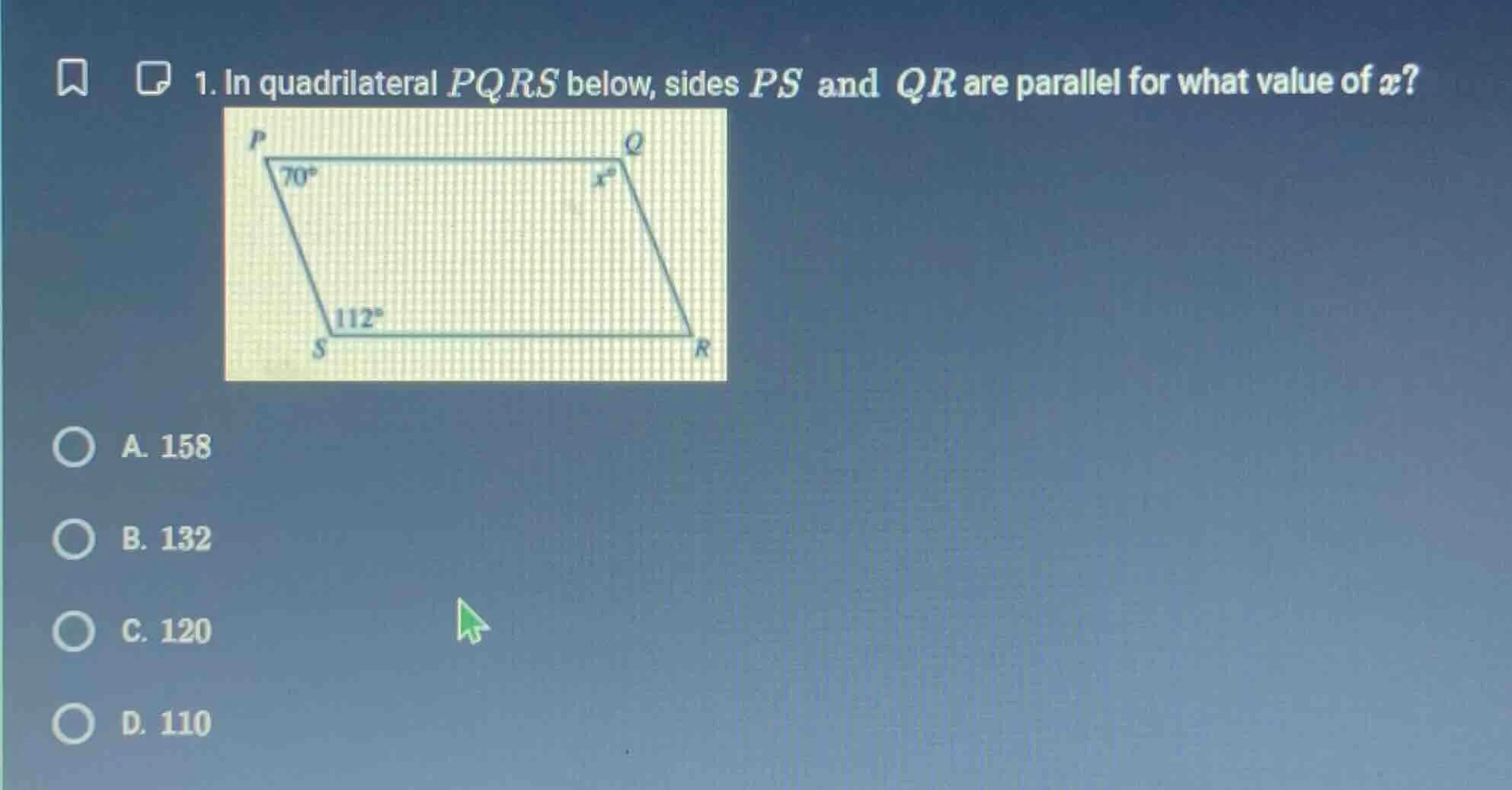
- in quadrilateral pqrs below, sides ps and qr are parallel for what value of x?
image of quadrilateral pqrs with angle at p: 70°, angle at s: 112°, angle at q: x°
a. 158
b. 132
c. 120
d. 110
Step1: Recall quadrilateral angle sum
The sum of interior angles in a quadrilateral is \(360^\circ\). Let the angles at \(P\), \(Q\), \(R\), \(S\) be \(\angle P = 70^\circ\), \(\angle Q = x^\circ\), \(\angle S = 112^\circ\), and we need to find \(\angle R\) or use parallel sides property. Wait, since \(PS \parallel QR\), consecutive interior angles should be supplementary? Wait no, maybe first use quadrilateral angle sum. Wait, maybe I made a mistake. Wait, actually, when \(PS \parallel QR\), then \(\angle P + \angle Q = 180^\circ\)? No, wait, \(PQ\) is a transversal? Wait, no, the sides \(PS\) and \(QR\) are parallel, so the transversal would be \(PQ\) or \(SR\). Wait, let's check the angles. The angle at \(P\) is \(70^\circ\), angle at \(S\) is \(112^\circ\). Let's use the fact that in a quadrilateral, sum of angles is \(360^\circ\). Wait, but if \(PS \parallel QR\), then \(\angle P + \angle Q = 180^\circ\) and \(\angle S + \angle R = 180^\circ\)? Wait, no, maybe I should first calculate the sum. Wait, the sum of interior angles of a quadrilateral is \( (4 - 2) \times 180^\circ = 360^\circ \). So \( \angle P + \angle Q + \angle R + \angle S = 360^\circ \). But if \(PS \parallel QR\), then \(\angle P + \angle Q = 180^\circ\) (consecutive interior angles) and \(\angle S + \angle R = 180^\circ\). Wait, but we know \(\angle P = 70^\circ\), \(\angle S = 112^\circ\). Wait, maybe that's not the case. Wait, let's re - examine. Let's list the angles: \(\angle P = 70^\circ\), \(\angle S = 112^\circ\), \(\angle Q = x\), \(\angle R\) is unknown. But since \(PS \parallel QR\), then \(\angle S + \angle R = 180^\circ\) (consecutive interior angles), so \(\angle R = 180^\circ - 112^\circ = 68^\circ\). Then, using quadrilateral angle sum: \(70 + x + 68 + 112 = 360\). Let's calculate that. \(70+112 = 182\), \(68 + x+182 = 360\), \(x + 250 = 360\), \(x = 360 - 250 = 110\)? Wait, no, that's not matching. Wait, maybe I messed up the transversal. Wait, maybe \(PQ\) is parallel to \(SR\)? No, the problem says \(PS\) and \(QR\) are parallel. So \(PS \parallel QR\), so the sides \(PS\) and \(QR\) are parallel, so the transversal is \(PQ\) (connecting \(P\) to \(Q\)) and \(SR\) (connecting \(S\) to \(R\)). So for transversal \(PQ\), \(\angle P\) and \(\angle Q\) are consecutive interior angles, so they should be supplementary. Wait, \(\angle P = 70^\circ\), so \(\angle Q = 180 - 70 = 110\)? But that's option D. Wait, but let's check with quadrilateral sum. If \(x = 110\), \(\angle R\) would be \(360 - 70 - 110 - 112 = 360 - 292 = 68\). And since \(PS \parallel QR\), \(\angle S + \angle R = 112 + 68 = 180\), which is supplementary, so that works. So the value of \(x\) is \(110\).
Step2: Calculate using quadrilateral angle sum and parallel lines
- Sum of interior angles in a quadrilateral: \( (4 - 2)\times180^\circ=360^\circ \).
- Given \(PS \parallel QR\), so \(\angle P+\angle Q = 180^\circ\) (consecutive interior angles) and \(\angle S+\angle R = 180^\circ\). But we can also use the total sum. Let's use the fact that \(\angle P = 70^\circ\), \(\angle S = 112^\circ\), and we need to find \(x=\angle Q\).
- From quadrilateral angle sum: \(\angle P+\angle Q+\angle R+\angle S = 360^\circ\). But since \(PS \parallel QR\), \(\angle S+\angle R = 180^\circ\) (so \(\angle R = 180 - 112 = 68^\circ\)) and \(\angle P+\angle Q = 180^\circ\) (so \(\angle Q=180 - 70 = 110^\circ\)).

Snap & solve any problem in the app
Get step-by-step solutions on Sovi AI
Photo-based solutions with guided steps
Explore more problems and detailed explanations
D. 110