QUESTION IMAGE
Question
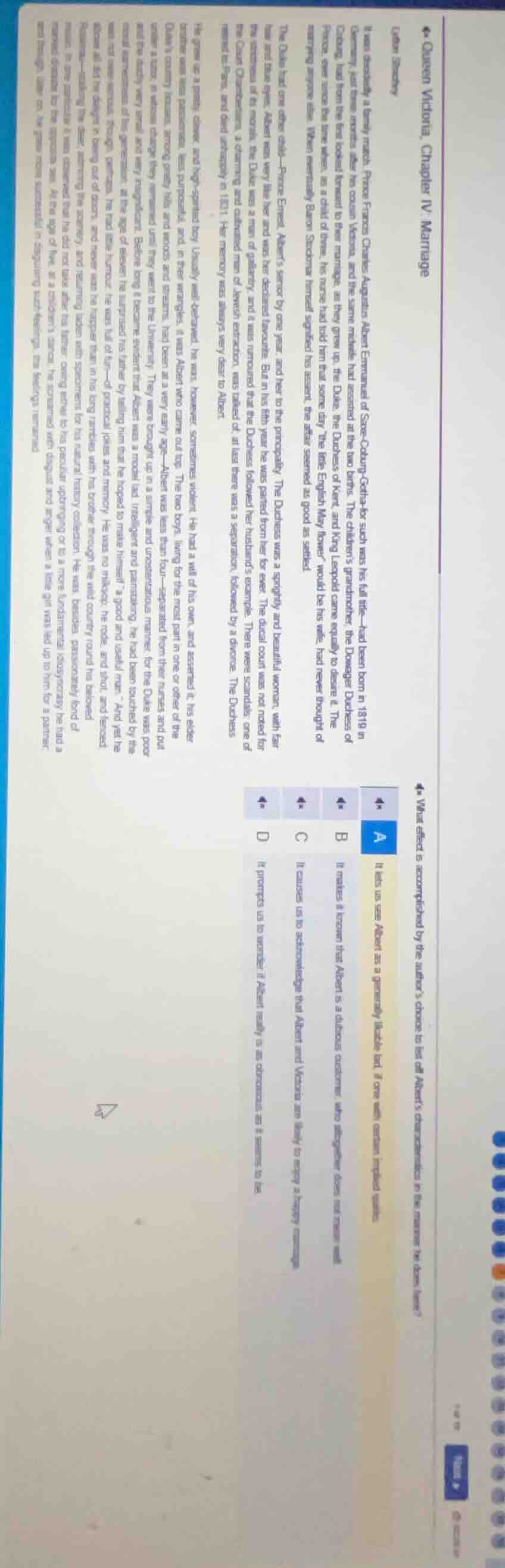
◆ queen victoria, chapter iv: marriage (upper secondary) germany, but these matches after his cousin victoria, and the same genes had descended at the two births. the childrens grandmother, the dowager duchess of coburg, had from the first looked forward to their marriage, as they grew up. charles francis, baron stockmar, himself inspired the ascent the great seemed as good as settled. the duke had one other child—prince ernest. alberts senior by one year, and heir to the principality. the duchess was a sprightly and beautiful woman, with fair hair and fine eyes. albert was very like her and was her declared favourite. but in his fifth year he was parted from her for ever. the ducal court was not noted for its correctness of morals. when the duke and a mistress of his were detected in an interaction, it was rumoured that the duchess followed her husbands example. there were scandals: one of them, in particular, a charming and careless man of fashion, was the subject of at least one separation, followed by a divorce. the duchess retired to paris, and died suddenly in 1831. her memory was always very dear to albert. he grew up a pretty, close, and high-spirited boy. loosely well-behaved, he was, however, sometimes violent. he had a will of his own, and asserted it. his elder brother was boisterous, ill-tempered, and unruly; and it was inevitable, it was albert who came out top. the two boys, living in the small town in one of the poorer german states, were poorly housed and clothed and often hungry. they had been at a very early age—albert was less than four—separated from their nurses, and put under a tutor, whose strong, easy, and woolly system seems, had been designed to make them happy and unconscious of their poverty. but the tutor was a failure. they were brought up in a simple and unpretentious manner, by the dukes own account, in the greatest privacy, at the age of eleven he surprised his father by asking him that he hoped to make himself a good and useful man. and he had been touched by the will and the manners, though, perhaps, he had little humour, he was full of fun—of practical jokes and mimicry. he was no milksop: he rode, and shot, and fenced, showed all the delight of a boy being let out of doors, and none was happier than he in his long rambles with his brother enough, the wild country round in his beloved coburg—he explored the hill, returning the poorer, and more learned, laden with specimens for his natural history collection. he was, besides, passionately fond of music. he was a sensitive, too, as his old nurse had told him, and he was aware of a more fundamental discrepancy he felt a keen though, he from one succeeded a copyhold but belonging to the deepest interests. ◆ what effect is accomplished by the author’s choice to list all albert’s characteristics in the manner he does here? a it lets us see albert as a generally likeable but flawed individual. b it makes it known that albert is a dubious outsider, who altogether does not meet well. c it causes us to acknowledge that albert and victoria are likely to enjoy a happy marriage. d it prompts us to wonder if albert really is as obnoxious as he seems to be.
To solve this, we analyze each option:
- Option A: The author lists Albert's characteristics (honest, studious, etc.) to show his positive traits, making us see him as likable. This aligns with how character portrayal works in literature/history (Social Science - History or Arts - Literature context here, but the effect is about perception of Albert's personality).
- Option B: There's no indication Albert is a dubious outsider; the text shows his positive qualities. Eliminate B.
- Option C: The focus is on Albert's traits, not predicting Victoria and Albert's marriage happiness. Eliminate C.
- Option D: The text doesn't prompt wondering if Albert is abnormal; it presents his normal positive traits. Eliminate D.

Snap & solve any problem in the app
Get step-by-step solutions on Sovi AI
Photo-based solutions with guided steps
Explore more problems and detailed explanations
A. It lets us see Albert as a generally likable but also realistically flawed individual