QUESTION IMAGE
Question
question 1-1
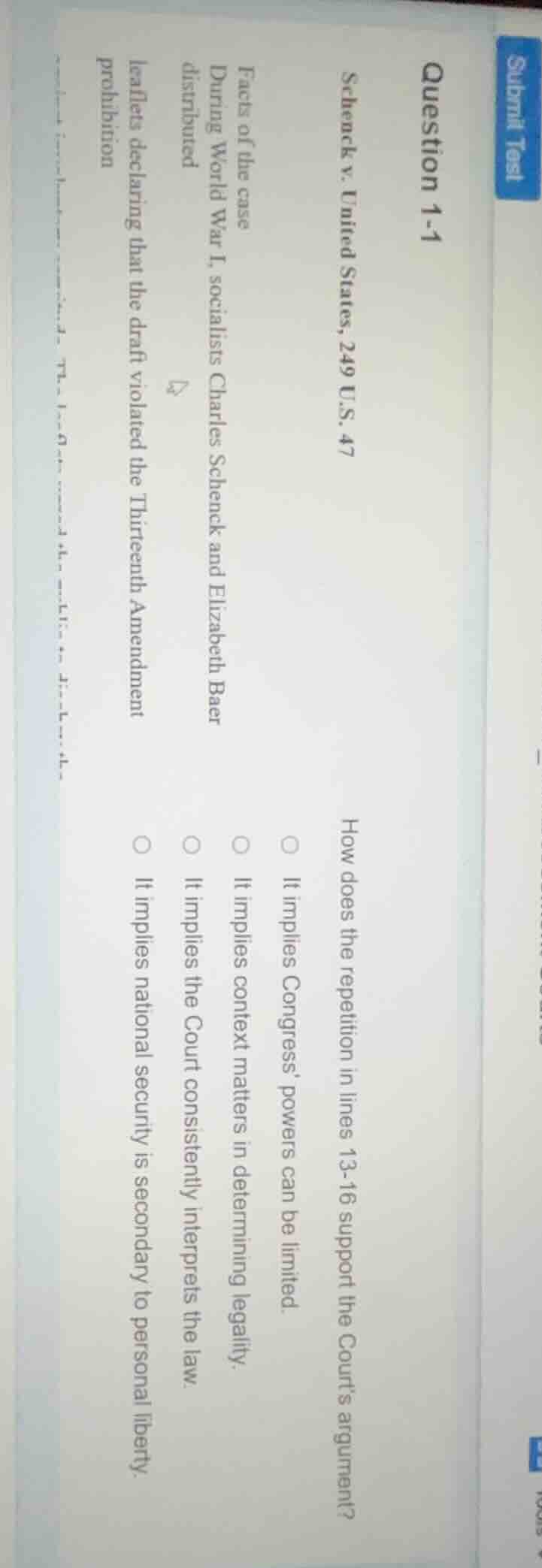
schenck v. united states, 249 u.s. 47
facts of the case
during world war i, socialists charles schenck and elizabeth baer
distributed
leaflets declaring that the draft violated the thirteenth amendment
prohibition
how does the repetition in lines 13-16 support the court’s argument?
○ it implies congress’ powers can be limited.
○ it implies context matters in determining legality.
○ it implies the court consistently interprets the law.
○ it implies national security is secondary to personal liberty.
The Schenck v. United States case established the "clear and present danger" test, holding that free speech can be restricted when it poses a threat during wartime. Repetition in the Court's reasoning would emphasize that the context of wartime (a national crisis) changes how speech and legal rules are evaluated, supporting that context determines if an act (like distributing the leaflets) is illegal. The other options are incorrect: the case upheld Congress's war powers (not limiting them), the Court's ruling was context-specific (not a consistent universal interpretation), and it prioritized national security over unregulated personal liberty here.

Snap & solve any problem in the app
Get step-by-step solutions on Sovi AI
Photo-based solutions with guided steps
Explore more problems and detailed explanations
○ It implies context matters in determining legality.